
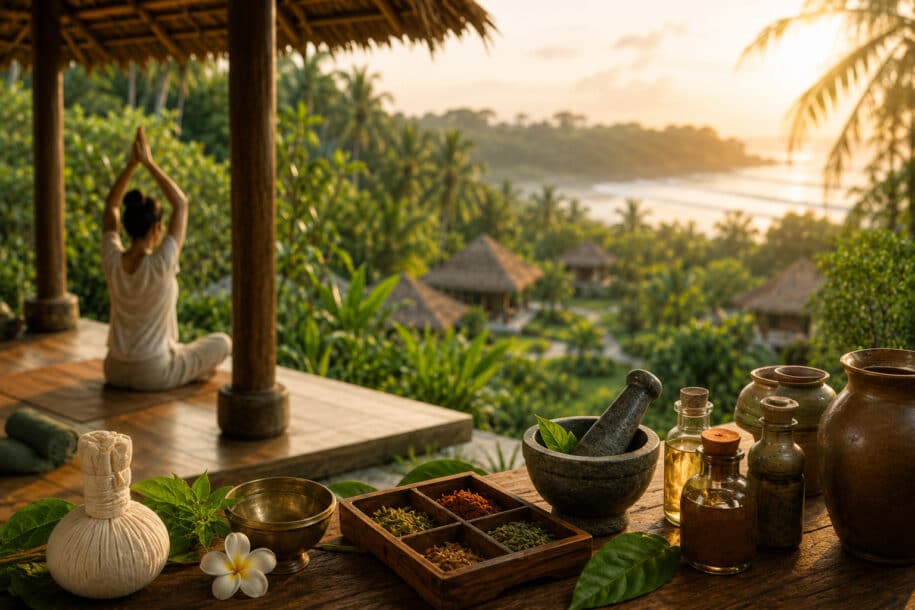
There are places you visit to tick off famous landmarks.
Then there are places you leave feeling genuinely different.
Sri Lanka has belonged to the second category for centuries. Because long before “wellness retreat” became an Instagram caption, the island’s Ayurvedic physicians were already pressing their thumbs into a patient’s wrist, reading a pulse, and prescribing a bitter herbal decoction brewed from plants growing thirty metres away. Personalised herbal therapies and meditation formed part of daily life in many communities, and nature itself was considered an essential part of healing.
Today, the world is finally catching up.
Recent international rankings have named Sri Lanka the world’s top trending wellness destination for 2026, recognising a surge in global interest driven by authentic Ayurveda, yoga, mindful travel, and affordable wellness experiences. For travellers who are done with holidays that leave them more exhausted than when they left, Sri Lanka wellness tourism offers something increasingly rare: the chance to slow down without feeling guilty about it, reconnect with a rhythm that isn’t dictated by notifications, and fly home feeling like you actually rested.
But here’s the question that keeps coming up in travel forums and Reddit threads:
Why Sri Lanka? Bali has its rice terraces. Thailand has its temples. India literally invented Ayurveda. What does this small Indian Ocean island do differently?
The answer goes far beyond luxury spas and scenic beaches.
Why Sri Lanka Wellness Tourism Is Having a Global Moment
Wellness travel has always existed. People have always gone somewhere quiet to feel less terrible. What’s changed is the appetite behind it and the dramatic change in the way people think about it.
Not long ago, a “wellness holiday” meant a weekend at a five-star spa, a hot-stone massage, a cucumber-water photo opportunity, and a return to the same burnout by Monday morning. Nobody blamed you. That was the whole product.
Today’s traveller wants more than that. They want to sleep through the night without melatonin. They want their lower back to stop screaming by Thursday. They want a doctor—actual, qualified, looked-you-in-the-eye doctor—to explain why their digestion has been a mess for two years. They want to leave with a routine they’ll actually keep, not a brochure they’ll toss in a drawer.
That shift has turned Sri Lanka wellness tourism from a niche corner of the travel industry into one of the fastest-growing segments of the country’s visitor economy.
According to recent international reports, Sri Lanka recorded a 100% surge in wellness travel interest, earning recognition as the world’s fastest-growing and top trending wellness destination for 2026. Those headlines may sound impressive—and they are—but the real story is why travellers are paying attention.
While wellness has become a commercial trend across the world, Sri Lanka stands out simply for being authentic.
Rather than being confined to luxury resorts, wellness here is reflected in traditional healing systems, seasonal cuisine, meditation practices, village life, biodiversity, and a slower pace that naturally encourages you to disconnect from daily pressures.
Sri Lanka is different because wellness here is lived around you, and not merely performed for you. The grandmother in the village next door is still grinding turmeric and neem into a paste for her grandson’s eczema. The Ayurvedic hospital in Colombo has been running since the 1920s. The herbal garden behind your retreat might seem like an interior design, but that’s where tonight’s medicine comes from. The rice-and-curry lunch on your plate was designed around your Dosha, and definitely not around what photographs well.
The destination itself becomes part of the therapy. And you can’t fake that.
A Wellness Destination Shaped by Thousands of Years of Healing
It’s easy to assume that Sri Lanka’s wellness appeal is a recent tourism success story.
The island’s Ayurvedic legacy stretches back more than 2,000 years. Certain passages in the Hindu epic Ramayana reference Sri Lankan herbal knowledge. Ancient Sinhalese kings maintained royal physicians. Monasteries doubled as healing centres. The Sinhala Vaidya tradition—Sri Lanka’s indigenous branch of Ayurveda—developed its own pharmacopoeia using plants found nowhere else on the island, and that tradition never fully disappeared. It just kept going, quietly, while the rest of the world discovered “mindfulness apps.”
That continuity matters. It means when you sit across from an Ayurvedic doctor in Kandy or Galle, you’re getting the real thing, passed down through teacher-student lineages that predate most European hospitals.
If you intend to get the complete experience, note that authentic Ayurvedic programmes usually begin with a conversation.
The doctor asks about your sleep, your digestion, whether you tend to run hot or cold, what you ate last week, what you’re worried about next month, and how your stress shows up—as tight jaw, shallow breathing, or 2 a.m. scrolling. They check your pulse. They look at your tongue. They ask questions that feel oddly personal for a medical consultation, because in Ayurveda, your lifestyle is your medical history. Only after that does a treatment plan take shape. It’s personalised in every way.
This doctor-led Ayurveda of Sri Lanka wellness tourism, where a registered Ayurvedic physician designs and supervises your entire programme, has become one of the defining features that separates the island from spa-heavy competitors. Travellers who’ve done the “pick-three-treatments-from-a-menu” thing elsewhere often describe their first Sri Lankan Ayurvedic consultation as a small revelation. “Someone actually asked me what was wrong before touching me.”
Of course, wellness here extends well beyond Ayurveda. You’ll find yoga retreats perched above the Indian Ocean where the only soundtrack is the surf, meditation programmes tucked into misty forest clearings in the hill country, and herbal steam treatments in century-old village centres. Cuisine built around seasonal, locally grown ingredients that happen to be anti-inflammatory, gut-friendly, and delicious. And—underrated as it sounds—simple, uninterrupted silence. The kind you can’t get at home because your phone keeps buzzing.
Sometimes wellness begins with a treatment. Sometimes it begins with sitting very still and hearing your own breathing for the first time in months.
What Illnesses and Conditions Does Ayurveda Treat in Sri Lanka?
This is the question people are usually too polite to ask out loud, so let’s just put it on the table: what can Ayurveda in Sri Lanka actually treat?
The honest answer is: a wider range than most travellers expect, but with important caveats.
Sri Lanka’s Ayurvedic system—regulated by the Department of Ayurveda under the Ministry of Health—recognises Ayurveda as a legitimate medical discipline, not a spa service. Registered Ayurvedic hospitals and clinics across the island treat patients daily for conditions that include:
- Chronic stress, anxiety, and mild-to-moderate depression: This is probably the single most common reason international visitors seek out Panchakarma Sri Lanka programmes. The combination of Shirodhara (warm oil poured over the forehead), Abhyanga massage, regulated sleep, and a digital-detox environment genuinely recalibrates the nervous system. Not magically. Gradually, but measurably.
- Skin diseases: Psoriasis, eczema, chronic acne, urticaria, and fungal infections respond well to Ayurvedic protocols that combine internal herbal medicines (often neem, turmeric, and manjistha-based formulations) with external treatments like medicated oil applications and herbal steam. Sri Lankan practitioners have a particularly long history with skin conditions because the tropical climate makes them prevalent.
- Arthritis and joint disorders: Rheumatoid arthritis, osteoarthritis, gout, and general joint inflammation are treated through a mix of internal medicines, Kati Basti (warm oil pooled over the lower back or affected joint), and Pizhichil (a full-body warm oil bath). Many patients report reduced stiffness and improved mobility within a 14-to-21-day programme.
- Digestive and metabolic disorders: IBS, chronic acidity, sluggish digestion, and even early-stage Type 2 diabetes management fall within Ayurvedic practice. The approach here is heavily diet-driven—your food literally becomes part of the prescription.
- Respiratory issues: Asthma, chronic sinusitis, and allergic rhinitis are addressed through Nasya (nasal herbal oil therapy), steam inhalation with specific herbs, and internal tonics.
- Neurological and musculoskeletal conditions: Migraines, sciatica, facial palsy, and post-stroke rehabilitation are handled at specialised Ayurvedic hospitals, often in conjunction with physiotherapy.
- Women’s health: Menstrual irregularities, PCOS-related symptoms, menopausal discomfort, and postpartum recovery.
- Cancer—supportive care, not a cure. This one needs to be said clearly. Ayurveda in Sri Lanka is not marketed or practised as a cancer cure. What certain specialised centres do offer is supportive and palliative Ayurvedic care alongside conventional oncology: managing chemotherapy side-effects like nausea, fatigue, and appetite loss; reducing inflammation; improving sleep and quality of life; and providing psychological comfort through a structured, compassionate routine. Reputable practitioners will always insist you continue your oncologist’s treatment. Anyone who tells you otherwise is not a doctor. Walk away.
The critical point: Ayurveda works best here as a complementary and preventive system, not as a replacement for emergency or acute medical care. Sri Lanka’s Ayurvedic hospitals coordinate with allopathic facilities when needed. The strength of the tradition lies in chronic conditions, lifestyle diseases, stress-related disorders, and long-term balance—not in replacing a surgeon or an oncologist.
If you’re travelling specifically to address a medical condition, choose a centre with registered Ayurvedic physicians (look for credentials from the Institute of Indigenous Medicine or the Department of Ayurveda) and be upfront about any medications you’re currently taking.
Acupuncture, Reflexology, and Other Natural Healing Methods
Ayurveda dominates the conversation, but it’s not the only traditional healing thread on the island.
Acupuncture has a small but established presence in Sri Lanka, practised mainly in Colombo, Kandy, and a handful of wellness centres along the south coast. It follows Traditional Chinese Medicine principles—thin needles inserted at specific meridian points to relieve pain, reduce inflammation, and address issues like chronic headaches, insomnia, and musculoskeletal tension. It’s less common than Ayurveda, so if it’s a priority, confirm availability before booking. Some larger wellness resorts (Santani in Kandy, for instance) integrate acupuncture into their holistic menus alongside Ayurvedic and Western therapies.
Beyond that, you’ll encounter reflexology (pressure-point foot and hand therapy), Siddha medicine (a South Indian healing tradition with some overlap with Ayurveda, practised mainly in the north and east), naturopathy, and herbal steam therapy in village-level centres. A few retreats also offer sound healing, Reiki, and Thai-influenced stretching therapies, though these are more “wellness resort” additions than deep-rooted local traditions.
The practical advice: if you want acupuncture or Siddha specifically, seek out dedicated practitioners rather than expecting every Ayurvedic resort to offer them. If you’re open to whatever the island does best, Ayurveda will more than fill your schedule.
What Is Included in a Doctor-Led Ayurveda Programme?
At a doctor-led Ayurvedic centre, you don’t pick anything. The doctor picks for you, based on what your body actually needs.
Most reputable programmes begin with a detailed consultation. The Ayurvedic physician discusses your lifestyle, diet, sleep quality, stress patterns, medical history, emotional state, and overall wellbeing. They assess your Dosha—your individual mind-body constitution (Vata, Pitta, Kapha, or a combination)—through pulse reading, observation, and questioning. That Dosha reading then dictates everything: which oils go on your skin, what you eat for breakfast, whether you do vigorous yoga or gentle stretching, which herbs go into your evening tonic.
Depending on your programme, a doctor-led Ayurveda Sri Lanka retreat typically includes:
- A personalised consultation and full wellness assessment
- A customised treatment plan built around your Dosha and specific health goals
- Daily herbal oil massages (Abhyanga) and therapeutic body treatments
- Herbal steam baths or medicated baths
- Yoga sessions calibrated to your ability and constitution
- Guided meditation and pranayama (breathing exercises)
- Individually planned Ayurvedic meals—yes, your plate is part of the prescription
- Herbal medicines, tonics, or supplements where appropriate
- Lifestyle and dietary advice designed to continue after you fly home
Rather than offering a quick fix, these programmes aim to restore balance gradually. Three days helps. Seven days is better. Fourteen to twenty-one days is where the real therapeutic work happens. It’s one reason Sri Lanka wellness tourism has earned a reputation for substance over indulgence.
Types of Massages, Treatments & What to Actually Expect
This is the section most first-timers wish they’d read before booking. So here it is, unfiltered.
The treatments you’ll most likely encounter
- Abhyanga – The workhorse of Ayurvedic therapy. A full-body warm-oil massage using Dosha-specific herbal oils. Rhythmic, firm, deeply relaxing. Usually 45–60 minutes. You’ll likely get this daily.
- Shirodhara – A continuous stream of warm medicated oil poured over your forehead (the “third eye” area) for 30–45 minutes while you lie still. Sounds simple. The effect on anxiety, insomnia, and mental chatter is almost absurdly effective. Many people fall asleep. Many people cry. Both are normal.
- Panchakarma – The big one. A 10-to-21-day intensive detoxification programme involving five cleansing procedures: Vamana (therapeutic emesis), Virechana (purgation), Basti (medicated enema), Nasya (nasal therapy), and Rakta Moksha (bloodletting, rarely used now). This is medical, not recreational. You’ll feel worse before you feel better. You need a registered physician supervising every step. Panchakarma Sri Lanka programmes are among the most sought-after in the world because of the island’s practitioner expertise and lower cost compared to India’s premium centres.
- Kati Basti / Janu Basti / Greeva Basti – Warm medicated oil pooled in a dough ring over the lower back, knee, or neck. Targeted relief for joint pain, sciatica, cervical spondylosis.
- Udvartana – A vigorous herbal-powder massage (no oil, or very little). Exfoliating, stimulating, often prescribed for Kapha-dominant individuals or weight management.
- Pizhichil – You lie on a wooden table while two therapists pour litres of warm medicated oil over your entire body in a continuous flow, massaging simultaneously. It’s like being bathed in warm herbal silk. Typically prescribed for arthritis, neurological issues, and deep Vata imbalance.
- Navarakizhi (Shashtika Shali Pinda Sweda) – A poultice of warm rice cooked in herbal milk, pressed over the body. Nourishing, strengthening, often used for muscle wasting, neurological weakness, and post-illness recovery.
- Nasya – Herbal oils or powders administered through the nostrils. Uncomfortable for about ten seconds. Remarkably effective for sinusitis, headaches, and cervical tension.
- Herbal steam (Swedana) – You sit in a wooden steam box with your head out, breathing normally, while medicated steam opens your pores and channels. Usually follows an oil massage.
Is medicine involved?
Yes. In a genuine Ayurvedic programme, internal herbal medicines are almost always part of the plan. Tablets, powders, decoctions, medicated ghee—you’ll take them at specific times, usually before meals. The doctor prescribes them based on your Dosha and condition. They’re formulated from documented herbal pharmacopoeia (the Bhavaprakasha, Charaka Samhita, and Sri Lanka’s own indigenous texts). Reputable centres will explain what each medicine is, what it does, and why you’re taking it. You have the right to ask. If a practitioner can’t or won’t explain the ingredients and their purpose, that’s a red flag.
For Panchakarma specifically, the medicines are stronger and the protocols more intensive. You’ll be monitored daily.
Do you have to stay longer?
For a basic relaxation programme (Abhyanga, Shirodhara, steam, yoga), 3–5 days is enough to feel the difference.
For a therapeutic programme addressing a specific condition—arthritis, chronic stress, skin issues—7–14 days is the realistic minimum.
For Panchakarma, plan for 14–21 days. The first few days are preparatory (oleation and sweating to loosen toxins), the middle phase is active cleansing, and the final days are gradual re-introduction of normal food and routine. Shortening a Panchakarma programme defeats its purpose. This isn’t a treatment you squeeze between sightseeing days.
Do you have to change your food?
Yes. Non-negotiable, really.
During an Ayurvedic programme, your meals are planned around your Dosha and the treatments you’re receiving. Typically that means:
- No alcohol, caffeine, or carbonated drinks.
- No processed food, refined sugar, or heavy fried items.
- Meals are freshly prepared, often vegetarian or light non-vegetarian (fish, chicken), using local rice, lentils, seasonal vegetables, and specific spices.
- You eat at set times. You eat slowly. You don’t snack between meals.
- During Panchakarma, the diet gets progressively simpler—rice gruel (kanji), light soups—then gradually builds back.
The harder question: do you maintain it after? Ideally, yes, at least partially. The doctor will give you a “home routine”—foods to favour, foods to avoid, a simple morning practice. You don’t have to become a monk. But if you fly home and immediately resume 2 a.m. takeout and four espressos a day, the programme’s effects will fade within weeks. Most practitioners are realistic about this. They’ll suggest manageable changes, not a total lifestyle overhaul.
Is it safe if you’ve never got Ayurvedic treatment before?
Yes. Ayurvedic treatments are non-invasive and gentle by design. First-timers are extremely common—arguably the majority of international visitors. The oils are warm, not hot. The massage pressure is adjustable (tell your therapist if it’s too firm or too light; they won’t be offended). Shirodhara feels like a warm, oily forehead kiss. Steam is… steam.
The one exception is Panchakarma, which involves actual cleansing procedures (purgation, emesis) that can be physically uncomfortable. But even those are supervised by a physician, and you’re never pushed beyond what your body can handle. You’ll be told exactly what to expect before each step.
If you’re pregnant, nursing, on blood thinners, recovering from surgery, or managing a serious chronic condition, tell the doctor upfront. Certain oils, herbs, and procedures are contraindicated. A good practitioner will adjust or decline specific treatments.
Are there female therapists for female guests and vice versa?
Yes, and this is standard practice at virtually every reputable centre in Sri Lanka. Female guests are treated by female therapists; male guests by male therapists. This applies to massages, oil treatments, steam, and all body therapies. If for any reason the arrangement isn’t clear, simply ask at reception. No one will find it odd. It’s expected.
For Ayurvedic doctor consultations, the physician may be male or female regardless of your gender, but you can request a female doctor if you prefer, and most centres will accommodate.
Can you just walk in and book on the spot?
For single spa treatments at a resort or standalone spa—yes, often you can walk in, though booking a day ahead is smarter during peak season (December–March, July–August).
For structured Ayurvedic programmes, especially Panchakarma or doctor-led retreats lasting 7+ days: book in advance. These programmes require the doctor to review your health information beforehand, prepare specific herbal oils and medicines for your Dosha, and schedule your daily therapy slots. Walking in and expecting a same-day Panchakarma start isn’t realistic. Most centres ask for at least 1–2 weeks’ notice, sometimes more for peak season.
Shorter 3–5-day wellness packages at larger resorts can sometimes be arranged with 2–3 days’ notice, but again, pre-booking secures your preferred dates and room.
Will they tell you what’s in the oils and medicines?
At a reputable centre, yes. The Ayurvedic doctor should explain your treatment plan, name the key herbs in your oils and medicines, and describe their purpose. “This oil contains Bala and Ashwagandha for your Vata imbalance; this tablet has Triphala for digestion.” You should feel informed, not mystified.
If a centre is vague, evasive, or treats the ingredients like a trade secret, that’s a warning sign. Authentic Ayurveda is a knowledge tradition. Practitioners are generally proud to explain what they’re doing and why. Ask. A good doctor will light up.
How Much Does a Wellness Retreat Cost in Sri Lanka?
If you’ve always assumed wellness holidays are reserved for luxury travellers, Sri Lanka might surprise you.
Compared with many other wellness destinations, Sri Lanka sits in a sweet spot: genuinely qualified practitioners, authentic herbal medicines prepared on-site, beautiful natural settings, and prices that don’t require a finance plan. The country’s lower cost of living, locally sourced herbs, and a government-regulated Ayurvedic infrastructure all keep pricing grounded.
That said, “affordable” is relative. A beachside yoga weekend and a 21-day medically supervised Panchakarma programme are not the same product. Here’s a realistic guide:
Retreat Type | Typical Duration | Approx. Price (USD) | Best For |
Wellness introduction / spa escape | 3–4 days | From ~US$372 | First-timers, post-itinerary decompression |
Ayurveda wellness retreat | 5–7 days | US$500–1,200 | Relaxation, stress relief, preventative wellbeing |
Panchakarma programme | 10–21 days | US$1,500–4,000+ | Deep therapeutic cleansing, chronic conditions |
Luxury wellness retreat | 5–10 days | US$2,000–5,000+ | Premium accommodation + personalised medical care |
A few notes on reading that table:
- The most affordable options typically include accommodation, three Ayurvedic meals daily, one or two treatments per day, a doctor consultation, and yoga. You’re not roughing it. You’re just not getting a private plunge pool.
- Mid-range programmes add more daily therapies, a second consultation mid-stay, herbal medicines, and sometimes a follow-up session.
- Higher-end and luxury programmes layer in private yoga, nutritional coaching, specialist therapies (Pizhichil, Navarakizhi), more frequent doctor check-ins, and significantly upgraded rooms.
- Panchakarma pricing varies the most because the programme length is dictated by your body’s response, not a fixed brochure. Some people need 14 days. Some need 21. The doctor decides.
The single best piece of pricing advice: don’t choose by price alone. A US$400 retreat with a registered Ayurvedic doctor and freshly prepared herbal medicines will outperform a US$1,500 “luxury wellness” package where the “Ayurveda” is a 40-minute oil rub-down by a spa therapist with a weekend certificate. Match the programme to your goal, then check the credentials.
Ayurveda vs Spa Retreat: What’s the Difference?
It’s easy to confuse an Ayurvedic retreat with a spa holiday. After all, both may include massages, herbal oils, and beautiful surroundings. But the philosophy behind them is very different.
A spa retreat is designed to make you feel good during your stay. You arrive, you pick treatments from a menu, you float around in a robe for a few hours, you leave feeling loose and pampered. Wonderful. Valid. Sometimes that’s exactly what you need.
An Ayurvedic retreat is designed to make you feel good for months after your stay. Every treatment is prescribed for a reason. The oil isn’t “lavender because it smells nice”—it’s a specific medicated formulation chosen because your Vata is aggravated and your joints are inflamed. The food isn’t “healthy-ish resort cuisine”—it’s a Dosha-balanced prescription. The yoga isn’t a generic sunrise flow—it’s calibrated to your constitution and current condition.
Here’s the comparison laid bare:
Spa Retreat | Ayurvedic Retreat | |
Core purpose | Relaxation and pampering | Restoring physiological balance |
Who decides your treatments? | You do, from a menu | A qualified Ayurvedic doctor does |
Medical consultation? | Usually no | Always yes (in authentic centres) |
Duration | A few hours to a few days | Typically 5–21 days |
Medicine involved? | Rarely | Almost always (herbal tablets, tonics, oils) |
Diet | Standard resort menu | Personalised Ayurvedic meal plan |
Aftercare / lifestyle guidance? | Minimal to none | Detailed home routine provided |
Best for | Decompressing after a busy trip | Addressing a specific health concern or deep reset |
Neither is “better.” They’re different tools.
If you’ve just spent ten days hiking Adam’s Peak, safariing in Yala, and navigating Colombo traffic, a two-hour spa session at a beach resort in Tangalle might be exactly the right medicine. No Dosha consultation needed. Just warm oil, ocean sound, and a long nap.
If you’ve been running on cortisol for three years, your sleep is shattered, your digestion is a mess, and your shoulders are permanently welded to your ears—book the Ayurvedic programme. The spa won’t fix that. The doctor might.
Best Wellness Retreats, Ayurvedic Centres & Spas in Sri Lanka
Alright. The practical part. Where do you actually go?
Sri Lanka has a genuinely wide spread of options, from no-frills village Ayurvedic clinics to architecturally stunning luxury resorts where the infinity pool merges with the Indian Ocean. The “best” depends entirely on what you’re after, so let’s break it down by category.
Dedicated Ayurvedic Centres (the real deal)
These are places where Ayurveda is not just a wellness department, but the entire reason the place exists. Doctors run the show. Treatments are prescribed and herbal medicines are often prepared on-site.
- Siddhalepa Ayurveda Resort, Wadduwa – Arguably the gold standard. Operating since 1941, Siddhalepa is a family-run institution with its own herbal gardens, in-house medicine manufacturing, and a team of hereditary Ayurvedic physicians. Programmes range from 7-day wellness stays to 21-day Panchakarma. It’s not flashy. The rooms are clean and simple. The medicine is extraordinary. If you want authentic above all else, this is it.
- Barberyn Reef Ayurveda Resort, Weligama – A pioneer in Sri Lankan Ayurvedic tourism since the 1980s. Beachfront location, dedicated Ayurvedic doctors, structured programmes, and a reputation built over decades. Slightly more “resort” than Siddhalepa, but the medical backbone is solid.
- Jetwing Ayurveda Pavilions, Negombo – Purpose-built Ayurvedic villas with private treatment rooms, dedicated doctors, and programmes ranging from 7 to 21 days. Convenient if you’re flying in/out of Colombo and want minimal transfer time. Good for first-timers who want structure without sacrificing comfort.
- Lanka Princess Ayurveda Resort, Beruwala – Another long-standing name. German-Sri Lankan management, strong medical protocols, popular with European visitors. Programmes are thorough and well-organised.
Luxury Wellness Resorts (Ayurveda meets five stars)
For travellers who want genuine Ayurvedic or holistic programmes without giving up premium accommodation, fine dining, and design-forward spaces.
- Santani Wellness, Kandy – Set in the misty hills above Kandy, Santani blends Ayurveda, Western wellness therapies, acupuncture, and holistic nutrition in a stunning minimalist setting. Doctor-led programmes, organic farm-to-table food, and a “digital detox by default” philosophy. One of the most respected luxury wellness retreats Sri Lanka has.
- Anantara Peace Haven, Tangalle – A luxury beach resort with a dedicated Ayurvedic centre. You get the full five-star experience—ocean-view rooms, multiple restaurants, a gorgeous pool—plus legitimate Ayurvedic consultations and treatments. Good for couples where one partner wants Ayurveda and the other wants to surf.
- Tri by Amaya, Koggala – Eco-luxury on the banks of Koggala Lake. Ayurvedic treatments, yoga, meditation, and a strong sustainability ethos. Beautifully designed. Smaller, more intimate.
- Heritance Kandalama, Dambulla – Geoffrey Bawa’s architectural masterpiece, built into a rock face overlooking a lake. The Ayurvedic centre here is well-regarded, and the cultural-triangle location means you can pair treatments with Sigiriya, Dambulla caves, and Minneriya safaris.
- Karpaha Sands, Palatupana (Yala) – Luxury tented villas near Yala National Park. Wellness programmes, yoga, and Ayurvedic treatments in a wild, remote setting. For people who want leopards in the morning and Shirodhara in the afternoon.
Standalone Spas & Resort Spas (relaxation-focused)
If your goal is pure relaxation—no consultations, no herbal tablets, no dietary overhaul—these deliver beautifully.
- Sigiriya Jungles Resort & Spa, Sigiriya – A serene retreat nestled in the lush landscape near the ancient rock fortress. It offers deeply relaxing, nature-immersive spa treatments, serving as a perfect sanctuary to unwind after a day of cultural exploration.
- The Fortress Resort & Spa, Galle – High-end spa with ocean views, excellent massage therapists, and a polished menu. Great for a one-or-two-day wind-down.
- Cinnamon Wild, Yala – Nature-immersive spa treatments in a jungle setting. More “wellness experience” than medical programme.
- Amaya Lake, Dambulla – Peaceful lakeside setting, good Ayurvedic-inspired treatments, and easy access to cultural sites.
- The Wallawwa, Colombo – A boutique gem in the city. If you need a half-day spa reset before or after a long flight, this is a lovely option.
- Most five-star resorts (Cinnamon Grand, Shangri-La Colombo, Jetwing Lighthouse Galle) have competent in-house spas offering Swedish, Thai, and basic Ayurvedic massages. Fine for a treat. Not a substitute for a dedicated Ayurvedic programme.
The big question: Resort-attached Ayurveda or a dedicated centre?
This comes up in every travel forum, so let’s settle it.
Go to a dedicated Ayurvedic centre if:
- You have a specific health condition you want addressed (arthritis, chronic stress, skin issues, digestive problems).
- You want a full Panchakarma programme.
- Authenticity and medical depth matter more to you than thread count and pool size.
- You’re comfortable with simpler accommodation in exchange for superior practitioner expertise.
- You want the entire environment—food, routine, staff, architecture—designed around healing.
Go to a resort-attached Ayurvedic centre if:
- You want a genuine Ayurvedic experience and luxury accommodation in the same property.
- You’re travelling with a partner or family who may not want a full Ayurvedic programme.
- You’re combining wellness with a broader Sri Lanka itinerary and want comfort between treatments.
- You’re a first-timer who’d prefer a “softer” introduction with resort amenities as a safety net.
- Budget is less of a constraint.
Go to a standalone spa if:
- You just want a really good massage after two weeks of touring.
- You have half a day, not a week.
- You’re not looking for medical guidance or lifestyle changes.
There’s no wrong answer. There’s only the answer that matches your trip.
Which Part of Sri Lanka Is Best for a Wellness Holiday?
Depends on what kind of quiet your nervous system is craving.
The South Coast – for ocean people
Tangalle, Ahangama, Weligama, Bentota, Galle. If the sound of waves is your natural sedative, this is your stretch.
The south coast is where you’ll find barefoot yoga shalas overlooking the surf, beachside Ayurvedic centres, and a pace of life that makes “hurry” feel like a foreign word. Mornings start with sunrise yoga. Afternoons are for treatments. Evenings are for walking the beach with salt in your hair and no particular plan.
Weligama and Ahangama are especially popular for combining yoga, surfing, and holistic wellness. Tangalle is quieter, more spread out, better for deep rest. Bentota is more developed, easier to reach from Colombo.
Best for: Yoga retreats, introductory Ayurveda, couples, surf-and-restore holidays.
The Hill Country – for people who need cool air and silence
Kandy, Nuwara Eliya, Ella, Haputale. Mist. Tea plantations. Waterfalls you stumble upon by accident. Walking trails through cloud forest where the only sound is your own breathing and the occasional bird.
The hill country’s cooler climate (15–22°C) is genuinely therapeutic if you’re coming from a hot, overstimulating environment. The air feels cleaner. The light is softer. Everything moves slower. Yoga retreats and meditation programmes here tend to be more introspective, more silence-heavy, more “sit with yourself” than the south coast’s sunnier vibe.
Santani Wellness sits in this zone. Several smaller, independent yoga and meditation centres operate around Ella and Haputale.
Best for: Meditation, mindfulness programmes, digital detox, cooler-climate wellness, introspective solo travellers.
The Cultural Triangle – for people who heal through context
Sigiriya, Dambulla, Habarana, Anuradhapura, Polonnaruwa. Ancient cities. 2,000-year-old stupas. Cave temples. Elephants crossing the road like they own it.
There’s something about doing a Shirodhara treatment in the shadow of a 1,500-year-old rock fortress that recalibrates your sense of proportion. Your deadline feels smaller. Your inbox feels less urgent. Civilisations rose and fell here. Your quarterly report will survive without you for a week.
Heritance Kandalama and Amaya Lake anchor the wellness options here. Many travellers combine 3–4 days of cultural exploration with 4–5 days of Ayurvedic treatment.
Best for: Combining culture and wellness, history lovers, first-time Sri Lanka visitors who want “a bit of everything.”
The West Coast & Negombo – for convenience
Close to the airport. Jetwing Ayurveda Pavilions and several smaller centres operate here. Practical if you have limited days and don’t want a four-hour transfer. Not the most scenic, but efficient.
Best for: Short programmes, pre/post-flight wellness stops, travellers with tight schedules.
Wellness Travel Is Also About Travelling More Responsibly
Wellness is often described as a personal journey. But in many ways, it’s also about the places you choose to visit and the impact you leave behind. As Sri Lanka wellness tourism grows—and it’s growing fast—the question of how it grows matters as much as the visitor numbers.
The encouraging news is that a lot of the island’s wellness infrastructure is naturally aligned with sustainable wellness tourism, almost by accident. Ayurvedic centres grow their own herbs. Meals are built around local, seasonal produce—rice from the nearest paddy, vegetables from the garden, fish from the morning catch. Smaller retreats employ local therapists, yoga teachers, and cooks. The economic footprint stays in the community.
But “naturally aligned” isn’t the same as “guaranteed sustainable.” As demand rises, so does the temptation to cut corners: import cheaper oils instead of pressing them locally, build bigger resorts on sensitive coastal land, dilute traditional practices to make them more “palatable” for international guests, or treat Ayurvedic knowledge as a commodity rather than a living tradition.
What can you do as a traveller?
A few simple filters:
- Ask where the herbs and oils come from. Centres with their own gardens or local sourcing partnerships are usually the real deal.
- Notice the staff. Are the therapists, doctors, and cooks local? Or is it an imported workforce with a Sri Lankan postcode?
- Look at the building. Is it working with the landscape or bulldozing it? Geoffrey Bawa’s architectural philosophy—building into the land, not on top of it—set a standard that the best Sri Lankan retreats still follow.
- Check whether traditional knowledge is credited. If a resort is selling “ancient Sri Lankan healing rituals” but can’t name the tradition, the text, or the lineage, be sceptical.
- Smaller isn’t always better, but it often is. A 12-room Ayurvedic retreat with a family recipe for herbal oil is doing something a 200-room resort chain can’t replicate.
Choosing an authentic, locally rooted retreat is more of a quality decision than an ethical one. The herbs are fresher. The practitioners are more invested. The experience is less performative. You feel the difference.
How to Choose the Right Wellness Retreat in Sri Lanka
A quick search for “Sri Lanka wellness retreat 2026” will return hundreds of options. Some are extraordinary. Some are a massage table in a guesthouse with a “wellness” label stuck on the website.
Here’s how to sort them.
- What’s your actual goal?
Be specific. “I want to relax” is different from “I want to address my chronic lower-back pain.” “I want to try Ayurveda” is different from “I need a 14-day Panchakarma programme supervised by a physician.” Your goal determines whether you need a spa, a wellness resort, or a dedicated Ayurvedic medical centre. Don’t book a Panchakarma programme because it sounds exotic if what you actually need is three days of beach and a good massage. And don’t book a spa weekend if your body is genuinely asking for medical attention.
- Is there a registered Ayurvedic doctor?
This is the single most important filter for any Ayurvedic programme. Check whether the centre employs physicians registered with Sri Lanka’s Department of Ayurveda or graduates of the Institute of Indigenous Medicine. “Ayurvedic practitioner” and “spa therapist trained in Ayurvedic massage” are not the same thing. If the website is vague about credentials, email and ask directly. A legitimate centre will answer proudly.
- What’s actually included in the price?
Accommodation? Meals? How many treatments per day? Doctor consultations (how many)? Herbal medicines? Yoga? Airport transfers? Some retreats quote a per-night rate that covers the room and breakfast, then charge separately for every treatment. Others are all-inclusive. Compare total cost, not headline rates.
- Does the programme match your travel style?
Some retreats enforce a strict digital detox—no phones, no Wi-Fi, no alcohol, no meat. That’s brilliant for some people and claustrophobic for others. Some are more flexible. Some are in remote jungle; others are beachfront with a bar. Know yourself. If you’ll spend the entire retreat anxious about your phone, a strict detox won’t heal you. It’ll stress you differently.
- Read reviews with a filter.
Look for reviews that mention the doctor, the medicines, the food, and the follow-up advice. If every review just says “lovely massage, beautiful pool,” it’s probably a spa with an Ayurvedic label. If reviews mention specific health improvements, named doctors, and detailed dietary guidance, you’re likely looking at the real thing.
- If you’re genuinely clueless, ask your tour operator.
A good Sri Lanka specialist tour operator will know which centres are medically legitimate, which are tourist traps, and which match your specific needs. There’s no shame in outsourcing the research. That’s what they’re for.
Common Myths About Wellness Holidays in Sri Lanka
Let’s clear the air on a few things that keep coming up.
Myth: “Wellness retreats are for old people.”
No. They’re for tired people. And tired people come in every age bracket. A 28-year-old software developer with tech-neck and insomnia needs a reset just as much as a 65-year-old with arthritis. The treatments will be different. The need isn’t.
Myth: “You need three weeks to get any benefit.”
A 21-day Panchakarma is the gold standard for deep therapeutic work, yes. But a well-structured 5-day programme can improve your sleep, reduce muscle tension, introduce you to Ayurvedic dietary principles, and give your nervous system a genuine break. You don’t need a sabbatical. You need a few days where nobody needs anything from you.
Myth: “Ayurveda is just massage with fancy oil.”
Massage is one tool in a very large toolbox. Authentic Ayurveda involves pulse diagnosis, Dosha assessment, internal herbal medicine, dietary prescription, lifestyle modification, yoga, meditation, and—in the case of Panchakarma—actual medical cleansing procedures. Reducing it to “a rub-down” is like reducing surgery to “someone cuts you.” Technically true. Misses the point entirely.
Myth: “It’s all pseudoscience.”
Ayurveda is a 2,000-year-old medical system with its own pharmacopoeia, diagnostic methodology, and clinical literature. Sri Lanka regulates it through a government department. Practitioners undergo formal university-level training. That doesn’t mean every claim made under the “Ayurveda” banner is evidence-based—be sceptical of miracle cures—but dismissing the entire tradition is intellectually lazy. Modern research is increasingly validating specific Ayurvedic interventions, particularly around stress reduction, anti-inflammatory herbs, and gut health.
Myth: “Wellness holidays mean doing nothing.”
Some do. And that’s fine. But many travellers combine wellness with cultural tours, wildlife safaris, hiking, cooking classes, temple visits, and village walks. In Sri Lanka, a morning yoga session followed by an afternoon leopard safari in Yala is a perfectly valid Tuesday. Wellness and exploration aren’t opposites. They’re partners.
Myth: “It’s not safe for first-timers.”
Ayurvedic treatments are non-invasive, gentle, and designed for all constitutions. First-timers make up the majority of international visitors. Therapists adjust pressure, oil temperature, and technique based on your comfort. You’ll be briefed before every treatment. The only caveat: disclose any medical conditions, allergies, or medications during your consultation. A good practitioner will adjust accordingly.
The Future of Sri Lanka Wellness Tourism
Global travel is shifting. Not dramatically. Not overnight. But the direction is clear.
More people are asking, “How do I want to feel after this trip?” instead of “How many places can I cram into ten days?” The post-pandemic years accelerated something that was already underway: a move away from performative, itinerary-heavy travel toward experiences that leave you genuinely better—physically, mentally, emotionally—than when you arrived.
Sri Lanka is positioned almost absurdly well for that shift.
It has the authenticity (2,000+ years of unbroken Ayurvedic tradition). It has the infrastructure (government-regulated practitioners, dedicated Ayurvedic hospitals, a growing network of quality retreats). It has the geography (beach, mountain, jungle, cultural heritage—all within a few hours’ drive). It has the pricing (genuinely competitive with Kerala, Bali, and Thailand). And it has the hospitality—a cultural DNA of looking after guests that no amount of branding can manufacture.
The challenge going forward isn’t demand. It’s protecting quality as demand scales. Ensuring that the rush to capitalise on “wellness tourism” doesn’t dilute the very traditions that make it meaningful. Supporting small, authentic practitioners alongside larger resorts. Keeping herbal knowledge in the hands of trained physicians rather than marketing teams. Building infrastructure that serves both visitors and local communities.
If Sri Lanka navigates that balance—and there are good reasons to think it can—Sri Lanka wellness tourism won’t just be a 2026 trend. It’ll be a permanent fixture on the global wellness map. The kind of destination people return to. Not because it’s trendy. Because it worked.
Frequently Asked Questions
Is Sri Lanka a good destination for wellness tourism?
Yes. Sri Lanka is recognised as one of the world’s top trending wellness destinations for 2026, thanks to its 2,000-year Ayurvedic tradition, qualified practitioner network, diverse landscapes (beach, hill country, cultural triangle), and pricing that undercuts comparable destinations like Bali, Kerala, and the Maldives. Wellness options range from 3-day spa escapes to 21-day medically supervised Panchakarma programmes.
How much does an Ayurveda retreat cost in Sri Lanka?
Short wellness introductions (3–4 days) start from around US$372. Mid-range Ayurvedic retreats (5–7 days) typically cost US$500–1,200. Panchakarma programmes (10–21 days) range from US$1,500 to US$4,000+. Luxury wellness retreats with premium accommodation start around US$2,000–5,000+. Most packages include accommodation, Ayurvedic meals, daily treatments, and doctor consultations.
What is included in a doctor-led Ayurveda programme in Sri Lanka?
A typical programme includes an initial consultation with a registered Ayurvedic physician, Dosha assessment, personalised treatment plan, daily herbal oil massages (Abhyanga), Shirodhara or other targeted therapies, herbal steam baths, yoga and meditation sessions, individually planned Ayurvedic meals, herbal medicines or tonics, and post-programme lifestyle guidance.
What illnesses can Ayurveda treat in Sri Lanka?
Sri Lankan Ayurvedic practitioners commonly treat chronic stress, anxiety, skin conditions (psoriasis, eczema, acne), arthritis, digestive disorders, respiratory issues, migraines, women’s health concerns, and lifestyle diseases. Ayurveda also provides supportive care alongside conventional cancer treatment (managing side-effects, improving quality of life). It is not a replacement for emergency or acute medical care.
Which region of Sri Lanka is best for a wellness retreat?
The South Coast (Tangalle, Weligama, Ahangama) suits beachside yoga and relaxation. The Hill Country (Kandy, Ella, Nuwara Eliya) offers cooler climates and introspective meditation settings. The Cultural Triangle (Sigiriya, Dambulla) combines wellness with heritage exploration. Negombo/West Coast is practical for short programmes near the airport.
Is Ayurveda in Sri Lanka authentic?
Yes. Sri Lanka maintains a government-regulated Ayurvedic healthcare system under the Department of Ayurveda, with formal university-level training at the Institute of Indigenous Medicine. Choosing centres with registered practitioners ensures an authentic, medically supervised experience.
Is it safe for first-time wellness travellers?
Ayurvedic treatments are non-invasive and gentle. First-timers are the majority of international visitors. Therapists adjust pressure and technique to your comfort. Disclose any medical conditions, allergies, or current medications during your consultation. Panchakarma involves more intensive procedures but is fully supervised by a physician.
Can I get female therapists for female guests?
Yes. This is standard practice at virtually all reputable Sri Lankan wellness centres. Female guests are treated by female therapists and vice versa. You can also request a female Ayurvedic doctor for consultations.
Do I need to book in advance?
For single spa treatments, walk-ins are often possible (though peak-season booking is wise). For structured Ayurvedic programmes—especially Panchakarma—book at least 1–2 weeks ahead. The doctor needs your health information beforehand, and specific herbal preparations are made for your Dosha.
Should I choose a resort-attached Ayurveda centre or a dedicated one?
For specific health conditions or Panchakarma, a dedicated Ayurvedic centre (Siddhalepa, Barberyn, Jetwing Ayurveda Pavilions) offers deeper medical expertise. For a blend of luxury and Ayurveda, resort-attached centres (Anantara Peace Haven, Santani, Heritance Kandalama) are excellent. For pure relaxation, a standalone spa is sufficient.