
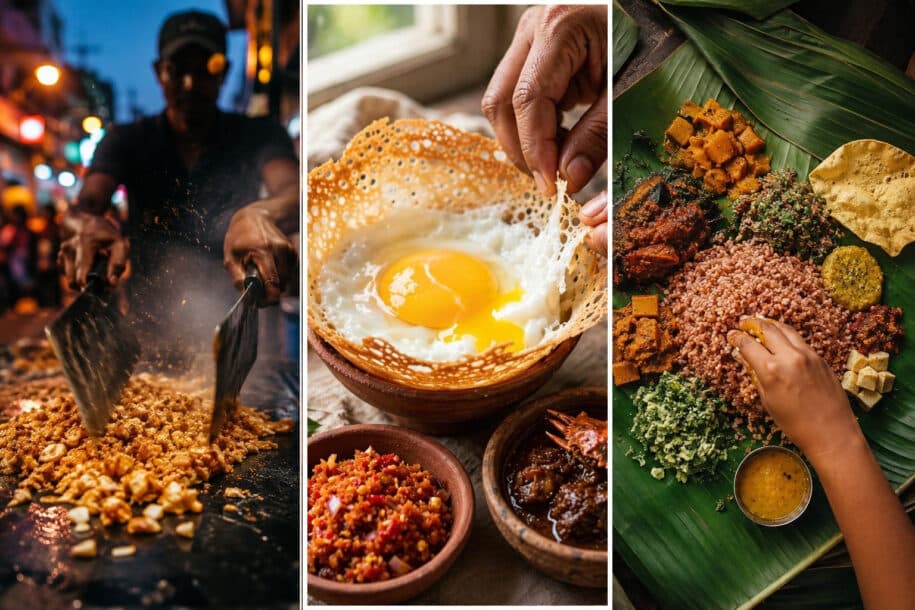
The drive from the airport to your hotel takes close to an hour. You spend the time watching palm trees blur past the window, waiting for the holiday to actually begin. Once you drop your bags, you head straight out. You are hungry, and you want proper Sri Lankan food. You order a plate of hoppers and a bowl of dark, spicy crab curry. The bowl-shaped pancake arrives with crisp, lacy edges and a soft, pillowy centre. You tear off a piece, dip it into the rich gravy, and take your first bite. The crunch and the heat hit first. Then comes the sweet, creamy wave of coconut milk to cool the spice. Before you have even unpacked your suitcase, you realize this culinary journey will be the absolute highlight of your trip.
Sri Lankan food has spent years building a devoted following among travellers who’ve already been, and 2026 is the year the rest of the world properly catches on. Major travel trend reports now rank the island among the top fifty food destinations globally. Tour operators are building entire itineraries around spice gardens, village kitchens, and night-market crawls. The Sri Lanka Tourism Development Authority has leaned into this momentum, promoting the country’s culinary traditions as a headline draw alongside beaches and tea country.
All of this means one thing for you. If you plan even a rough food itinerary before you fly, you will eat extraordinarily well. This guide is that rough itinerary, fleshed out. Every dish worth seeking, every region worth tasting, every cooking class worth booking, and every dietary question answered. Just the practical stuff that helps you order confidently, cook alongside a grandmother in Kandy, and figure out why your hoppers taste different in Jaffna than they do in Galle.
Let’s eat.
Why Sri Lankan Food Is Having Its Moment Right Now
Culinary tourism isn’t a niche anymore. Surveys from the World Food Travel Association and major booking platforms show that a growing share of travellers, roughly a third and climbing, now pick a destination partly or primarily for what they’ll eat there. They want hands in dough, fingers in spice bowls, a seat at someone’s actual dinner table.
Sri Lanka slots into that appetite almost perfectly. The island grows its own cinnamon, cardamom, cloves, nutmeg, and black pepper. Coconut appears in breakfast, lunch, dinner, and the snacks between. Seafood lands fresh every morning on both coasts. Rice paddies stitch the lowlands together, and hill-country vegetable plots supply everything from drumsticks to bitter gourd. Add four distinct culinary traditions, Sinhalese, Tamil, Muslim, and Burgher, layered over centuries of trade with South India, Southeast Asia, the Arab world, and colonial Portugal, the Netherlands, and Britain, and you get a cuisine with genuine range packed into a landmass smaller than Ireland.
What’s changed heading into 2026 is accessibility. Home-cooking experiences that used to require a local friend’s introduction are now bookable through platforms like TravelingSpoon, Airbnb Experiences, and GetYourGuide. Spice-garden walks in Matale and Kandy come with English-speaking guides who’ll let you crush a cardamom pod between your teeth. Street-food walks in Colombo’s Pettah district run on fixed schedules. The infrastructure around eating well in Sri Lanka has matured, and travellers are noticing.
The Dishes You Actually Need to Eat
Sri Lankan cuisine rewards the curious, but it also has a shortlist of icons that every first-time visitor should tick off. Here they are, in roughly the order you’ll encounter them.
Rice and Curry
This is the backbone of the entire cuisine, and it shows up everywhere from a roadside eatery in Matara to a white-tablecloth restaurant in Colombo 07. A plate of steamed rice arrives surrounded by small bowls: a dhal (lentil) curry, a potato or beetroot curry, a green-leaf mallum, a sambol, and one protein curry, often fish, chicken, or mutton. The combination shifts daily, regionally, and by the cook’s mood. No two plates match exactly.
A few things to know before you dig in:
- The rice is usually red or white country rice, slightly nutty, and it soaks up curry liquid beautifully.
- “Curry” here means a spiced gravy, often coconut-milk-based, and it ranges from mildly warm to properly fierce depending on the kitchen.
- The plate is meant to be mixed. Scoop rice, add a spoon of each curry, tear a piece of papadum, and eat with your fingers. Locals do. You’ll get a spoon if you ask, but the hand method gives you better control over ratios.
- Cost: a full rice-and-curry plate at a local spot runs roughly 400–800 LKR (about $1.30–$2.60 USD at early-2025 rates). Tourist-facing restaurants charge more, maybe $5–$10.
Hoppers (Appam)
Picture a lacy, bowl-shaped pancake with a crisp golden rim and a soft, slightly sour centre. That’s a hopper. The batter is fermented rice flour and coconut milk, poured into a small wok-shaped pan and swirled so it climbs the sides. Cooked over a flame for a couple of minutes, it comes out crackling at the edges and pillowy in the middle.
You’ll meet hoppers at breakfast, at dinner, and at 10 p.m. street stalls. Variations to look for:
- Plain hopper – the classic. Tear it, dip it in coconut sambol or a mild curry.
- Egg hopper – an egg cracked into the centre while the batter sets. The yolk stays runny if you’re lucky. Served with Lunu Miris (a chili-onion paste) or pol sambol.
- Milk hopper (kiri appa) – sweeter, made with a thicker pour of coconut milk. Often a dessert-style snack.
- String hoppers (idiyappam) – these are a different animal. Steamed nests of pressed rice-flour noodles, pale white, served with a thin coconut gravy (kiri hodi) and a curry on the side. They’re a breakfast and dinner staple in Tamil and Sinhalese homes alike.
Hoppers cost around 60–150 LKR each at a local joint. An egg hopper with sambol and a small curry might set you back 300–500 LKR.
Kottu Roti
If hoppers are breakfast royalty, kottu roti is the loud, glorious street-food king of the evening. Take godamba roti, a thin, layered flatbread, chop it into strips on a metal griddle with two cleavers (the rhythmic clang-clang-clang carries down entire streets), then fry the strips with vegetables, egg, and a spicy gravy. Add chicken, beef, mutton, or cheese depending on the stall. The result is a heaped, spicy, slightly charred mound that eats like the world’s most flavourful stir-fry.
Ordering tips:
- “Chicken kottu” is the safest crowd-pleaser. “Cheese kottu” is richer, almost indulgent.
- Spice level is adjustable. Say “less spicy” if you want to keep your tongue functional for the next three days.
- Best eaten fresh off the griddle, standing at the stall, with a lime wedge squeezed over the top.
- Price: 500–1,500 LKR depending on protein and location.
Pol Sambol
You’ll see this little bowl of fiery, tangy coconut relish beside almost every meal. Grated fresh coconut is pounded or mixed with dried red chilies, red onion, lime juice, a pinch of Maldive fish flakes (dried tuna), and sometimes a whisper of black pepper. The result is bright, hot, salty, and citrusy all at once. It wakes up plain rice, transforms a hopper, and makes grilled fish sing.
A heads-up for vegetarians and vegans: traditional pol sambol contains Maldive fish. Ask for it without, and most cooks will oblige happily. The coconut-chili-lime base is entirely plant-based on its own.
Lamprais
This one carries history in its banana-leaf wrapping. Lamprais (lumprijst in Dutch) is a Burgher creation from the colonial era: rice cooked in meat stock, piled with a mixed-meat curry (usually beef, pork, and chicken), a boiled egg, eggplant moju (a sweet-sour pickle), frikkadels (spiced meatballs), and a smear of shrimp-paste sambol. The whole lot gets wrapped in a banana leaf and baked until the leaf chars slightly, perfuming everything inside.
Unwrapping a lamprais parcel at the table is an event. The steam rises, the banana leaf smells green and smoky, and the layers of flavour hit you in sequence. Galle, on the south coast, is the traditional home of lamprais, and several old-family restaurants there still make it the way their great-grandmothers did. Colombo has excellent versions too, particularly at Burgher-run cafés.
Ambul Thiyal (Sour Fish Curry)
A southern specialty, especially around Galle and Matara. Firm fish, usually tuna or kingfish, is cooked with goraka (a dried Garcinia fruit), black pepper, and a blend of spices until the liquid reduces and the flesh takes on a tangy, almost dry finish. The goraka gives it a distinctive sourness you won’t find in any other Sri Lankan curry. It keeps well without refrigeration, which is why fishermen’s families historically relied on it for multi-day trips. Eat it with rice or string hoppers.
Jaffna Crab Curry
Head north and the flavour profile shifts hard. Jaffna-style cooking leans into roasted-spice gravies, tamarind sharpness, and serious heat. The crab curry is the signature: lagoon crab simmered in a thick, dark coconut-and-spice sauce loaded with black pepper, fennel, and dried chilies. You crack the shell at the table, pull out sweet white meat, and drag it through the gravy. Messy, spicy, deeply satisfying.
Jaffna’s version is noticeably hotter and more intensely spiced than crab curries you’ll find in Colombo or the south. If you have a low chili tolerance, ask for a milder preparation. Cooks are used to the request and will adjust without fuss.
A Quick Glossary for the Menu
Sri Lankan menus, especially in local eateries, can throw unfamiliar terms at you. Here’s a short decoder:
- Sambol – a relish, usually coconut-based, served as a condiment. Pol sambol (coconut), lunumiris (chili-onion), seeni sambol (caramelised onion) are the big three.
- Mallum – a dry stir-fry of chopped greens (gotu kola, spinach, bean leaves) with grated coconut and mild spice.
- Kiri hodi – a thin, mildly spiced coconut-milk gravy served with string hoppers or plain rice.
- Moju / Moju – a sweet-and-sour pickle, often eggplant or onion.
- Frikkadel – a spiced meatball, a Dutch-Burgher legacy.
- Goraka – a souring fruit (Garcinia gummi-gutta) used in southern fish curries.
- Pol roti – a flatbread made with grated coconut kneaded into wheat or rice flour, cooked on a griddle. Often stuffed with a chili-onion filling.
- Vada / Wade – a deep-fried lentil fritter, crunchy outside, soft inside. Sold at street stalls and tea shops.
Sri Lanka’s Regional Food Map: What to Eat Where
The island is small enough to cross in a day by car, yet its kitchen changes dramatically every couple of hours on the road. Ethnic composition, coastline versus highland, colonial history, and even the direction the monsoon blows all shape what lands on the plate. Treat each region as its own menu. You’ll eat better for it.
Colombo and the Western Coast
Colombo is where every Sri Lankan culinary tradition collides in one humid, honking, glorious city. You can start the morning with egg hoppers and pol sambol at a Tamil-run café in Wellawatte, grab a lamprais parcel from a Burgher bakery in Bambalapitiya by noon, demolish a plate of kottu roti in Pettah after sunset, and finish with a seafood platter at a rooftop restaurant overlooking the Galle Face Green.
The Pettah district deserves special mention. Its narrow lanes are lined with spice merchants, dried-fish sellers, fruit vendors stacking rambutan and mangosteen in pyramids, and tiny eateries serving short eats (small fried snacks like cutlets, patties, and rolls) for a few coins. Walking through Pettah with a local guide is one of the best Sri Lanka street food experiences you can have. You’ll taste things you didn’t know existed and walk out with chili dust on your fingers.
Negombo, about forty minutes north of the airport, sits on a lagoon and lives by its catch. Lagoon prawns, mud crab, seer fish, and squid hit the tables within hours of landing. The town’s fish market is a spectacle at dawn: hundreds of silver fish laid on ice, vendors calling prices, cats weaving between legs. Several waterfront restaurants will grill your chosen fish to order with a simple chili-lime rub. Negombo also has a strong Catholic fishing-community tradition, which shows up in richer, tomato-based fish stews you won’t find further south.
What to order here: kottu roti (any protein), egg hoppers with lunumiris, seafood platters, lamprais, short eats, lagoon prawn curry.
The South: Galle, Matara, Dondra, Mirissa
The southern coast is seafood country, full stop. Tuna, kingfish, wahoo, snapper, crab, prawns, and squid dominate menus from Galle Fort down to Tangalle. But the south also carries a couple of dishes that belong to it specifically.
Ambul thiyal, the sour fish curry made with goraka, originated in these parts. The dried Garcinia fruit gives the curry a sharp, almost fermented tang, and the fish is cooked down until the gravy clings thick and dark. It’s the kind of dish that makes you slow down, pick apart each flake, and chase the last smear of sauce with a piece of pol roti.
Lamprais also calls Galle home. Several family-run restaurants inside and around the Galle Fort still prepare it the old Burgher way: stock-soaked rice, three-meat curry, frikkadels, moju, and that essential banana-leaf bake. If you’re in the Fort for an evening, seek one out. The experience of unwrapping that leaf at a candlelit table, the steam curling up with a smoky-green fragrance, is hard to replicate anywhere else on the island.
Mirissa and Weligama, further east along the coast, lean into the tourist trade with fresh grilled fish, coconut-based curries, and smoothie bowls, but the local eateries a street or two back from the beach still serve proper rice and curry for a song. Matara, a working town past the tourist strip, has some of the best-value seafood curries in the country.
What to order here: ambul thiyal, grilled tuna steaks, coconut crab curry, lamprais (Galle), prawn curry, fish ambul thiyal with string hoppers.
The Central Highlands: Kandy, Nuwara Eliya, Ella
Climb into the hill country and the menu shifts toward vegetables, tubers, and fruit. The cooler climate grows carrots, leeks, potatoes, cabbage, and beans that taste noticeably sweeter than their lowland cousins. Jackfruit, both young (polos) and ripe, appears in curries, stir-fries, and even desserts. Coconut breads, pol roti stuffed with onion and chili, and hearty dhal preparations fill the gap where seafood thins out.
Kandy, the old Sinhalese capital, is the highland’s culinary hub. The Central Market near the Kandy Lake is a sensory overload: pyramids of red onions, bundles of curry leaves, slabs of jaggery, sacks of mountain-grown spices (cinnamon, cardamom, cloves, white pepper), and stalls selling kavum (oil cakes), kokis (crispy rosette cookies), and aluvam (rice-flour sweets) stacked in glass cases. Wander here before any cooking class. The market tour is half the education.
Nuwara Eliya, higher up, carries a faint British colonial echo in its food culture: tea plantation bungalows serving scones with strawberry jam, vegetable soups, and roast dinners alongside the usual Sri Lankan spread. It’s an odd, charming mash-up. The town’s markets brim with temperate vegetables you won’t see at sea level.
Ella, the backpacker favourite, has evolved its own little food scene: wood-fired pizza next to proper Sri Lankan curry shops, smoothie cafés across from kade (small local eateries) serving rice and curry on banana leaves. The views from hillside restaurants, rice terraces dropping away below you while you eat a plate of dhal and jackfruit curry, add a layer of atmosphere no city can match.
What to order here: polos (young jackfruit) curry, beetroot and potato curries, mushroom curries, coconut roti, kandyan sweets (kavum, aluvam, kokis), mountain-spice teas, vegetable mallum.
The East: Trincomalee, Batticaloa, Arugam Bay
The eastern coast blends Sinhalese, Tamil, and Muslim culinary traditions in a way that feels seamless rather than segmented. Seafood curries are the default protein, but the spicing leans toward Tamil and Moorish profiles: fennel, star anise, dried red chilies, and a heavier hand with roasted curry powder.
Trincomalee’s harbour brings in excellent crab, prawns, and reef fish. Batticaloa, further south, is known for its lagoon seafood and for a slightly sweeter style of coconut-based curry. Arugam Bay, the surf town, has a fun beach-café culture layered over local Tamil cooking: you’ll find grilled fish with sambol, coconut flatbreads, and spicy lentil soups alongside the expected smoothie bowls and burgers.
Muslim influence is strong here. Watalappam, a steamed coconut-jaggery custard spiced with cardamom and nutmeg, is a Sri Lankan Muslim dessert you absolutely should try. It’s rich, dense, faintly smoky from the jaggery, and usually served in small clay bowls. Look for it at Muslim-run bakeries and during Ramadan celebrations, though many places sell it year-round.
What to order here: crab curry, prawn curry, watalappam, coconut flatbread (pol roti), fish moju, mutton curry with fennel, spicy lentil dhal.
The North: Jaffna and the Tamil Heartland
Northern Sri Lankan food is its own bold universe. Jaffna cuisine, rooted in Tamil tradition, uses roasted spices, tamarind, and a quantity of dried red chili that would make a Sri Lankan from the south blink. The curries are darker, fierier, and more intensely layered than what you’ll encounter elsewhere on the island.
Jaffna crab curry is the headline act. Lagoon crab, cracked and simmered in a thick gravy of roasted spices, coconut, tamarind, and black pepper. The sauce clings to the shell, the meat inside is sweet against the heat, and you eat with your hands, licking your fingers, possibly sweating a little. It’s magnificent.
Beyond crab, Jaffna’s street food deserves a full morning: crisp lentil dosas with coconut chutney, egg hoppers with a sharper lunumiris than the southern version, vada sold from bicycles, and kool, a thick seafood soup made with palmyra root, crab, prawns, and a tangle of spices. Kool is a Jaffna original, and finding a good bowl of it is worth planning a lunch around.
The Tamil-influenced north also excels at vegetarian cooking. Lentil preparations, vegetable kofta curries, and coconut-based gravies are everyday staples. Meals here come with an array of pickles, papadums, and sambols that add crunch and acid to the heat.
What to order here: Jaffna crab curry, kool, lentil dosas, egg hoppers, mutton kofta curry, vegetable curries with roasted spice, palmyra-based sweets.
Sri Lanka Street Food: What to Grab, Where, and When
If restaurants give you the composed version of Sri Lankan cuisine, the street gives you the raw, immediate, slightly chaotic version. And for many travellers, the street is where the real memories form.
Short-eats are the backbone of Sri Lankan snacking. The term covers a wide family of small, usually fried or baked bites sold at bakeries, tea shops, and roadside carts:
- Cutlets – spiced potato-and-fish (or chicken) croquettes, breaded and fried.
- Patties – flaky pastry shells stuffed with spiced vegetables or minced meat.
- Rolls – elongated fried pastries with a filling of egg, potato, or fish.
- Vada / Wade – crunchy lentil fritters, sometimes with a green chili embedded in the centre.
- Samosas – triangular pastry pockets, usually potato-spiced, occasionally meat-filled.
A short-eat costs the equivalent of a few cents to maybe half a dollar. Grab three or four from a bakery counter, pair them with a cup of strong sweet milk tea, and you’ve just had breakfast for pocket change.
Evening kottu stalls deserve their own ritual. As the sun drops, metal griddles heat up across every town, and the clang-clang-clang of cleavers chopping roti begins. Follow the sound. Order a chicken or cheese kottu, watch it assembled in front of you, and eat it standing up with a lime wedge and a side of spicy gravy. The theatre of it, the sparks, the smoke, the pile of chopped roti growing on the metal plate, is half the pleasure.
Galle Face Green in Colombo transforms at dusk into a long strip of food carts: grilled corn, isso vada (prawn fritters), mango slices with chili salt, roasted peanuts, and fresh coconut water cracked open with a machete. Walk the length of it, grazing as you go, with the Indian Ocean breeze on one side and the city lights on the other.
Fruit carts are everywhere. Pineapple, papaya, mango, rambutan, mangosteen, wood apple, soursop, passion fruit, guava. Vendors peel and slice to order, often with a sprinkle of chili-lime salt. A bag of sliced mango or pineapple costs almost nothing and makes the perfect walking snack between sightseeing stops.
Night markets and weekend food fairs have grown in popularity, especially in Colombo, Kandy, and Galle. These bring together dozens of stalls in one location: hoppers, kottu, grilled seafood, string hoppers, sweets, fresh juices. They’re social, loud, slightly smoky, and a great way to sample many dishes in one evening without committing to a full sit-down meal.
A practical note: street food in Sri Lanka is generally safe. Stalls cook to order over high heat, which kills most concerns. Use basic sense. Pick stalls with a steady flow of customers (high turnover means fresh food), watch the food being cooked, and peel fruit yourself or buy it pre-peeled from the vendor. Tap water is the main thing to skip; stick to bottled or filtered water, fresh coconut water, and hot tea.
Cooking Classes in Sri Lanka: Get Your Hands in the Spice
Here’s where the culinary tourism trend gets personal. Reading about a dish is one thing. Standing in a village kitchen, grinding roasted coriander seeds with a stone mortar while a grandmother corrects your wrist angle, is another thing entirely. Cooking classes have become one of the most-booked experiences on the island, and for good reason: they compress a market education, a spice lesson, a hands-on cooking session, and a shared meal into three or four deeply satisfying hours.
What a Typical Class Looks Like
Most Sri Lankan cooking classes follow a loose arc:
Market or garden visit: You start early, often around 8 or 9 a.m., walking a local market or a home garden with your host. They show you how to pick a good coconut, explain the difference between Sri Lankan cinnamon (Cinnamomum verum, the real deal) and cassia, let you tear curry leaves off the branch, and introduce you to vegetables you’ve never seen. In spice-garden towns like Matale, this segment may include a walk through pepper vines, clove trees, and nutmeg groves.
Hands-on cooking: Back in the kitchen, which might be an open-air structure with a wood-fired clay stove, a modern gas range in a Colombo apartment, or a shaded patio in a hill-country garden, you cook. Typically three to five dishes: a vegetable curry, a dhal, a protein curry (fish, chicken, or a crab in coastal classes), a sambol, and a bread like roti or hoppers. Your host demonstrates, you replicate, they adjust. You’ll likely grind a spice blend by hand, squeeze coconut milk from grated flesh, and learn the timing that separates a properly tempered curry from a burnt one.
The shared meal: This is the payoff. You sit down, often on mats or at a low table, sometimes on a banana leaf, and eat everything you just cooked alongside your host and their family. Conversation flows. You ask about the recipe’s origins, the family’s food traditions, what they ate growing up. They ask where you’re from, whether you found the chili tolerable, whether you want seconds. It’s warm, unscripted, and frequently the highlight travellers mention in reviews.
Types of Classes You’ll Find
The range has broadened considerably heading into 2026:
Village home classes: The most immersive. A family in a rural area hosts you in their actual kitchen. The setting is simple: clay stoves, firewood, banana-leaf plating. These tend to be in the Kandy, Sigiriya, Ella, and Dambulla regions.
Urban home classes: Set in Colombo, Kandy city, or Galle. The kitchen is more modern, but the cooking is still hands-on and personal. A Colombo crab-curry class, for example, might start at the fish market and end with a spread of string hoppers, crab curry, and three sambols.
Spice-garden cooking classes: Common around Matale and Kandy. You tour a working spice plantation, learn to identify and harvest spices, then cook with them. These lean slightly more educational and are great if you want to understand Sri Lankan spices at the source.
Hotel and resort classes: Many mid-range and upscale hotels now offer cooking sessions as a guest activity. These are convenient and well-organised, though they tend to feel a little more structured and less intimate than a home class.
Street-food walking tours: Strictly speaking these aren’t cooking classes, but they overlap with the culinary-tourism experience. A guided walk through Pettah, Kandy market, or Jaffna’s food stalls, tasting as you go, with commentary on ingredients and history.
Pricing: What to Expect
Prices vary based on location, group size, whether transport is included, and the length of the session. Here’s a realistic picture as of the 2025–2026 season:
Group classes (4–10 people, 2–4 hours): These are the most affordable entry point. Expect to pay somewhere in the range of $20–$40 USD per person. They typically include all ingredients, the cooking session, and the meal. Some add a brief market or spice-garden walk. You’ll find these on platforms like GetYourGuide, Viator, and local tour-agency websites, especially in the Sigiriya, Dambulla, Mirissa, and Ella areas.
Small-group or semi-private classes (2–4 people, 3–5 hours): A step up in personal attention. These often include a market tour, transport by tuk-tuk, and a longer cooking session covering more dishes. Pricing generally sits in the $40–$80 USD per-person band.
Private home classes (1–2 guests, 3–5 hours, with market tour and transport): The premium, most immersive option. You’re in someone’s home, cooking one-on-one or as a couple, with full market integration. These typically range from $70 to $160+ USD per person, depending on the host, location, and inclusions. A Kandy village class with a full market tour, tuk-tuk pickup, and a five-dish cook might land at the higher end. A Colombo crab-curry session in a home kitchen usually sits in the middle.
Hotel cooking sessions: These are often bundled into a stay or offered as a half-day activity. Pricing can range widely, from around $30 for a group session at a mid-range property to $100+ at a luxury resort. The quality varies; read recent guest reviews before booking.
A few pricing notes worth keeping in mind:
- Most classes include all ingredients and the meal you cook. Transport to and from your hotel is sometimes included, sometimes an added fee (usually a small tuk-tuk charge). Confirm before booking.
- Tipping your host is appreciated and customary. A modest tip, maybe $5–$15 depending on the experience, goes a long way and is a nice acknowledgment of the effort.
- Prices shift with season and demand. Peak tourist months (December through March on the west and south coasts, May through September on the east coast) can push rates slightly higher.
- If you’re travelling as a solo traveller, some private classes have a minimum-guest requirement or a solo supplement. Group classes sidestep this neatly.
How to Book and What to Look For
Platforms to search: TravelingSpoon, Airbnb Experiences, GetYourGuide, Viator, Tripadvisor Experiences, and byFood all list Sri Lanka cooking classes. Searching “Sri Lanka cooking class” plus your destination city (Kandy, Colombo, Ella, Mirissa, Sigiriya) will surface options.
Read recent reviews: Look for comments about the host’s English (or your language), the amount of hands-on cooking versus watching, whether the market tour actually happened, and the quality of the meal.
Check what’s included: Ingredients, meal, transport, market visit, spice-garden entry. Clarify before you book.
Communicate dietary needs in advance: Vegetarian, vegan, gluten-free, halal, allergy concerns. Sri Lankan hosts are generally very accommodating and will adjust a menu if you tell them ahead of time. Cooking-class listings on major platforms often explicitly note that vegetarian, vegan, gluten-free, and halal menus are available on request.
Confirm the start time and duration: Market tours mean early starts, often 8 a.m. or earlier. If you’re not a morning person, look for classes that skip the market or start later.
Group size matters. A class with twelve strangers feels different from one with a couple and a grandmother. If intimacy is what you’re after, filter for small-group or private options.
What to Wear and Bring
- Comfortable, breathable clothing you don’t mind getting a little splattered. You’ll be near oil, coconut milk, and turmeric (which stains).
- Closed-toe shoes or sandals that can handle a market floor.
- A small bag for any spices or ingredients you might want to buy at the market.
- Sunscreen and a hat if the market tour is outdoors.
- An open mind and a willingness to ask questions. Hosts love curiosity. Ask why they add the curry leaves at that moment, what the roasted spice blend is for, how their grandmother made the dish differently. The answers are part of the meal.
Dietary Guides, Practical Tips & The Ultimate FAQ
Navigating a new cuisine always comes with a few logistical questions. You want to know what to order, how to eat it, and whether your stomach will agree with the local spice levels. Sri Lankan food is incredibly rewarding, but it does have its own set of rules and hidden ingredients. This final section clears up the dietary details, shares a few ground-level eating tips, and answers the exact questions travellers type into search engines before they fly.
The Dietary Guide: Eating Well on Any Diet
Sri Lanka is a dream destination for plant-based eaters, though a few hidden ingredients require a quick vocabulary lesson. The island’s reliance on coconut, rice, and local vegetables means you will never go hungry, provided you know what to ask for.
Vegetarian and Vegan Travellers
The foundation of Sri Lankan cuisine is naturally plant-based. Coconut milk replaces dairy in almost every curry. Jackfruit, pumpkin, beans, lotus root, and bitter gourd are treated with the same culinary respect as meat.
The one major hurdle for vegans and strict vegetarians is Maldive fish. This is a cured, dried tuna product that tastes somewhat like bonito flakes. Cooks use it as a flavour enhancer, pounding it into pol sambol, stirring it into dhal, and adding it to vegetable mallums.
To eat strictly plant-based, you simply need to learn one phrase: “without Maldive fish.” Most cooks understand immediately. When booking a Sri Lanka cooking class, mention your vegan preference in advance. Hosts will gladly swap the fish flakes for a pinch of extra salt or a dash of lime.
Watch out for ghee (clarified butter) in some flatbreads and sweets, and avoid watalappan if it contains condensed milk, though traditional recipes use coconut milk and jaggery.
Gluten-Free Eating
You are in luck. The primary starches of the island are naturally gluten-free. Rice, rice flour, tapioca, and cassava form the bulk of the diet.
Hoppers, string hoppers, and rice-and-curry platters are entirely safe. The main gluten traps are wheat-based flatbreads like godamba roti (the flaky bread used to make kottu) and pol roti (which often uses a mix of wheat and rice flour). Baked goods in local bakeries, like biscuits and cakes, also contain wheat. Stick to the rice-based dishes and you will have zero issues.
Halal Food
Sri Lanka has a large, vibrant Muslim population, particularly the Sri Lankan Moors and Malays. Halal meat is widely available and clearly marked in restaurants across Colombo, the eastern coast, and the southern tourist hubs.
Many local eateries display a Halal certification sticker on the glass counter. In Muslim-run cafes, you will find incredible biryani, watalappan, and spiced mutton dishes. Note that traditional Muslim eateries do not serve alcohol, making them excellent spots for a quiet, family-friendly dinner.
Managing the Heat
Sri Lankan curries pack a serious punch. The heat comes from fresh green chilies, dried red chilies, and black pepper. Northern dishes from Jaffna and eastern coastal curries sit at the top of the spice scale.
If you have a low tolerance for heat, do not suffer in silence. Sri Lankan hosts are incredibly accommodating. Use the phrase “tikak less spicy” (a little less spicy) or simply ask for a “mild” curry.
When the heat does catch up with you, reach for the cooling agents on the table. A spoonful of buffalo curd (a thick, creamy yogurt), a scoop of plain white rice, or a crunchy papadum will neutralise the chili burn instantly. Coconut milk-based gravies, like kiri hodi, are also excellent for soothing the palate.
Practical Tips for the Sri Lankan Table
Knowing how to eat is just as important as knowing what to eat. A few local customs will make your meals smoother and more enjoyable.
Eat with your right hand:
Locals eat rice and curry with their fingers. It mixes the food better and lets you gauge the temperature before it hits your tongue. Use only your right hand. The left hand is considered unclean in South Asian cultures. Scoop the curry and rice together with your fingertips, push it into your palm with your thumb, and eat. If you prefer a spoon, no one will mind, but trying the local method is part of the fun.
Wash your hands before and after:
Restaurants and local kades (small eateries) always have a sink or a communal water jug near the dining area. After the meal, a staff member might bring a finger bowl with warm water and a lime wedge to your table.
Drink King Coconut:
You will see bright orange, trumpet-shaped coconuts sold at roadside stalls everywhere. This is the thambili, or king coconut. It is sweeter than the standard green coconut and packed with electrolytes. Drink it straight from the shell after a spicy meal or a long day of sightseeing.
Timing your meals:
Hoppers are traditionally a breakfast or dinner food. You will struggle to find a hopper stand open at noon. Kottu roti, on the other hand, is the ultimate evening meal. The metal griddles fire up around 6:00 PM, and the chopping continues late into the night.
Frequently Asked Questions
What is the most famous Sri Lankan food?
Rice and curry is the most famous and widely consumed Sri Lankan food. It is the daily staple for locals across the island. For street food, kottu roti and hoppers are the most iconic dishes that travellers seek out.
Is Sri Lankan food similar to Indian food?
Sri Lankan food shares historical roots with South Indian cuisine but has evolved into a distinct culinary tradition. Sri Lankan curries rely heavily on coconut milk, tropical souring agents like goraka, and Maldive fish. The spice blends are often roasted darker, giving the curries a deeper colour and a more intense, earthy flavour profile compared to many North Indian dishes.
What do Sri Lankans eat for breakfast?
A traditional Sri Lankan breakfast usually consists of hoppers, string hoppers, or pol roti. These are served with a side of dhal, a spicy coconut sambol, and sometimes a small portion of potato or onion curry. Another popular breakfast dish is kiri bath, which is rice cooked in thick coconut milk and cut into diamond shapes, served with a spicy onion relish called lunu miris.
What is the national dish of Sri Lanka?
Rice and curry is widely considered the national dish of Sri Lanka. It represents the agricultural backbone of the country and is eaten daily by the vast majority of the population. However, kottu roti holds the unofficial title of the national street food.
How much does it cost to eat in Sri Lanka?
Eating at local Sri Lankan eateries is very affordable. A filling plate of rice and curry at a local spot costs between $1.50 and $3.00 USD. A hearty portion of kottu roti from a street stall ranges from $2.00 to $4.00 USD. Dining at mid-range tourist restaurants or beachfront cafes will typically cost between $8.00 and $15.00 USD per person, including a drink.
Is it safe to eat street food in Sri Lanka?
Yes, it is generally safe to eat Sri Lanka street food, provided you choose stalls with a high turnover of customers. High turnover means the ingredients are fresh and the food is cooked to order over high heat. Stick to foods that are cooked in front of you, like hoppers and kottu, and avoid pre-cut raw fruits that have been sitting out in the sun.
What is goraka?
Goraka is a small, dark, dried fruit native to southern Sri Lanka. It has a deeply sour, slightly smoky flavour and is used as a souring agent in meat and fish curries. It is the defining ingredient in ambul thiyal, the famous southern sour fish curry.
The Final Bite
The culinary tourism boom of 2026 is not just about ticking famous dishes off a list. It is about the smell of roasting curry leaves hitting hot coconut oil. It is about the rhythmic clatter of kottu blades echoing down a Colombo street at dusk. It is about sitting in a village kitchen in Kandy, watching a grandmother teach you how to fold a perfect lamprais parcel.
Sri Lanka offers a flavour frontier that few other destinations can match. The ingredients are hyper-local, the techniques are centuries old, and the people serving the food are genuinely eager to share their culture with you.
Pack an appetite, bring a willingness to try everything, and let the island feed you. You will leave with a full stomach, a camera roll full of vibrant market photos, and a lingering craving for pol sambol that will follow you all the way home.