
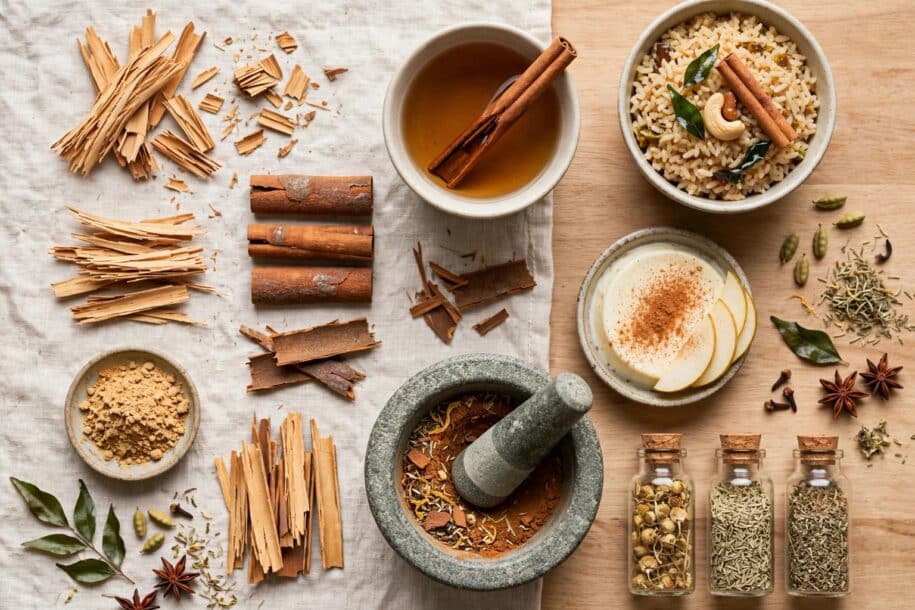
Ceylon Cinnamon smells like a warm, slow afternoon in the southern hills. Sweet, faintly floral, a little citrusy at the edges, with something almost like clove hiding underneath. It fills a kitchen in a way that is completely different from the sharp, one-note heat most of the world calls cinnamon.
This is the original. The one that started centuries of ocean crossings, trade wars, and colonial fights over a small island in the Indian Ocean. And it still grows right here, in the red-soil gardens stretching from Galle down toward Matara, tended by families who have been peeling bark by hand for generations.
Sri Lanka’s Golden Bark
For anyone heading to Sri Lanka, Ceylon Cinnamon is worth more than a suitcase souvenir. It opens a door into the island’s food, its ancient medicine, its complicated history, and a craft so specific to this place that the European Union gave it protected status in 2022. Walk into a spice garden near Ambalangoda, watch a peeler work his curved knife around a fresh branch, and the whole story of this island compresses into one fragrant, ten-minute moment.
This guide covers the science, the kitchen, the Ayurveda, the grades, the fakes, and exactly where to find the good stuff once boots hit Sri Lankan soil.
The Ceylon Cinnamon Advantage
The species Cinnamomum verum grew wild in Sri Lanka’s central and southern regions long before anyone thought to bottle its smell and sell it across the world. The island’s specific mix of tropical humidity, laterite-rich soil, and two annual monsoons gave this plant a chemical fingerprint no other origin has managed to replicate at scale.
The Department of Cinnamon Development officially oversees and manages the national cinnamon industry in Sri Lanka. Their records note over forty aromatic compounds in the bark, led by cinnamaldehyde at roughly 55–70% of the essential oil content. That high cinnamaldehyde is what delivers the warm sweetness. The supporting cast of eugenol, linalool, and trace terpenes adds the floral and citrus layers underneath.
Cassia varieties, grown in China, Indonesia, and Vietnam, lean heavily on cinnamaldehyde too, but with far fewer supporting compounds. The result is a flavour that hits hard and flat, like a single loud note held too long. Ceylon Cinnamon plays a chord.
There is also the coumarin question, which gets its own section later. Short version: Ceylon Cinnamon carries almost none of it. Cassia carries a lot. That single difference is why every wellness article on the planet insists on the Sri Lankan variety.
But the chemistry is only half the story. The other half happens with a knife, a brass rod, and two very experienced hands.
Harvesting Ceylon Cinnamon
Here is the part no video quite captures.
A cinnamon peeler in a Galle district garden picks branches about two years old, roughly finger-thick. He strips the rough outer bark with a curved knife called a keththa, then slides the blade underneath to loosen the tender inner layer. The trick is the rolling. He works a small brass rod back and forth inside the loosened bark until it separates cleanly, then peels it away in long, papery strips.
Those strips get packed inside larger ones, layer upon layer, forming a single quill. Think of it like rolling a very tight, very thin cigar out of dried bark paper. The quills dry in shade for four to seven days, shrinking, tightening, turning that familiar pale tan colour.
A skilled peeler produces several hundred quills in a working day. The entire process is done by hand. No machines. No shortcuts. The Sri Lanka Export Development Board, which regulates grading and export standards, documents this traditional method as part of what qualifies the product for its Protected Geographical Indication status.
Watching it happen is hypnotic. The smell in the drying room alone is worth the detour.
Several family-run spice gardens along the Galle–Ambalangoda–Hikkaduwa corridor welcome visitors without an entry fee. The peeling families are proud of their craft and generous with explanations. Most DMC itineraries in the southern region include a stop at one of these gardens, and it pairs naturally with a visit to a nearby spice oil distillery, where copper stills turn cinnamon leaf and bark into the essential oils that end up in pharmacies and perfumeries worldwide.
If the trip extends toward Matara or Hambantota, smaller-scale operations there offer a more intimate look at the process, often with the option to buy directly from the drying floor.
The quills look beautiful. But not all quills are equal, and the grading system is worth understanding before money changes hands.
Ceylon Cinnamon Grades Explained
The Sri Lanka Export Development Board classifies Ceylon Cinnamon quills by diameter, colour, and neatness of roll. The system is specific, and knowing it helps avoid overpaying for a mid-grade product dressed up as premium.
- Alba: Pencil-thin, tightly rolled, pale gold. The most expensive grade, reserved for high-end export and fine dining. Exquisite aroma.
- C5 Special: Slightly thicker than Alba. A popular choice for gifting.
- C5: Roughly 10–14 mm diameter. The quality workhorse. Excellent flavour at a fair price.
- C4: A touch wider. Common in Sri Lankan supermarkets and local spice shops. Very good for everyday cooking.
- M5 and M4: Thicker quills, often destined for grinding into powder.
- H1: The thickest commercial grade. Used industrially.
Beyond whole quills, the trade sells quillings (broken pieces), featherings (thin inner bark shavings), and chips (rough outer pieces). These work perfectly well for home cooking, steeping in tea, or making infused oils. They simply lack the visual elegance of intact quills.
For a traveller picking up a gift, C5 or C4 hits the sweet spot of quality and value. Alba is worth the splurge if the goal is to impress someone who cooks seriously. Quillings and featherings are the smart buy for personal kitchen use.
One thing to check before paying: the quills should crumble easily between the fingers. If a stick resists and feels woody, it is likely not Ceylon Cinnamon at all. That leads directly into the problem most buyers never see coming.
Ceylon vs Cassia Cinnamon
Walk into almost any standard supermarket in Europe or North America, grab a generic jar of ground cinnamon, and flip it over. Unless the label explicitly states otherwise, you are holding Cassia.
Cassia comes from three main species (Cinnamomum cassia, C. burmannii, and C. loureiroi) grown primarily in China, Indonesia, and Vietnam. It is a phenomenal spice for its intended purpose. When a baker is making a heavy cinnamon roll or a strongly spiced apple pie, they need a loud, pungent, hot flavour that can punch through thick layers of butter, dough, and sugar. Professional pastry chefs keep Cassia in their pantry exactly for those heavy-lifting applications.
But in raw applications, delicate sauces, teas, or daily wellness routines, Cassia overwhelms the palate.
This brings us to the distinction that every high-end chef and clinical nutritionist keeps at the front of their mind: coumarin. Cassia naturally contains up to 5% coumarin, a compound that can cause liver strain if consumed in large daily doses. The German Federal Institute for Risk Assessment (BfR) sets strict daily tolerable limits for coumarin intake, a guideline that global health bodies frequently reference.
Ceylon Cinnamon, by contrast, contains roughly 0.004% coumarin. It is virtually negligible.
When professional chefs build a spice rub for a delicate piece of fish, or when wellness experts formulate a daily morning tonic, they reach for Ceylon Cinnamon. It allows them to use generous quantities for depth and sweetness without crossing any safety thresholds. It also preserves the subtle, floral top notes that Cassia simply does not possess.
Knowing the difference in chemistry is step one. Actually proving you have the right bark when you hold two identical-looking brown sticks in your hand is step two.
Identifying Real Ceylon Cinnamon
A professional buyer will tell you that identifying true Ceylon Cinnamon starts long before you grind it into a powder. It starts with the physical structure of the quill and the way it breaks.
When you visit a spice garden in Sri Lanka or a high-end grocer back home, run through this quick checklist.
The Snap Test: Cassia bark is thick, dense, and woody. If you try to break it, it resists, eventually cracking with a hard, sharp snap. Ceylon Cinnamon is fragile. Because only the delicate inner bark is used, a true quill shatters almost like dried leaves when squeezed.
The Teardown: Look at the hollow end of the stick. Cassia rolls inward from both sides, creating a thick, double-scroll with an empty centre. Ceylon Cinnamon is rolled like a telescopic cigar. One side curls over the other, packed tightly with multiple paper-thin layers of bark.
The Iodine Trick: This is the ultimate kitchen lab test, often taught in pharmacognosy courses. Mix a teaspoon of cinnamon powder with a little water and add a drop of standard tincture of iodine (easily found in any local pharmacy). Cassia has a high starch content and will instantly turn dark blue or black. True Ceylon Cinnamon has very low starch and will show little to no colour change.
The Taste Test: Put a tiny pinch on your tongue. Cassia hits immediately with a hot, spicy burn and leaves a slightly bitter, astringent aftertaste. Ceylon Cinnamon starts mild, tasting sweet and citrusy, leaving a clean, pleasant finish.
Professional kitchens pay a premium for Ceylon Cinnamon because these physical and chemical markers guarantee consistency in their dishes. Once you have the genuine article in your own kitchen, the rules of cooking change entirely. You stop treating it like a background note and start treating it like the main event.
Cooking with Ceylon Cinnamon
In many Western households, cinnamon waits in the pantry until someone bakes a pie or steams hot cider. In Sri Lanka, Ceylon Cinnamon is a foundational savoury ingredient. It builds the base of the meal, not just the dessert.
To cook like a local, you have to understand the concept of Thalippu, or tempering.
In a traditional Sri Lankan kitchen, whole Ceylon Cinnamon quills are thrown into hot coconut oil alongside fresh curry leaves, mustard seeds, and pandan (rampe) leaves before the main ingredients are added. The fat-soluble essential oils in the bark extract perfectly into the hot oil, perfuming the entire dish. This technique is the backbone of Sri Lankan dhal, potato curries, and rich meat dishes.
Then there is Thuna Paha, the traditional roasted curry powder. This is not the bright yellow turmeric-heavy powder found in western supermarkets. It is a dark, smoky blend. Home cooks and chefs dry-roast coriander, cumin, fennel, and large pieces of Ceylon Cinnamon in a pan until they are almost black. The natural sweetness of the cinnamon balances the bitter, charred notes of the other seeds, creating a complex seasoning that transforms plain rice into a feast.
If you want to recreate the true taste of the island at home, start with these two recipes.
Wattalappam
This is the crown jewel of Sri Lankan Moorish desserts. It is a steamed custard made from Kithul jaggery (a local palm sugar), thick coconut milk, and eggs. The magic happens with the spice blend. A heavy hand of freshly grated Ceylon Cinnamon is folded into the mixture along with cardamom and nutmeg. The delicate citrus notes of the bark cut right through the deep, dark molasses flavour of the jaggery, resulting in a dessert that is rich but never cloying.
Spiced Black Tea (Kahata)
This is the daily ritual served everywhere, from roadside stalls to five-star hotel lobbies. Simmer water with two whole Ceylon Cinnamon quills, a bruised cardamom pod, and a few slices of fresh ginger for five minutes. Add high-quality Ceylon black tea leaves, steep for two minutes, and serve plain. The result is a highly aromatic, digestive brew that settles the stomach after a heavy meal.
Mastering the kitchen, however, is only one part of the Ceylon Cinnamon story. To truly understand why ancient merchants risked shipwrecks and empires fought over this island, you have to look past the food and into the medicine cabinet.
Cinnamon Benefits in Ayurveda
Professional wellness chefs and clinical nutritionists treat this bark with the same reverence a sommelier reserves for a vintage wine. In the world of functional medicine and high-end hospitality, Ceylon Cinnamon is classified as a therapeutic ingredient first and a flavouring agent second.
The island’s traditional medical system, Ayurveda, documented the therapeutic properties of Tvak (the Sanskrit and Sinhala term for the bark) thousands of years ago. The Department of Ayurveda in Sri Lanka classifies the spice as a powerful warming agent (ayurveda.gov.lk). Ayurvedic physicians prescribe it specifically to balance the Vata and Kapha doshas. It stimulates digestion, clears respiratory congestion, and improves circulation. Luxury wellness retreats across the island, from the cliffs of Tangalle to the cultural triangle in Kandy, build their entire spa and dietary menus around these exact dosha-balancing principles.
Modern biochemistry has spent the last two decades validating what ancient practitioners already knew. Research published in the National Institutes of Health (NIH) database highlights the profound impact of cinnamaldehyde and polyphenols on human metabolism (ncbi.nlm.nih.gov). These compounds mimic insulin, slowing the breakdown of carbohydrates in the digestive tract and significantly lowering fasting blood sugar levels.
The antioxidant capacity of true Ceylon Cinnamon also outpaces many recognized superfoods. It neutralizes free radicals and lowers systemic inflammation, which is a primary driver of cardiovascular disease. Neurologists are currently studying its potential to inhibit the buildup of tau proteins in the brain, a primary marker for neurodegenerative conditions.
Because clinical protocols often require daily consumption over several months, the coumarin factor becomes the deciding element. A functional medicine practitioner will exclusively recommend Ceylon Cinnamon to patients managing metabolic syndrome, as the negligible coumarin levels allow for safe, long-term daily dosing without risking hepatic strain. The science is undeniable. The challenge for the modern traveller simply lies in navigating the retail landscape to secure the genuine article.
Where to Buy Good Cinnamon in Sri Lanka
Tourists arriving in Sri Lanka often fall into a predictable trap. They visit highly commercialized “spice gardens” heavily promoted by tuk-tuk drivers, only to pay exorbitant prices for mediocre, heavily marked-up Cassia. Shopping for authentic Sri Lankan spices requires a slightly more strategic approach.
For the highest guarantee of quality and export-grade standards, look for products bearing the “Pure Ceylon Cinnamon” lion logo. The Sri Lanka Export Development Board (EDB) regulates this certification mark, ensuring the product meets strict chemical and physical purity standards (srilankabusiness.com).
When buying whole quills or powder for everyday use, skip the tourist traps entirely and walk into a major local supermarket chain like Keells, Cargills Food City, or Arpico Supercentre. These retailers stock highly reputable, locally loved export brands such as Diamond, MD, and Serendipity. A large jar of C4 grade Ceylon Cinnamon powder in the baking aisle will cost a fraction of the price charged at the airport duty-free shops, and the quality is identical to what ends up in Michelin-starred kitchens in London or Paris.
If the goal is to purchase beautifully packaged Alba grade quills for gifting, Laksala is the premier destination. As the state-owned handicrafts and spice emporium, Laksala guarantees authenticity and offers elegant, travel-ready packaging that clears international customs without issue.
For the ultimate insider experience, visit a reputable, family-owned estate in the Matale district or the southern coastal belt. Watching the harvest, smelling the drying rooms, and buying directly from the curing floor provides a connection to the product that no retail store can replicate.
Once you hold that freshly peeled bark in your hands, the sheer weight of its history becomes palpable. This is a spice that altered the map of the world.
The History of Ceylon Cinnamon
The story of Ceylon Cinnamon is written in blood, gold, and ocean tides. For centuries, Arab traders controlled the global spice routes. They kept the exact origin of the bark a closely guarded secret, spinning elaborate myths for Roman and Greek buyers about giant winged creatures guarding the cinnamon trees in distant, inaccessible lands. This manufactured scarcity allowed them to charge astronomical prices.
The myth shattered in 1505 when Portuguese sailors, blown off course by a storm, landed on the shores of Sri Lanka. They quickly realized they had stumbled upon the legendary source of the world’s most coveted spice. The Portuguese aggressively monopolized the trade, subjugating the local Kingdom of Kotte and forcing the indigenous Salagama caste to harvest the bark under brutal conditions.
The Dutch East India Company arrived in the 17th century, ousting the Portuguese and establishing an even tighter, more systematic monopoly. They mapped the wild cinnamon forests, established strict quotas, and reportedly destroyed any bark harvested outside their control to artificially inflate global prices. The British took control of the island in 1796, but by then, the monopoly was already fracturing as cultivation spread to other tropical colonies.
Today, the island has reclaimed its heritage. The spice is no longer a tool of colonial extraction, but a source of national pride and economic empowerment. The families peeling the bark today are the descendants of those who survived the empire builders, and their craft remains entirely their own.
Understanding this history transforms a simple cup of spiced tea into a profound experience. For the modern culinary professional or the curious traveller, knowing the exact origin, grade, and story of the ingredients on their plate is the ultimate luxury.
Frequently Asked Questions
What is the healthiest cinnamon to consume?
Ceylon Cinnamon (Cinnamomum verum) is the healthiest option due to its negligible coumarin content. It provides all the antioxidant and metabolic benefits of the spice without the risk of liver toxicity associated with high-coumarin Cassia varieties.
Which cinnamon is best for blood sugar management?
Clinical nutritionists recommend Ceylon Cinnamon for daily blood sugar management. Its active compounds mimic insulin and slow carbohydrate digestion, and its safety profile allows for the consistent daily use required to see metabolic results.
How much Ceylon Cinnamon is safe per day?
Most health authorities consider half a teaspoon to one full teaspoon (approximately 2 to 4 grams) of Ceylon Cinnamon powder per day to be highly beneficial and completely safe for long-term consumption.
Do cheap cinnamon powders contain heavy metals?
Recent consumer protection studies, including a 2024 report by Consumer Reports, found elevated lead levels in several cheap, unbranded Cassia cinnamon powders. Purchasing certified Pure Ceylon Cinnamon from reputable, regulated brands mitigates this risk entirely.
How do I store Ceylon Cinnamon to keep it fresh?
Store whole quills and ground powder in an airtight glass container, away from direct sunlight and heat. Whole quills retain their essential oils and peak flavour for up to two years, while ground powder remains highly aromatic for about six to twelve months.