
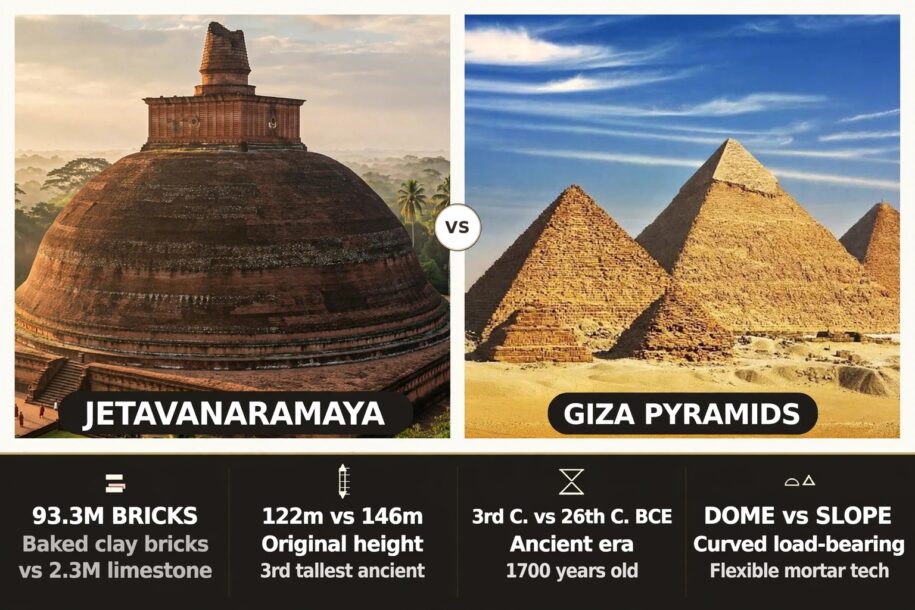
When people picture the ancient world reaching for the sky, the mind immediately jumps to the desert sands of Giza. Massive stone triangles dominate the historical narrative. Yet, a different kind of mountain rose in the tropical heart of South Asia. The Jetavanaramaya Stupa commands the skyline of Anuradhapura. It stands as a colossal, bell-shaped marvel that completely shatters modern assumptions about early engineering.
Built in the third century, this massive structure claimed the title of the third tallest building on the planet. Only the Great Pyramid of Khufu and the Pyramid of Khafre stood taller. Imagine a monument soaring 122 meters into the clouds. That original height is roughly equivalent to a modern forty-story skyscraper. King Mahasena commissioned this Buddhist reliquary monument to serve as a spiritual centerpiece housing sacred relics. It functioned as a thriving hub for thousands of monks.
Tourists wandering through the Sacred City today experience a profound sense of scale. The surrounding jungle canopy barely reaches the massive square base. Pilgrims and travelers alike find themselves dwarfed by the sweeping curves of the dome. The sheer physical presence of these Anuradhapura Stupas forces a complete reevaluation of ancient global capabilities. Egypt mastered the slope. Sri Lanka perfected the dome. Both civilizations achieved absolute architectural immortality using the raw materials beneath their feet.
Jetavanaramaya Stupa Brick Count
Stone requires quarrying. It demands heavy chisels, massive labor forces, and precise geometric cuts. The builders of ancient Sri Lankan architecture chose a completely different medium. They chose mud. Specifically, they chose baked clay. The sheer volume of materials used in these monuments borders on the incomprehensible.
The Jetavanaramaya Stupa required an estimated 93.3 million baked bricks.
Counting to ninety-three million takes years. Every single block was shaped by hand, dried in the tropical sun, and fired in kilns. This was an industrial operation of staggering proportions. The ancient brick technology involved mixing local clay with specific organic binders to ensure structural integrity during the baking process.
Here is the raw math behind the monument:
- Original Height: 122 meters (400 feet).
- Current Height: Roughly 71 meters (due to the loss of the upper spire over millennia).
- Base Diameter: Over 176 meters on one side.
- Total Volume: Approximately 233,000 cubic meters.
- Brick Count: 93.3 million individual clay blocks.
Jetavanaramaya Stupa Engineering
Stacking 93 million bricks without the whole thing collapsing under its own immense weight requires genius. The Egyptian pyramids rely on a wide, sloping base that naturally distributes mass downward. A hemispherical dome presents a much trickier physics problem. The outward thrust at the base of a dome is tremendous.
Ancient engineers solved this by creating a massive foundation of stone and compacted earth. They layered the bricks with a specialized mortar. This mortar often contained natural resins and clays that acted as a flexible buffer. When minor seismic tremors hit the island, the structure could absorb the shock. The bricks would shift microscopically and settle back into place. Rigid stone shatters. Flexible brick survives.
Comparing this to the Great Pyramid of Giza highlights two distinct engineering philosophies. The Egyptians moved an estimated 2.3 million limestone blocks to build Khufu’s pyramid. The total volume of Khufu’s pyramid reaches roughly 2.5 million cubic meters. Jetavanaramaya holds about 233,000 cubic meters of solid brick. While the Egyptian structures win on total stone volume and absolute peak height, the dagobas of Sri Lanka required a far more complex understanding of load-bearing curves. Building a 120-meter tall slope is an exercise in stacking. Building a 120-meter tall curve is an exercise in advanced structural mechanics.
Jetavanaramaya Stupa Anatomy
A mound of clay does not survive for seventeen centuries. The structure demands strict anatomy. Ancient engineers designed the dagoba in six distinct tiers. This layered approach distributed the massive vertical load.
The base begins with the hataras kotuwa. This is the square upper terrace. It anchors the sweeping curve of the gharbha. The gharbha is the massive hemispherical dome. It represents the universe.
Above the dome sits the hath panava. This octagonal neck transitions the circular dome into a square block. That square block is the devata kotuwa. It translates to the cube of the gods.
The structure culminates in the koth kerella. This is the conical spire. The spire terminates in a large crystal. Jetavanaramaya lost this upper tier centuries ago. That loss accounts for the massive height difference between the ancient 122-meter peak and the modern 71-meter ruin.
Jetavanaramaya Stupa Foundation
Stacking millions of clay blocks creates a terrifying amount of pressure. Gravity pulls everything straight down. The ground must bear the load. Ancient builders knew this fundamental truth. They dug deep before laying a single brick.
The foundation extends far below the visible surface. Builders mixed local soil with specific sands and crushed rock. This composite base acted as a massive shock absorber. Tropical storms and minor earth tremors frequently hit the island. The flexible earth mixture allowed the entire structure to shift slightly during seismic events. The bricks ground together. The mortar flexed. The mountain settled back into place once the shaking stopped. This brilliant use of local geology kept the monument standing for over a millennium.
Other Ancient Stupas of Sri Lanka
The Sacred City of Anuradhapura holds more than one giant. Ruwanwelisaya sits proudly near the center. King Dutugemunu built this masterpiece in the second century BCE. It shines brilliant white against the green jungle canopy. This stupa represents the fully restored ideal. Pilgrims gather here daily. The energy is vibrant and alive.
Then there is Abhayagiri. This monument originally stood 370 feet tall. That makes it the fifth tallest structure of the ancient world. Abhayagiri looks completely different today. Conservators left the central brick core exposed. Visitors see the raw skeleton of the mountain. Vines and moss cling to the ancient baked clay. It offers a highly textured archaeological experience. Both sites belong to the same grand architectural family.
The Stupa Experts
Historians do not throw around pyramid comparisons lightly. The architectural weight of these monuments demands serious academic attention.
James Fergusson documented these structures in the nineteenth century. This pioneering Western architectural historian noted the sheer bulk of the Anuradhapura dagobas. He explicitly stated their mass rivaled the largest Egyptian pyramids.
Local scholars mapped the complex mathematics. Dr. Senarath Paranavithana spent decades deciphering the stone inscriptions surrounding the stupas. His work proved the massive logistical networks required to feed and house the brickmakers.
Roland Silva served as the first Archaeology Director of Sri Lanka. He analyzed the extensive floor space of the monastic complexes in 1984. His research placed the scale of these living spiritual cities on par with the greatest global wonders.
Global media recently caught up to the academics. A major February 2026 CNN Travel feature titled “Built For Eternity” highlighted the 93 million bricks. The piece explicitly contrasted the sealed stone tombs of Giza with the living brick mountains of Sri Lanka.
Jetavanaramaya Stupa 2026 Status
Monuments fight a daily war against the jungle. The year 2026 brings intense focus to heritage preservation. The Central Cultural Fund leads the charge on the ground.
Conservationists face a unique challenge. The original builders used mud mortar. Modern cement traps moisture. Trapped moisture destroys ancient baked clay from the inside out. Restorers now mix authentic clay recipes to match the third-century originals. They practice soft capping to protect the exposed brick cores from heavy monsoon rains.
The IUCN and UNESCO actively monitor the broader Sacred City environment. They assess the delicate balance between mass tourism and ecological preservation. Visitors today see extensive scaffolding on specific terraces. This indicates active, careful stabilization. The site remains deeply alive. It functions exactly as King Mahasena intended.
Visiting the Jetavanaramaya Stupa
Planning a trip to Anuradhapura requires some tactical thinking. The tropical sun gets brutal by noon. Renting a bicycle is the absolute best way to navigate the sprawling ruins. Pedaling from one giant dome to the next turns the history tour into a genuine adventure.
Arrive right when the gates open. The morning light hits the brickwork beautifully. The temperatures stay manageable. You will share the pathways with monks in bright saffron robes. This remains an active religious site. Dress modestly by covering your shoulders and knees. Remove your shoes and hat before entering the paved terraces surrounding the domes. Never turn your back to a Buddha statue for a quick photo. Respecting these local customs ensures a smooth and deeply rewarding experience. The Central Cultural Fund manages the grounds meticulously. Your entry ticket directly supports the ongoing conservation of these ancient marvels.
Frequently Asked Questions
Is Jetavanaramaya taller than the Great Pyramid?
No. The Great Pyramid of Khufu originally stood at 146.6 meters. Jetavanaramaya reached 122 meters. However, Jetavanaramaya remains the tallest stupa ever constructed in human history.
What is inside the Jetavanaramaya Stupa?
The interior is almost entirely solid brick. Builders constructed small, sealed relic chambers near the center and the base. These chambers house sacred Buddhist artifacts. The rest of the mountain is solid baked clay and earth.
Why are stupas domed instead of pyramidal?
The shape holds deep spiritual meaning. The hemispherical dome represents the cosmic universe and Mount Meru. It also mimics the inverted alms bowl of the Buddha. Pyramids functioned as solar ramps to launch the pharaoh’s soul into the sky. Stupas functioned as focal points for circumambulation and earthly meditation.
How long did it take to build?
Historical chronicles suggest construction took several decades. The sheer volume of 93.3 million bricks required a multi-generational workforce operating massive kiln networks across the North Central Province.