
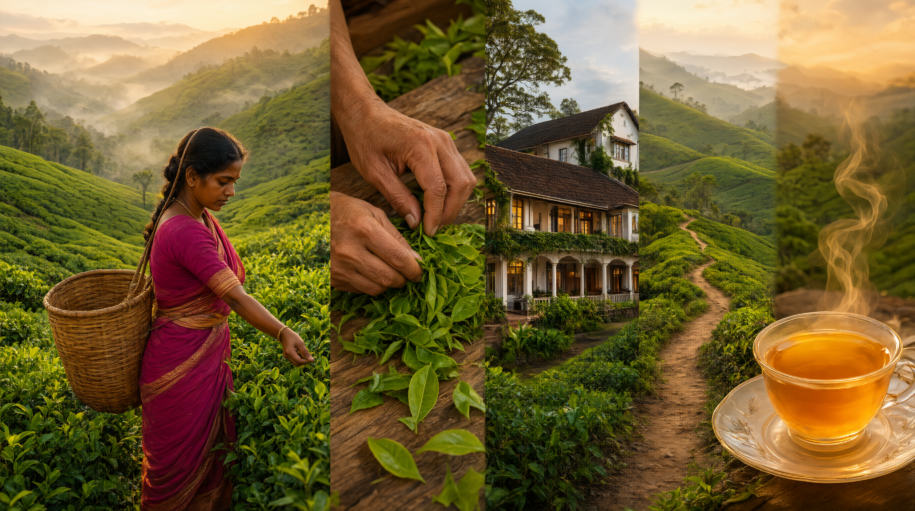
You have probably already seen the photographs. Rows of green tea curving over a mountainside. Mist sitting low in a valley. A woman in a colourful sari plucking leaves with practised hands. And somewhere in the back of your mind, a question: what does it actually feel like to stand in the middle of all that?
This guide covers everything a traveller needs before booking. Which regions suit which kind of trip. What a half-day visit, a full-day immersion and a multi-day estate journey actually look like. What happens inside a working factory. How to taste Ceylon Tea properly. Where to stay. What to pack. How the Pekoe Trail fits into the picture. And how the 2026 Ceylon Tea Village programme is changing what a tea tour can be.
It also goes deeper than logistics. The people who built this industry. The communities still shaping it. The environmental pressures the hills face. And how a traveller’s choices can support the landscape rather than simply pass through it.
Grab a cup. This one takes a while.
What a Tour Actually Looks Like
There is no single format. A tea plantation tour can last two hours or fill an entire week. The right choice depends on how much time sits inside the wider Sri Lanka itinerary, how much walking feels comfortable, and whether the goal is a quick introduction or a genuine immersion.
Here are the three formats that cover most travellers.
The Half-Day Taster
This suits anyone travelling between Kandy and Nuwara Eliya, or between Ella and Haputale, who wants to add tea to an existing route without dedicating an entire day.
The structure is straightforward:
- Transfer to a working estate
- A guided walk through the plantation
- A plucking demonstration, or a chance to try it where permitted
- A factory visit with processing explanations
- A tasting session
- Time to buy tea directly from the estate
Two to three hours, start to finish. Enough to understand how a green leaf becomes the liquid in a cup. Enough to taste the difference between a high-grown Nuwara Eliya brew and something fuller-bodied. Enough to leave with a box of tea that carries a story.
The Full-Day Immersion
This turns tea from a quick stop into a landscape experience.
The day combines a scenic drive through tea country with a dedicated local guide. The itinerary includes a working factory visit, a tasting, a locally prepared lunch, and one or two additional elements: a waterfall stop, a village interaction, a short hike, or a viewpoint that stretches across the hills.
The difference from the half-day format is rhythm. There is time to walk slowly. Time to ask questions. Time to notice how the same plantation looks different after the morning cloud burns off. Time to eat a meal prepared by someone who lives in the valley.
The Multi-Day Estate Journey
This is where tea tourism becomes the trip rather than a stop on the trip.
A two- or three-day version might look like this:
Day 1: Travel from Kandy into the highlands. Stop at a plantation and factory along the way. Check into estate accommodation. Spend the evening surrounded by tea fields.
Day 2: Morning plantation walk. Depending on the estate, this could include plucking, processing, tasting, a local meal, a nature walk or a Pekoe Trail section. The evening belongs to the hills.
Day 3: A morning walk or community experience. Then continue towards Ella, Haputale, or the next destination.
Three nights is often enough to turn tea from an excursion into a theme.
For travellers with five or seven days, several tea regions can be connected. Kandy, Loolecondera, Nuwara Eliya, Hatton, Dimbula, Haputale and Ella each offer a different character. The tea changes. The landscape changes. The journey becomes the lesson.
How Long Should You Stay?
A few hours work when tea is one item on a wider itinerary.
One full day works when tea deserves more than a checklist box.
Two to three days work when the destination matters as much as the activity.
Five days or more work when tea becomes the reason for the trip.
There is no wrong answer. There is only the answer that fits the time available and the kind of traveller doing the asking.
A couple on a romantic escape will slow the pace. A family with young children will keep walks short and hands-on. A hiker will build the trip around the Pekoe Trail. A photographer will chase early morning light. A food lover will pair tastings with local cooking.
The best tea plantation tours match the traveller. They do not force the traveller into a generic mould.
Which Region Suits You?
Sri Lanka’s tea country is not one destination. The island has seven recognised tea-growing regions, and each one feels different.
Choose Nuwara Eliya for the classic experience
High elevation. Cool air. Fragrant, light-bodied tea. Colonial-era architecture. Estate roads that change character every few kilometres. Mist that rolls in without warning.
This is the region most closely associated with the image of Ceylon Tea. It suits first-time visitors who want scenery alongside the story.
Choose Hatton and Dimbula for estate life and walking
Steeper slopes. Reservoirs tucked between mountains. Old plantation roads. Estates generally above 1,250 metres. A landscape that rewards slow walking.
Hatton works well as a base for combining tea with Adam’s Peak, Pekoe Trail stages, or simply two nights of unhurried estate time.
Choose Haputale for drama
A ridge-top town. Estates spilling down both flanks. The climb to Lipton’s Seat at roughly 1,970 metres. Uva tea with its own aromatic signature, shaped by two monsoons.
Photographers and hikers should head here. Early starts matter because cloud builds fast.
Choose Ella for an active base
Lower elevation. Warmer. Buzzing with independent travellers. Short plantation walks, waterfalls, viewpoints, the railway line, and easy access to Uva estates and Pekoe Trail sections.
Ella works best as a base camp. The richest tea experiences sit outside the town itself.
Choose Kandy and Loolecondera for history
This is where commercial Ceylon Tea began. James Taylor’s 1860s planting at Loolecondera is recognised as the birthplace of the industry. Pekoe Trail Stage 2 runs through this landscape, covering approximately 15 kilometres from Galaha.
History buffs and walkers who want context with their kilometres should start here.
Choose the Low Country for something different
Ruhuna and Sabaragamuwa produce darker, fuller teas at lower elevations. The landscape is flatter, hotter, far from the mountain mist. Most international visitors never make it here.
Repeat visitors who have already done the highland circuit will find a refreshingly different side of Ceylon Tea.
What Does It Cost?
There is no single national price for tea plantation tours in Sri Lanka. A two-hour factory stop and a private guided multi-day trek are entirely different products, even if both appear under the label “tea tour.”
Prices vary according to:
- The estate or region
- Duration
- Group size
- Private or shared transport
- Whether a guide is included
- Factory access
- Tasting sessions
- Meals
- Accommodation
- Walking activities
- Community experiences
- Season
Before booking, check exactly what the quoted price covers. Does it include hotel pickup? Estate entry? Factory fees? Transport? Meals? Trail passes? Return transfers?
For private tours, the quality of the vehicle matters. Hill-country roads involve long stretches of winding travel. A comfortable car and an experienced driver make a genuine difference.
The most useful approach: compare what is included, not just the headline number.
A Simple Booking Checklist
Before confirming any tea plantation tour, run through these questions:
Location: Which estate or region is involved?
Duration: How much time is actually spent at the estate?
Factory: Is the factory operating on the chosen date?
Guide: Who leads the experience? Are local guides involved?
Community: Are local hosts or businesses part of the itinerary?
Activities: Plantation walk, factory, tasting, hiking, food?
Transport: Is pickup and return included?
Terrain: How much walking is involved? Is it suitable?
Weather: Is there flexibility if conditions change?
Sustainability: Are environmental claims specific and verifiable?
Photography: What permissions apply for photographing workers?
Trail: If hiking the Pekoe Trail, what is the current official status?
That last question matters particularly in 2026. The Pekoe Trail organisation actively publishes stage-by-stage updates. Conditions change after heavy rain. Always check immediately before departure.
Walking the Pekoe Trail
Some travellers want the plantation from the back of a car. Others want it under their boots. The Pekoe Trail exists for the second kind.
Roughly 300 kilometres of marked route, cut into 22 stages across the Central Highlands, threading past around 80 villages, forests, small towns and working estates.
Tea never travels alone here. Forest reserves, waterfall drops, colonial bungalows, village shrines, cardamom plots and ridge lines that open out without warning all sit inside the same day’s walking.
Why does this matter for tea plantation tours? Because a factory fills an hour. A trail stage fills a day. And the money spent along a trail lands in villages that tour buses never enter.
What the Trail Actually Covers
Stage 2 is the one most often stitched into itineraries, running about 15 kilometres from Galaha down towards Loolecondera, five to six hours on foot. It links the working tea landscape with the estate where commercial Ceylon Tea began.
Other stages suit shorter attention spans and weaker knees. Some drift gently between villages. Others climb properly, and climb back down. Distances, elevations and difficulty vary stage by stage, so matching the stage to the traveller matters far more than chasing the most photographed one.
Timing rules apply too. Most stages run between 6am and 6pm, with shorter windows in certain areas. Trail passes themselves are free, though protected areas and private land can charge separately.
The 2026 Host Programme
This is the part that changes the texture of the walk.
Local residents now receive training in guiding, hospitality, storytelling and first aid, with specialist modules covering tea heritage, tea tasting, biodiversity and traditional food. A map tells a visitor where the path goes. A trained host explains what the path is walking through: why the shade trees stand exactly where they stand, which birds nest in the estate forest, how village income rises and falls across the plucking seasons.
Independent walking has its appeal, and arriving somewhere alone carries a genuine satisfaction of its own. A walk with a host simply adds a layer on top. Navigation becomes understanding.
Before Setting Out
Check the official trail information shortly before departure. Stage statuses change after heavy rain, and at least one section currently carries an amber status following landslide damage, with the trail organisation recommending a check before setting out.
Then sort transport at both ends. A ridge walk loses its charm quickly when the pickup waits at the wrong trailhead three valleys away. A trail pass, a weather window, a return driver, a packed lunch and a waterproof layer make up the entire kit for a happy day.
Ever noticed how the best travel stories rarely begin with the scenery? They usually begin with something going slightly wrong, and being handled well.
Tea Factory Tours Explained
A working factory hits the senses before it hits the brain. The floor vibrates underfoot. The air turns warm and thick, carrying a green, roasted smell that clings to clothes for hours. Machines rattle through grades of leaf in long metal troughs.
Fresh leaf spoils quickly, which is why processing begins almost immediately after plucking. Sri Lanka’s appellation rules add another layer: tea must be manufactured within its growing region to carry that region’s name. The factory is where the hill becomes the product.
The Five Stages
Withering: leaves spread in troughs and lose moisture until they turn pliable.
Rolling or maceration: machinery breaks the cell walls, releasing the juices that start the chemistry.
Oxidation: controlled exposure to air builds colour and aroma, moving the leaf from green towards deep copper.
Drying: hot air halts oxidation and drops moisture to a stable level, locking the flavour in.
Sorting and grading: the finished tea splits into grades and particle sizes, which is precisely why one estate can produce several very different cups.
Watch a plucking basket arrive, then watch it leave as a sealed box, and the entire journey compresses into ninety minutes.
How to Taste Like a Professional
Tasting is the part most visitors fumble. Quiet sipping from a ceramic mug tells almost nothing.
Cupping uses a spoon and a deliberate slurp. Spraying the liquor across the palate lets aroma, body and astringency register all at once, which is why the sound comes out loud and thoroughly impolite. A good line-up puts two regions side by side rather than pouring one cup after another. A delicate high-grown Nuwara Eliya sitting next to a fuller Kandy brew makes the difference obvious within seconds, and no vocabulary required.
Ask for the comparison. It costs nothing and teaches more than an hour of explanation.
So what separates a factory visit from a tea plantation tour that actually sticks in the memory? Time, and someone willing to answer the awkward questions.
Ceylon Tea: Types and Tasting
Black tea dominates. It accounts for the overwhelming share of production and export, and it is what a Sri Lankan means by “plain tea” at a roadside kiosk: black, usually without milk, strong enough to sort out the day before the day has started.
White tea is the collector’s prize. Silver Tips and Golden Tips get hand-plucked, sun-dried, and never rolled or oxidised. The flavour sits at the delicate end of the spectrum and the price reflects the labour behind it. Estates producing it work in small batches, which is exactly why tasting it at source beats reading about it from home.
Green tea and Oolong also grow on the island, holding a smaller, craft-oriented corner of the industry. Finding them means seeking estates that specialise in artisanal batches rather than the biggest factory on the route.
Ceylon Against the World
How does a Sri Lankan cup compare with an Indian one? Immediately, once the palate knows what to listen for.
Assam arrives heavy and malty, built to carry milk and sugar. Darjeeling turns floral and delicate. Ceylon holds the middle with a brightness all its own: a clean citrus edge, a golden colour in the cup, a finish that reads as altitude. Tasting a high-grown Ceylon black next to an Assam CTC is the fastest route to understanding terroir without a single technical term.
Tea Experts and Sommeliers
A standard cultural guide knows the colonial architecture and the James Taylor chapter. A certified tea sommelier or master blender knows oxidation chemistry, grade structures and the micro-climates sitting behind each valley.
Arranging a specialist means booking through an operator with the network to find one, and the pricing reflects that. A standard cultural guide generally runs in the region of $50 to $70 a day. A dedicated tea expert, master blender or sommelier typically starts around $150 and climbs from there, with transport and accommodation added. Training routes in Sri Lanka run through bodies such as the Tea Research Institute, along with the specialist schools attached to major tea houses, and that is where the depth comes from.
Worth it? On a single factory stop, hardly. On a three-day journey across three elevations, it turns the trip from seeing into reading.
Tasting Programs and Cupping
Formal cupping sessions run across tea country and in Colombo. Heritage estates host masterclasses comparing elevations side by side. Community-led estates in Uva run sessions built around single-origin batches. City lounges attached to major brands offer structured tasting menus pairing infusions with food.
Ask for one to be written into the itinerary. A guided cupping compresses a month of trial and error into an hour.
Buying on the Spot
The estate shop beats the airport, and it beats the duty-free trolley by a comfortable margin.
Look for the Pure Ceylon Tea lion logo, certifying the tea was grown, manufactured and packed in Sri Lanka. For Silver Tips and rare single-estate orthodox batches, check that the tin is sealed and authenticated by the estate itself.
Buying direct does two useful things at once. The leaf stays fresher, and the money stays in the valley that grew it.
One question worth asking at the counter: which estate, which elevation, which harvest? A shop answering those three with confidence usually knows its own tea.
Where Regeneration Actually Lives
The word “regenerative” gets thrown around a lot in travel marketing these days. Time to separate the real thing from the brochure language.
Sustainable tourism asks a fairly simple question: how does this trip avoid doing harm? Regenerative tourism pushes further. It asks whether the visit leaves the destination measurably better than before. Better soil. Healthier waterways. Stronger local livelihoods. More intact habitat.
On a tea estate, that philosophy translates into physical things a visitor can see and walk through.
Soil conservation shows up as terracing on steep slopes, ground cover between tea rows, and drainage systems designed to slow rainfall rather than channel it downhill at speed. Tea country terrain is dramatic precisely because it is steep, and steep terrain sheds topsoil fast when poorly managed.
Organic matter management means composting, mulching and building soil biology rather than leaning on synthetic inputs. Some estates are reducing chemical dependence as part of regenerative certification frameworks.
Water management covers how estates handle drainage, infiltration and runoff in high-rainfall hill landscapes. Healthy soil absorbs water. Vegetation and well-designed drains reduce the speed at which it moves.
Biodiversity sits alongside the tea rows rather than being pushed out by them. Shade trees, forest patches, streams and habitat corridors form part of the wider agricultural landscape. Some estates maintain defined conservation areas and monitor specific species within them.
Agroforestry integrates trees and other vegetation into the production system, creating layered landscapes that support both agriculture and wildlife movement.
None of these practices should be assumed simply because an estate uses the word “regenerative.” The details matter, and a good traveller asks for them.
Halgolla: A Working Example
One Sri Lankan estate makes this conversation concrete.
Halgolla Estate in the Kelani Valley region has been associated with biodiversity conservation work for years. In 2024, Kelani Valley Plantations announced that Halgolla had become the world’s first tea estate to receive Regenagri certification for regenerative agriculture. The company also announced an on-estate biodiversity conservation centre and what it calls an “intellectual tourism” concept connected to the estate’s environmental work.
One important distinction to keep in mind. Regenagri certification covers regenerative agricultural practices. It does not automatically certify every tourism activity on the estate. That separation matters when evaluating any operator’s claims.
What makes Halgolla interesting for visitors is the possibility of connecting certified farming practices, biodiversity interpretation and a genuine tea experience within the same landscape. A traveller arrives to learn about tea. The same visit opens into soil health, water management, forest patches and the wider ecosystem holding the plantation together. The cup becomes the final chapter rather than the entire story.
The Ceylon Tea Village Programme
2026 brought a significant national development into this space.
The Sri Lankan government launched the Ceylon Tea Village programme in July 2026, starting with 144 villages and carrying a longer-term target of 500. The programme weaves together sustainable farming, regenerative agriculture training, value addition, producer organisation, social protection and the integration of tourism with tea-growing communities.
The national targets attached to this push are ambitious: 400 million kilograms of annual tea production and US$2.5 billion in tea export earnings by 2030.
For a traveller, the practical significance is this. Tea tourism is moving beyond the estate gate. The destination is expanding to include farms, food, people, culture, nature and community enterprise alongside the factory and the tasting room. That creates opportunities to encounter tea production at household and village scale rather than only at industrial scale.
The programme is still developing. Individual tourism experiences and outcomes should be assessed as they come online. That is precisely what makes 2026 an interesting moment to be planning a visit.
How to Spot Genuine Effort from Glossy Wording
Travellers encounter more sustainability language than ever. A tea estate might describe itself as sustainable, eco-friendly, organic, carbon-conscious, biodiversity-friendly, regenerative or community-focused. Those terms do not all mean the same thing.
Every sustainability claim worth trusting should answer three questions. What is being done? Who verifies it? How is progress measured?
A certification can cover one part of an operation without covering everything. A regenerative agriculture certificate does not automatically extend to tourism operations. An organic label speaks to inputs, not necessarily to community income. Precision builds trust. Vague adjectives signal marketing.
What a Tourist Can Actually Do
Regenerative tourism does not require spending a holiday digging drainage channels. There are far better ways to participate.
Stay longer. A two-night stay gives a rural destination more opportunity to benefit than a rushed stop between major attractions.
Use local guides. A knowledgeable local host provides context that no factory signboard can match, and the payment goes directly into the local economy.
Eat locally. Meals are a significant part of the tourism economy. Choosing locally prepared food keeps spending within the destination.
Buy tea directly where appropriate. Purchasing from reputable estates, factories or certified retailers strengthens the connection between the product and the place.
Respect workers. Ask before taking photographs, particularly close-up portraits. Tea workers are people going about their livelihoods.
Follow trail rules. Stay on marked routes. Respect private estate land and protected areas.
Carry reusable essentials. Mountain trails and rural destinations have limited waste-management capacity compared to cities.
Ask questions. A responsible operator should be comfortable explaining environmental and community programmes in concrete terms.
The most valuable contribution is often simply spending thoughtfully. A traveller does not need to become a volunteer. The tourism economy itself can provide the mechanism for regeneration, as long as the money circulates within the landscape.
The Traveller’s Dollar Becomes Part of the Landscape
Picture two visitors.
The first spends two hours at a factory, buys a packet of tea and leaves. The second spends three nights in tea country, hires a local guide, stays at an estate property, eats local meals, walks a trail with a host, visits a community experience, buys tea and uses local transport.
Both have enjoyed Ceylon Tea. The second journey has simply created more opportunities for value to circulate within the destination.
That is the economic logic behind longer, community-connected tourism. It also explains why slow travel fits tea country so well. The hills reward time. The more time a visitor gives the landscape, the more the landscape gives back.
And that circle of value is exactly what regenerative tea tourism is trying to build.
The People Who Built These Hills
A tea plantation can look almost timeless from a distance. Rows of tea curve around a mountainside. A factory sits among the greenery. A road winds through the estate. The hills disappear into cloud.
Then the human story comes into view, and it changes everything.
How Tea Actually Got Here
The story of Ceylon Tea begins with a disaster.
Coffee had been the major plantation crop in colonial Ceylon. In the 1860s, coffee leaf disease swept through and devastated the plantations. The industry collapsed.
Tea stepped into the gap. James Taylor is closely associated with the beginning of commercial tea cultivation in Sri Lanka, establishing it at Loolecondera in the 1860s. The Central Province Tourism Department identifies Loolecondera as the birthplace of Ceylon Tea and includes the estate in its Ceylon Tea Trail itinerary.
From that single starting point, tea expanded rapidly across the highlands.
The crop also transformed transportation. Railways were built through the central highlands specifically to move tea towards Colombo and the port. Towns such as Hatton, Nanu Oya, Talawakele, Haputale and Badulla grew around the plantation economy.
Ever wondered why the scenic train tracks wind through the steepest parts of the mountains? Those railways were engineered to haul tea down to the coast. Walking through these estates means stepping directly into a landscape shaped by more than 150 years of production, transportation, migration, labour and trade.
The Communities Behind the Crop
The history of Sri Lanka’s tea plantations cannot be separated from the history of the communities who built their lives around plantation work.
Many estate workers are descendants of Indian-origin communities brought to Ceylon during the colonial plantation era. These communities developed their own cultural traditions, religious practices, foodways and social networks within the plantation landscape.
The history after independence was complicated. Sri Lanka’s Citizenship Act of 1948 and the Indian and Pakistani Residents (Citizenship) Act of 1949 affected the legal status of many people of Indian origin living in the country. Subsequent agreements and legislation shaped the citizenship situation over the following decades.
Today, the communities associated with the plantations form an important part of the cultural landscape of Sri Lanka’s central hills. Their story deserves space in tea tourism. That does not mean turning difficult history into a tourist attraction. It means giving visitors enough context to understand why the people they meet, the houses they see, the languages they hear, the food they eat and the traditions they encounter are part of a much larger historical journey.
A good local guide can bring that history to life in a way that no factory display can.
The Hands That Do the Picking
Walk through a tea estate during harvesting and one of the most visible features of plantation life becomes clear. Women have historically played a major role in tea plucking.
The International Labour Organization has described tea as a major employer of women in Sri Lanka and has highlighted gender-related challenges within the sector. This makes the design of visitor experiences particularly important.
Tea workers should never become scenery. Visitors should be able to learn about their work without disrupting it. Good practice includes asking permission before taking close-up photographs, following estate rules, avoiding blocking workers or slowing harvesting, listening when workers choose to share their experiences, and using trained local guides for interpretation.
A respectful interaction is usually more memorable anyway. The goal is to understand the work, not simply reproduce a photograph.
The Numbers Behind the Industry
Tea is one of Sri Lanka’s major agricultural industries and an important source of rural employment. The International Labour Organization estimates that more than 2.5 million people are connected to the tea sector.
Smallholders cultivate about 60% of the country’s tea land and account for more than 70% of production. Regional Plantation Companies employ around 115,000 workers on large estates, while more than one million people live on those plantations, including family members, dependants and people working outside the tea industry.
Those numbers change how a tea plantation tour can be understood. The tea landscape is also a workplace, a home, an agricultural system and a community. Learning that story adds another layer to the journey.
Smallholders Matter
Sri Lanka’s tea story is often told through grand estates and colonial-era factories. There is another side to it.
Almost half a million smallholders were estimated by the ILO to produce around 70% of Sri Lanka’s tea in its 2018 assessment. Smallholder farms are generally household-operated, and many are much smaller than the large estates associated with traditional plantation tourism.
This matters for tourism because a tea experience does not have to begin with a giant plantation. A visitor can encounter tea through smaller farms, village businesses, local guides, community food, homestays and producer-led experiences.
That creates a wider tourism map and a wider economic opportunity. When tourism is designed well, spending can reach farmers, estate workers, local guides, drivers, small accommodation providers, home-based food businesses, craft producers, community enterprises, local shops, tea producers and retailers.
The more locally connected the experience, the more opportunities exist for visitor spending to circulate within the destination. That is one of the central ideas behind community-based tourism Sri Lanka.
The Labour Question
Tea is beautiful. Tea production is hard work.
The industry faces challenges around labour availability, an ageing workforce, production costs and the attractiveness of plantation work to younger generations. The ILO has highlighted labour shortages and the declining interest of young people in entering the industry as important issues for the future.
Tourism cannot solve all of these challenges. It can create additional opportunities. A young person living in tea country may have skills that translate into guiding, hospitality, food preparation, photography, transport, interpretation, trail services, digital marketing, tea tasting, heritage experiences or nature tourism.
That can broaden the economic possibilities available within the community. A tea-growing village with several income streams may be more resilient than one dependent on a single activity.
Climate Adds Urgency
Sri Lanka’s tea industry is particularly exposed to environmental conditions because tea is an agricultural crop grown across varied elevations and climates. Rainfall patterns, temperature, extreme weather, soil conditions and water availability can all affect productivity.
The vulnerability is not theoretical. The December 2025 Cyclone Ditwah disaster caused severe flooding and landslides in parts of Sri Lanka’s central regions, where many tea plantations are located. The ILO estimated that up to 374,000 workers were in directly affected areas and reported preliminary estimates that tea-industry output losses could reach 35%, with smallholder farmers disproportionately affected because they account for about 70% of sector output.
For tea-country tourism, this reinforces the importance of resilient infrastructure, careful trail management, emergency planning and flexible itineraries. For regenerative agriculture, it reinforces the value of building landscapes that can withstand environmental stress.
The two conversations increasingly meet. And a traveller who understands that context walks through the hills differently.
Tea Tourism Around the World
Sri Lanka does not exist in a vacuum. The global appetite for agricultural travel is surging, and looking at other regions highlights exactly what makes the Ceylon experience so unique.
India: Assam and Darjeeling pair tea gardens with heritage bungalows and colonial-era golf courses. The cross-border tea culture is expanding rapidly right now. In August 2026, Sri Lanka’s Dilmah launched its Thambapanni luxury collection exclusively for the Indian market, alongside plans for premium tea bars across the country.
Kenya: Promotes massive agrotourism operations in Kericho, focusing on the sheer scale of production and climate-smart innovations like purple tea cultivation.
Japan: Offers highly structured, intimate green tea homestays in places like Wazuka, where visitors learn the meticulous art of matcha preparation.
China: Secured UNESCO World Heritage status in 2023 for the ancient tea forests of Jingmai Mountain, protecting centuries-old cultivation traditions of the Blang and Dai peoples.
Sri Lanka’s distinct advantage lies in its compact geography. You can trace the entire history of the crop, walk through wildly different microclimates, and interact with deeply rooted local communities, all within a few hours’ drive. The island packs an entire world of tea into one remarkably accessible destination.
The UNESCO Conversation
Sri Lanka’s Tea Cultural Landscape currently sits on the national UNESCO Tentative List. It is not yet a fully inscribed World Heritage Site, but the nomination recognizes the plantations, historic infrastructure, and communities as a single, interconnected cultural system.
This places Ceylon Tea in the same global conversation as Jingmai Mountain. The core message is simple: the landscape itself is the heritage, and protecting it is non-negotiable.
What Happens by 2030?
The Sri Lankan government has set aggressive targets: 400 million kilograms of annual tea production and US$2.5 billion in export earnings by 2030. The 2026 Ceylon Tea Village programme and the expansion of the Pekoe Trail are the engines driving this vision.
Young people in the highlands are finding new reasons to stay. Instead of leaving for Colombo, a new generation is turning local knowledge into professions. They are becoming trail hosts, biodiversity interpreters, and specialty tea tasters. Tourism is creating economic pathways that keep the next generation rooted in the landscape.
The Landscape Behind the Cup
A factory tour explains how tea is made. A journey through the highlands explains why it matters.
The most rewarding trips happen when visitors stop rushing. A two-hour factory hop checks a box. A three-night estate stay changes your perspective. You wake up to the mist. You watch the pluckers head out at dawn. You eat food grown in the valley below. Your tourist dollar stops being a simple transaction and becomes a vital thread in the local economy.
That is the real promise of regenerative travel. It is not about turning a holiday into an agricultural workshop. It is about spending thoughtfully. It is about choosing operators who can answer exactly where your money goes, which soil conservation projects your visit supports, and how the community benefits.
The hills reward time. The slower the pace, the deeper the story becomes.
Plan Your Tea Country Journey
Sri Lanka already possesses an extraordinary advantage. The tea is globally recognized. The highland scenery is dramatic. The history runs deep. The challenge has always been connecting those pieces thoughtfully.
That is exactly where a well-designed itinerary steps in.
Whether the goal is a romantic weekend in a colonial bungalow, a week-long hiking expedition across the Pekoe Trail, or a deep dive into the smallholder farms of the 2026 Ceylon Tea Village programme, the foundation is already here. The next step is simply stitching it together.
Reach out to start building a tea country journey that goes far beyond the factory floor. The landscape is waiting.
Frequently Asked Questions
What is the best region for a first-time tea plantation tour?
Nuwara Eliya offers the classic highland experience with cool weather, scenic estates, and easy access to working factories. Haputale and Ella are better suited for hikers and those seeking dramatic mountain viewpoints.
Can tourists actually pick tea leaves in Sri Lanka?
Many estates allow supervised plucking demonstrations. Visitors should always follow the estate’s instructions, avoid disrupting the workers’ daily quotas, and ask permission before taking close-up photographs.
Is the Pekoe Trail safe for independent walkers?
The trail is well-marked, but mountain weather and terrain change rapidly. Checking the official 2026 live stage updates is essential. Hiring a certified local host through the Host Programme is highly recommended for safety, navigation, and cultural context.
What does regenerative tea tourism actually mean?
It is an approach where travel actively supports soil health, biodiversity, and local livelihoods. Rather than just minimizing harm, regenerative estates use tourism revenue to fund conservation, organic composting, and community enterprises.
How many days are needed for a proper tea country trip?
A single day covers the basic factory and tasting experience. However, three to five days allow for estate stays, Pekoe Trail hiking, and immersive village interactions that reveal the true depth of the highlands.
Is Sri Lanka’s tea landscape a UNESCO World Heritage Site?
Not yet. The Sri Lankan Tea Cultural Landscape is currently on the national UNESCO Tentative List, recognizing its historical and cultural significance while the formal inscription process continues.
How much does a private tea sommelier or expert guide cost?
While a standard cultural guide typically costs between $50 and $70 a day, a certified tea sommelier or master blender usually starts around $150 to $250 a day, plus transport and accommodation.
What is the Ceylon Tea Village programme?
Launched in July 2026, this national initiative integrates sustainable farming, social protection, and tourism into smallholder communities. It starts with 144 villages and aims to scale to 500, ensuring tourism revenue directly supports the families growing the tea.