
The Short Version
Rameswaram to Sri Lanka is a journey stitched together by mythology, shallow seas, and five ancient Shiva temples. Ram Setu, a 48-kilometre chain of limestone shoals, connects Dhanushkodi on India’s tip to Mannar on Sri Lanka’s northwest coast. On the Sri Lankan side, the Pancha Ishwarams and over 50 Ramayana-linked sites stretch from Jaffna down to Ella. As of 2026, a regular commercial ferry between Rameswaram and Talaimannar is still in the works, so most travellers fly or take the Chennai-Jaffna route. Indian passport holders get a free 30-day double-entry ETA. The full cross-border trail takes about 8 to 10 days. Scroll down for the temples, the stories, the logistics, and an itinerary that actually works.
The Bridge Between Two Worlds
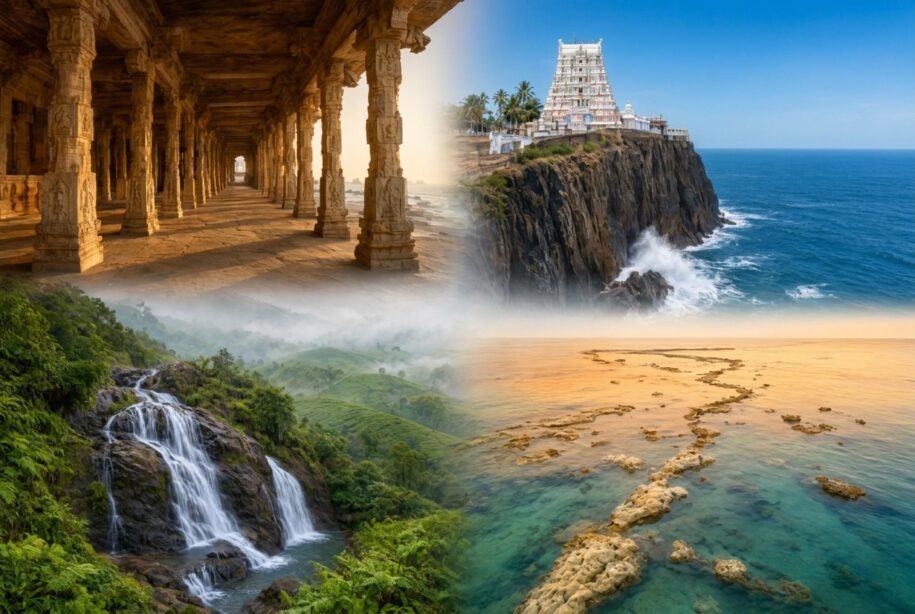
Stand at Dhanushkodi on a clear evening, and you’ll see it. A thin ribbon of sand and shallow water stretching southeast, dissolving into the blue where the Gulf of Mannar meets the Indian Ocean. That’s Ram Setu. Also called Adam’s Bridge. Forty-eight kilometres of limestone shoals, sandbanks, and small islets linking Rameswaram in Tamil Nadu to Mannar Island in Sri Lanka.
For millions across South Asia, this strip of shallows is the bridge Lord Rama’s army of vanaras built from floating stones, so he could cross the ocean and rescue Sita from Ravana’s Lanka. For geologists, it’s a natural tombolo, a chain of sediment deposits shaped by currents over millennia. For the traveller standing at the water’s edge with salt on their lips and wind in their hair, it’s the place where a story you grew up hearing suddenly turns into something you can point at.
The Archaeological Survey of India has, in past reports, classified the formation as natural. Underwater exploration projects approved in recent years continue to study the age and composition of the shoals. As of early 2026, an RTI filing revealed that Ram Setu does not yet appear on the ASI’s protected heritage register, despite recurring political promises to grant it that status. The debate is far from settled, and honestly, that’s part of what makes standing here feel electric. You’re looking at something that science, faith, and history all want to claim.
What matters for you as a traveller is this. Rameswaram to Sri Lanka is a route that has drawn pilgrims, traders, and storytellers for over two thousand years. The Palk Strait at its narrowest is barely 30 kilometres wide. The water between Dhanushkodi and Talaimannar is so shallow in places that you can see the seabed. The connection is not abstract. It’s right there, glittering under the sun.
And on the other side of those shallows? Five ancient Shiva temples, a trail of Ramayana sites, and a story that keeps unfolding.
Ramanathaswamy: Where It All Begins
Every Rameswaram to Sri Lanka journey starts at the Ramanathaswamy Temple. Not because of some tourism board directive. Because for centuries, pilgrims have believed that Rama himself paused here, prayed to Shiva, and sought forgiveness before stepping onto the bridge.
The temple is one of the twelve Jyotirlingas in India, which already makes it a heavyweight in the Shaivite world. But what sets it apart architecturally is sheer scale. The corridors run longer than any other temple in Asia. Over 1,200 granite pillars line the hallways, each one carved with figures of deities, dancers, and mythical creatures. The outer corridor alone stretches nearly 1,200 metres. Walking it barefoot on cool stone, with oil lamps flickering in alcoves, is an experience that slows your pulse whether you want it to or not.
Here’s the detail most guidebooks gloss over. There are two Shiva Lingams inside the sanctum.
The first, called the Ramalingam, is said to have been shaped by Sita’s own hands from sand, because Hanuman delayed bringing one from Kailash. The second, the Vishwalingam, is the one Hanuman finally carried back from the Himalayas. To honour Hanuman’s effort, temple tradition dictates that the Vishwalingam receives worship first, even though the Ramalingam is the principal deity. Two lingams, one story about patience, devotion, and keeping your word.
Before you head toward the Sri Lankan side of the trail, there’s a ritual worth knowing about. Pilgrims traditionally bathe in Agni Theertham, the sea in front of the temple, and then in the sacred wells inside the complex. There are 22 such wells, each said to carry a different taste. Locals will tell you the water changes from sweet to salty to bitter depending on which well you draw from. Go ahead and test that claim. It’s a small, sensory moment that grounds you before the bigger journey.
The temple opens around 5 in the morning for the first darshan. If you can make it for the early aarti, do. The chanting reverberates off those long corridors in a way that photographs simply cannot capture.
From here, the trail turns southeast, toward the water, and toward Lanka.
Five Abodes of Shiva
Cross into Sri Lanka, and the Shiva story doesn’t fade. It multiplies.
The Pancha Ishwarams are five ancient coastal temples dedicated to Lord Shiva, positioned roughly at the cardinal points of the island. Their origins stretch back well over a thousand years, with patronage from Chola, Pandya, and local Tamil kings. Ravana himself, the central figure of the Lanka chapters in the Ramayana, is described in tradition as a devoted Shaivite. Several of these temples are linked to his reign and his worship.
What’s striking about the Pancha Ishwarams is their placement. Each one sits near the coast, as if Shiva stands guard over the island’s edges. For a traveller tracing Rameswaram to Sri Lanka, these five temples form the backbone of the spiritual itinerary.
Let’s walk through them, one by one.
Naguleswaram, Jaffna
The northernmost of the five. It sits at Keerimalai, a rocky outcrop where freshwater springs bubble up from the earth and meet the sea.
The legend here is charming. A mongoose, cursed into a disfigured form, is said to have been healed after bathing in these springs and praying to Shiva. The name Keerimalai loosely translates to “mongoose hill,” and the spring complex still draws visitors who come to soak in the mineral-rich water. Locals swear by its healing properties.
The temple itself was damaged during Sri Lanka’s civil conflict and has undergone restoration in the years since. The current structure is modest compared to what ancient texts describe, but the setting makes up for it. You’re standing at the northern tip of the island, with the Palk Strait shimmering to your left and a sacred spring at your feet. It feels like the edge of a map.
A practical note. Jaffna is about a four-hour drive from Mannar, so most Rameswaram to Sri Lanka itineraries hit Naguleswaram on day two or three of the Sri Lankan leg. The Nallur Kandaswamy Kovil, one of the most vibrant Hindu temples on the island, is a short drive from here and pairs well with the visit.
Ketheeswaram, Mannar
This is the Pancha Ishwaram closest to Rameswaram. Geographically, spiritually, and emotionally.
Ketheeswaram sits on the northwestern coast, staring across the Gulf of Mannar toward Dhanushkodi. If you stand at the temple’s outer wall on a clear day, you can almost sense the Indian coastline pulling at the horizon. Tradition holds that this is the hometown of Mandodari, Ravana’s queen. The temple was buried under sand dunes for centuries, forgotten, before excavation efforts brought its foundations back to light.
The current structure is a reconstruction, but the sanctity of the site is untouched. Pilgrims arriving from the Rameswaram side often make Ketheeswaram their first stop in Sri Lanka. It feels like a continuation of the prayer they started at Ramanathaswamy, just across a narrow stretch of sea.
Mannar town itself is quiet, dusty, and unhurried. The Dutch-era Doric Bungalow sits nearby, a crumbling colonial relic that adds an odd, beautiful contrast to the ancient temple. Give yourself half a day here. You won’t need more, but you’ll want every minute of it.
Koneswaram, Trincomalee
Now we move to the eastern coast, and the tone shifts.
Koneswaram perches atop Swami Rock, a sheer cliff that drops about 400 feet straight into the Indian Ocean. The view from the top is staggering. You get the full sweep of Trincomalee’s natural harbour, one of the finest deep-water harbours in the world, stretching out below you.
Historically, this was a massive temple complex. Ancient inscriptions and Tamil literary sources describe a “thousand-pillared” temple built and expanded by Chola and Pandya rulers. In 1624, Portuguese colonial forces dismantled much of the structure, hurling pillars and sculptures into the sea. For centuries, fragments lay on the ocean floor. In the twentieth century, underwater recovery efforts retrieved some of these stones, and the temple was rebuilt using what could be salvaged.
Today, Koneswaram is a functioning temple with a devoted local following. The drive up to Swami Rock passes through Fort Frederick, a British-era military installation. You’ll need to pass a security checkpoint. Keep your ID handy and your camera ready, because the view from the top is the kind that makes you forget you’re holding a phone.
A fun detail for the Ramayana-minded. Local tradition connects Koneswaram to Ravana’s devotion. Some accounts say he carved a Shiva Lingam here. Whether you take the legend literally or as metaphor, the devotion embedded in this cliff-top shrine is palpable.
Munneswaram, Chilaw
Heading south along the western coast, the trail brings you to Munneswaram, near the town of Chilaw.
This is where the Ramayana connection tightens its grip. Legend says that after Rama defeated Ravana in battle, he was burdened with Brahmahatti Dosham, the sin of killing a Brahmin. Ravana, for all his flaws and fury, was a Brahmin king and a learned scholar. To cleanse himself of this sin, Rama is said to have stopped at Munneswaram and prayed to Shiva before continuing his journey home.
The temple complex is spread across several acres and includes shrines to Shiva, Vishnu, Ganesha, and Kali, along with a Buddhist temple within the same compound. That coexistence, Hindu kovil and Buddhist vihare sharing a boundary wall, is a lovely reminder of how Sri Lanka’s spiritual landscape has always been layered.
Munneswaram is roughly 80 kilometres north of Colombo, making it a natural final stop before heading to the airport. If your Rameswaram to Sri Lanka trip is ending in Colombo, slot this in on your last full day. The evening puja here has a grounded, village-temple warmth that makes for a gentle close to the journey.
Thondeswaram, the Southern Anchor
The fifth Ishwaram is the most debated of the five. Ancient texts reference Thondeswaram as the southernmost Shiva shrine on the island. Some scholars place it near Galle. Others point to the Mantota area in the north-west. What’s consistent across sources is that it existed, it was ancient, and it anchored the southern end of the Pancha Ishwaram grid.
For the modern traveller, Thondeswaram doesn’t have a single, clearly marked temple you can walk into the way you can with the other four. But its place in the Pancha Ishwaram framework matters. It completes the geometry. Five points, five directions, Shiva watching over the island from every edge.
If you’re the kind of traveller who likes to tick every box, the Mantota region and the Galle coast both carry echoes of this legacy. The Galle Fort area, while dominated by Dutch and Portuguese colonial history, sits in a region where older Shaivite worship once thrived. A quiet acknowledgement is enough.
Walking the Ramayana Trail
Leaving the coast behind, the route climbs into the central highlands. The air turns cool. Tea estates blanket the hillsides in electric green. This is where the Ramayana Trail Sri Lanka shifts from tales of war to tales of captivity, longing, and rescue. Over 50 sites are linked to the epic, but a handful carry the real emotional weight of the story.
Seetha Amman and Ashok Vatika
Nestled in a valley near Nuwara Eliya, the Seetha Amman Temple is unique. It is the only temple on the island dedicated entirely to Goddess Sita. A cold, clear stream runs right past the shrine. Legend says Sita bathed in these waters during her captivity.
A short walk from the temple takes you to the Hakgala Rock Garden, widely believed to be the site of Ashok Vatika. This is the grove where Ravana kept Sita confined. The landscape here is wild, moody, and breathtaking. Locals point to strange depressions in the rock face near the stream, claiming they are the footprints of Hanuman. The sheer size of the rocks in the area makes the legend of a giant monkey army feel strangely plausible.
Divurumpola and the Trial by Fire
Heading toward the Uva province, you hit a small, unassuming stupa site called Divurumpola. The name translates roughly to “Place of Oath.”
This is the spot where Sita underwent the Agni Pariksha, the trial by fire, to prove her purity before returning to Ayodhya. The shrine is quiet. Pilgrims leave lotus flowers on the steps. Standing here, surrounded by paddy fields and distant mountains, you feel the gravity of her decision. It is a heavy, grounded spot that leaves most visitors lost in thought.
Ravana Falls and the Cave Network
Near the popular backpacker town of Ella, the Ravana Falls plunge 25 metres down a rocky cliff face. The mist hits your face from fifty yards away. During the rainy season, the roar of the water drowns out all conversation.
But the waterfall is just the entrance. Behind it lies the Ravana Cave network. These tunnels stretch for miles, connecting to other parts of the country like Dambulla and Sigiriya. Archaeologists acknowledge these are natural cave systems, but local lore insists Ravana expanded them. He is remembered here not just as a demon king, but as a brilliant engineer, a master of aviation who flew a vimana, and a ruler who built a subterranean highway to move his armies unseen. Walking into the cool, dark mouth of the main cave, it is easy to see why the myths stuck.
Kelaniya and the New King
Bringing the trail back down toward the western coast, the Kelaniya Raja Maha Vihara sits just outside Colombo. While primarily a Buddhist temple, its Ramayana connection is foundational.
This is where Lakshmana crowned Vibhishana, Ravana’s righteous brother, as the new king of Lanka after the war. The temple walls are covered in stunning murals depicting the epic, blending Hindu mythology with Buddhist reverence. It serves as the perfect spiritual bookend to the journey. The war is over. Order is restored. The story comes full circle.
Getting There in 2026
Planning a cross-border trip used to mean drowning in paperwork and unpredictable boat schedules. The landscape for a Rameswaram to Sri Lanka transit has shifted dramatically this year, making the logistics much smoother.
The Visa Revolution
The biggest game-changer arrived on May 25, 2026. Indian passport holders, along with citizens from 39 other countries, are now eligible for a free 30-day double-entry tourist Electronic Travel Authorisation (ETA).
This removes the old visa fee entirely. A double-entry permit is a massive win for the Ramayana trail. You can fly into Colombo, do a loop around the island, and pop back into the capital for your international flight home without paying a second visa fee. You just need to apply online before departure through the official government portal.
The Ferry Situation
Everyone asks about the Rameswaram Sri Lanka ferry. The historic 18-mile route connecting Rameswaram to Talaimannar was suspended decades ago due to the civil war.
As of late 2026, a regular commercial passenger service on this specific route is still in the advanced discussion phase between the two governments. The push to restore it is strong, aimed at boosting local economies and religious tourism, but it is not running a daily schedule yet.
There is an intermittent high-speed passenger ferry running between Chennai and Jaffna. It operates based on weather conditions and bilateral clearances. If you want the sea crossing experience, the Chennai route is your current option. Otherwise, most travellers opt for the speed and reliability of flights.
Flights and Land Transits
The most seamless way to execute this itinerary is a quick flight. Airlines operate frequent, short hops from Madurai, Trichy, and Chennai directly into Bandaranaike International Airport in Colombo. The flight takes about an hour.
Once you land in Colombo, hiring a private vehicle through a local DMC is the only way to tackle the trail efficiently. The roads to Jaffna and Trincomalee are well-paved now, but public transport between these specific temple towns is fragmented. A dedicated driver turns a logistical headache into a scenic road trip.
A 9-Day Itinerary That Works
Trying to cram the Pancha Ishwarams and the Ramayana sites into a standard one-week holiday usually results in exhaustion. A nine-day framework gives you the breathing room to actually absorb the sites. Here is a road-tested route that balances driving, worship, and rest.
Day 1: Arrival in Rameswaram
Arrive in Madurai and drive down to Rameswaram. Spend the evening at the Ramanathaswamy temple. Walk the outer corridors. Take in the scale of the architecture.
Day 2: Dhanushkodi and the Crossing
Take an early morning local jeep to Dhanushkodi. Stand at the edge of the land, look out over Ram Setu, and feel the geography of the epic. In the afternoon, head to the Madurai airport and fly to Colombo. Your driver meets you at arrivals and takes you straight to Mannar for the night.
Day 3: The Northern Ishwarams
Start with the Ketheeswaram temple in Mannar. It is the closest spiritual link to Rameswaram. Later, drive up the Jaffna peninsula. Visit the Keerimalai springs and the Naguleswaram temple. Catch the evening puja at the Nallur Kandaswamy Kovil before sleeping in Jaffna.
Day 4: The Eastern Cliff
Drive across the island to the eastern coast. The journey takes a few hours, but the scenery changes from dry plains to lush coastal forests. Arrive in Trincomalee in the afternoon. Head straight up Swami Rock to the Koneswaram temple for sunset. The view of the ocean from 400 feet up is unmatched.
Day 5: The Cultural Triangle
Leave the coast and drive inland toward Kandy. Break the journey at the Dambulla Cave Temple, a UNESCO site with incredible ancient frescoes. Arrive in Kandy by evening. Walk around the lake, visit the Temple of the Tooth, and rest your legs.
Day 6: Into the Highlands
Drive up into the hill country to Nuwara Eliya. The temperature drops noticeably. Visit the Seetha Amman temple and walk the grounds of Hakgala Gardens, exploring the remnants of Ashok Vatika. Enjoy a cup of strong Ceylon tea at a local plantation.
Day 7: Waterfalls and Vows
Head toward the Ella and Welimada region. Stop at Divurumpola to pay respects at the site of the trial by fire. Continue to Ravana Falls. Hike up to the cave entrances. The mist from the falls provides a perfect cool-down before a quiet evening in the hills.
Day 8: The Western Anchor
Begin the descent back to the western coast. Drive to Chilaw and visit the Munneswaram temple, the site of Rama’s final prayer for absolution. Continue down the coastal highway to Colombo. Enjoy a final dinner in the city, reflecting on the sheer variety of the landscape you just crossed.
Day 9: The Coronation and Departure
Spend your last morning at the Kelaniya Raja Maha Vihara. View the murals depicting Vibhishana’s coronation. Head to the airport for your flight home, carrying the stories of the trail back with you.
Stories Worth Telling Over Dinner
Every sacred site comes wrapped in a tale, and the best part of the Rameswaram to Sri Lanka trail is swapping these stories with fellow travellers over a plate of hoppers or a strong cup of filter coffee. Here are a few that hit different when you are standing right where they supposedly happened.
Hanuman’s Leap
The most famous crossing in the Ramayana belongs to Hanuman. Tasked with finding Sita, he stood on the southern tip of India, expanded his body to the size of a mountain, and leapt across the ocean to Lanka. Mid-flight, he encountered obstacles. A mountain tried to rise from the sea to block his path. A serpent goddess tried to swallow him. He outsmarted both, landed on the shores of Lanka, and shrank back down to the size of a cat to scout the city unseen.
When you stand at Dhanushkodi looking across the water, try to picture that leap. Thirty kilometres of open ocean. One jump. The sheer audacity of the image is why Hanuman remains the most beloved figure in the entire epic.
The Floating Stones
The vanara army needed to build a bridge fast. The solution was stones inscribed with Rama’s name, which floated on water instead of sinking. Nala and Nila, the chief architects, directed the operation. Squirrels helped too, rolling in sand and shaking it onto the bridge to fill the gaps between the larger rocks. Rama, grateful for their tiny effort, stroked their backs. The three stripes on a squirrel’s spine are said to be his fingerprints.
Next time you spot a squirrel darting across a temple courtyard in Rameswaram or Mannar, look for those stripes. The detail is small, but it grounds the myth in something you can actually see.
Ravana’s Devotion
Here is a twist that surprises first-time visitors. Ravana is not remembered in Sri Lanka the way he is remembered in India. Locally, he is often viewed as a complex, brilliant ruler. A devout Shaivite. A master of the veena. A physician who authored medical texts. A king who built a flying chariot called the Dandu Monara.
The Pancha Ishwarams exist partly because of his patronage. At Koneswaram, some traditions hold that Ravana himself carved a lingam. At Ketheeswaram, his queen Mandodari is said to have worshipped. Walking these temples, you get a sense of a ruler who was fierce in battle but tender in prayer. That duality makes the Ramayana feel more human, more layered, more worth discussing.
The Mangoose and the Mongoose
Back at Naguleswaram in Jaffna, the legend takes a lighter turn. A sage was cursed and transformed into a mangoose. He prayed to Shiva and bathed in the freshwater spring at Keerimalai, which restored his human form. A mongoose, witnessing this miracle, also took a dip and was elevated to divine status.
The spring is still there. The water is cold, mineral-heavy, and oddly refreshing after a long drive. Pilgrims still bathe here, especially during the new moon, hoping the water carries a fraction of that old healing power. Whether you believe in the curse or not, dunking your feet in Keerimalai after a dusty day on the road feels genuinely restorative.
Sita’s Footprints
At the Seetha Amman temple near Hakgala, there are circular depressions carved into the rock face beside the stream. Locals call them Sita’s footprints. Some say they mark where she stood while bathing. Others say they appeared where she stamped her foot in frustration during her long captivity.
Children press their own feet into the depressions, comparing sizes. Elders bow and touch the stone. It is one of those small, tactile details that turns a temple visit into a memory you carry home.
Tips Before You Pack
The Rameswaram to Sri Lanka trail spans two countries, two climates, and a lot of barefoot temple floors. A little preparation saves you from uncomfortable surprises. Here is what actually matters.
When to Go
October through March is the sweet spot. The northeast monsoon has settled, the seas around the Palk Strait are calmer, and the hill country is cool and green. Avoid May through August if you can. The Yala monsoon hammers the eastern and northern coasts, which means Koneswaram and Naguleswaram get lashed with rain and the roads to Ravana Falls get slippery.
What to Wear
Temple dress codes are strict on both sides of the strait. Shoulders and knees must be covered. Carry a lightweight cotton scarf or shawl. It doubles as a head cover, a shoulder wrap, and a barrier against the sun. Men should know that at several ancient kovils, you must remove your shirt before entering the inner sanctum. A clean vest or undershirt underneath keeps things comfortable.
Footwear matters. You will be walking barefoot on stone floors that can get blazing hot by midday, especially at Ramanathaswamy and Koneswaram. Leave your sandals at the temple entrance if required, but keep a pair of easily removable slip-ons for the walk between sites.
Photography Rules
Never photograph the inner sanctum of a Shiva temple unless a priest explicitly allows it. At Buddhist sites like Kelaniya, do not turn your back to a Buddha statue for a photo. It is considered deeply disrespectful and can get you in genuine trouble with local authorities. At Ravana Falls, the rocks are wet and mossy. A good grip on your phone matters more than the perfect angle.
Money and Payments
The Sri Lankan Rupee is the local currency. As of 2026, digital payments have improved significantly in Colombo, Kandy, and Nuwara Eliya. However, the northern towns of Mannar and Jaffna still run heavily on cash. Withdraw a healthy amount of LKR before heading north. Indian Rupees are not accepted at Sri Lankan shops, so sort your exchange in Colombo or at the airport.
Scams to Dodge
At Ravana Falls and the Dambulla area, unofficial guides may approach you offering “secret cave tunnels” or “hidden meditation spots” for a fee. Politely decline. Stick to the marked paths and licensed guides arranged through your tour operator. At Rameswaram, be cautious of individuals offering “special darshan shortcuts” for cash. The temple has an official queue system, and skipping it through unofficial channels can land you in a messy situation.
Health and Hydration
The coastal stretches around Mannar and Trincomalee get intensely hot and humid. Carry at least two litres of water per person during temple-hopping days. The hill country is cooler, but the winding roads to Nuwara Eliya and Ella can trigger motion sickness. Keep some ginger candy or anti-nausea tablets handy if you are sensitive to long drives.
For Tour Operators and B2B Partners
If you are reading this from the operations side, the Rameswaram to Sri Lanka corridor is shaping up to be one of the highest-potential religious tourism products in the region. Here is where the opportunity sits and how to build around it.
The 2026 ETA Advantage
The free 30-day double-entry ETA for Indian nationals is a conversion catalyst. It removes the psychological and financial friction of applying for a visa. For Indian travellers who treat Rameswaram as a standalone domestic pilgrimage, the cost barrier was the single biggest reason they never extended the trip across the strait. That barrier is gone. Package pricing can now absorb the flight cost without the visa markup, making the Rameswaram to Sri Lanka pitch significantly easier to close.
Audience Segments
The trail attracts three distinct buyer profiles, and your marketing should speak to each one differently.
The Devout Pilgrim (50+): Focused on darshan, ancestral rites, and temple rituals. They want comfortable coaches, early morning temple slots, Ayurvedic wellness add-ons, and minimal hiking. Sell them the Pancha Ishwarams and the spiritual continuity from Ramanathaswamy to Ketheeswaram.
The Mythology Enthusiast (25-40): Drawn by Ram Setu debates, ancient engineering theories, and the Ramayana’s narrative arc. They want Ravana Falls, the cave networks, and the story of Hanuman’s leap. Sell them the adventure and the mystery.
The Multi-Generational Family: Grandparents want the temples. Parents want the logistics handled. Kids want the waterfalls and the wildlife. Sell them a blended itinerary where every age group gets a highlight.
Package Architecture
The most sellable structure is a 7 to 10-day dual-country package. Start in Rameswaram, fly to Colombo, and run the Sri Lankan loop. Partner with Indian DMCs in Tamil Nadu for the Rameswaram leg. Offer a seamless handoff at the airport.
High-margin add-ons include private vehicle hire across the Sri Lankan loop, Ayurvedic treatment sessions in Jaffna or Trincomalee, and a dedicated temple priest for guided puja rituals at the Pancha Ishwarams. The private vehicle segment is particularly lucrative because public transport between Mannar, Trincomalee, and the hill country is limited.
Operational Considerations
The northern and eastern roads have improved dramatically, but fuel availability and driver accommodation in Mannar and Jaffna still require advance booking. Secure your fleet contracts early. Build relationships with hoteliers in Trincomalee and Nuwara Eliya for group rates, as these two destinations see the highest seasonal demand.
The Chennai-Jaffna ferry remains an option for operators wanting to offer a sea-crossing experience, but build in a buffer day for weather-related cancellations. Do not sell the ferry as a guaranteed daily departure. Position it as an occasional, weather-dependent alternative to flying.
Frequently Asked Questions
Can you travel from Rameswaram to Sri Lanka by ferry?
As of 2026, a regular commercial ferry service between Rameswaram and Talaimannar is not yet operational. The two governments are in advanced discussions to revive the route. The Chennai-Jaffna high-speed ferry operates intermittently, subject to weather and bilateral clearances. Most travellers currently fly from Madurai, Trichy, or Chennai to Colombo.
Do Indian citizens need a visa for Sri Lanka in 2026?
Indian passport holders receive a free 30-day double-entry Electronic Travel Authorization. You must apply online through the official Sri Lankan government portal before departure. The ETA is free of charge and allows you to enter, exit, and re-enter within the 30-day window.
What is the best time to visit the Ramayana trail?
October through March offers the most comfortable weather across both the northern coast and the central highlands. The seas are calmer, the roads are dry, and the hill country is pleasantly cool. Avoid the peak monsoon months of May through August if your itinerary includes the eastern and northern temples.
How many days do you need for the full trail?
A thorough Rameswaram to Sri Lanka itinerary covering the Pancha Ishwarams, the major Ramayana sites, and travel time requires 8 to 10 days. A rushed version hitting only the highlights can be compressed into 6 days, but you will spend more time in the vehicle than at the sites.
Is the Pancha Ishwaram trail safe for solo travellers?
Yes. The northern and eastern provinces have seen significant infrastructure and security improvements since the end of the civil conflict. Standard travel precautions apply. Keep your ETA printout handy, use registered vehicles, and avoid unmarked paths near the Ravana cave network. Solo women travellers report positive experiences, particularly at the temple sites where local communities are welcoming and helpful.
What should you wear at the Shiva temples in Sri Lanka?
Cover your shoulders and knees. A lightweight scarf or shawl works well. Men may need to remove shirts before entering the inner sanctum at certain ancient kovils. Footwear is left at the entrance. Temple floors get hot by midday, so plan your visits for early morning or late afternoon.
Is Ram Setu visible from Dhanushkodi?
You can see the shallow sandbanks and the chain of shoals stretching toward Sri Lanka on a clear day. The water is very shallow, and the linear formation is visible from the shoreline. For a closer look, local boat operators near Dhanushkodi offer short rides to the nearest sandbars.
Are there Shiva temples in Sri Lanka besides the Pancha Ishwarams?
Absolutely. Sri Lanka has hundreds of active Shiva temples, particularly in the northern and eastern provinces. The Pancha Ishwarams are the five most historically significant coastal shrines, but temples like the Nallur Kandaswamy Kovil in Jaffna and various smaller kovils in Trincomalee and Batticaloa are also deeply revered and worth visiting.
Ready to Walk the Trail?
The Rameswaram to Sri Lanka route is more than a travel itinerary. It is a walk through a living epic, across shallow seas and ancient stone, past springs that heal and waterfalls that roar. Whether you are chasing darshan at the Pancha Ishwarams, hunting for Ravana’s caves in the highlands, or simply standing at Dhanushkodi watching the sun melt into the strait, this trail delivers something that stays with you long after the journey ends.
Planning a cross-border Ramayana pilgrimage or building a package for your clients? Reach out to our team. We handle the vehicles, the temple timings, the driver logistics, and the routing so you can focus on the story unfolding around you. Drop a line, and let us put together a Rameswaram to Sri Lanka itinerary built around your pace, your prayers, and your curiosity.