
The Short Version
Dumbara weaving in Sri Lanka refers to a centuries-old pick-up weaving tradition from the central highlands, practised by fewer than ten families in two small villages near Kandy and Matale. Visiting Kalasirigama or Alokagama means stepping into a living Kandyan-era craft where mats are woven thread by thread from agave fibre, entirely by memory. Book ahead, allow three hours, skip the flash photography, and buy directly from the weaver. The experience is short on spectacle and long on the kind of detail that stays with a traveller for years.
Dumbara Weaving Sri Lanka: The Last Royal Looms
There is a stretch of road outside Kandy where the tea bushes thin out, the air smells faintly of dried grass, and a handful of families still sit at wooden looms doing something no machine has ever managed to replicate. They weave Dumbara mats. Thread by thread. Pattern by pattern, entirely from memory.
Dumbara weaving in Sri Lanka has carried the label of royal craft since the Kandyan Kingdom, supplied palace floors with geometric mats that doubled as mathematical statements, and survived colonial disruption, civil conflict, and an economic crisis that nearly finished it off. As of late 2026, the UNESCO-inscribed tradition rests in the hands of fewer than ten weaving families scattered across two villages. Visiting them is one of the most genuinely rewarding cultural experiences the island offers, provided the visit is planned with care.
This guide covers the craft itself, the two villages worth travelling to, exact logistics for getting there, etiquette that keeps the weavers comfortable, and how to buy an authentic Dumbara mat without overpaying or accidentally funding a knockoff. Everything a curious traveller needs, in one place.
And here’s the hook: the whole experience fits neatly into a single morning from Kandy. No trekking gear. No special permits. Just a tuk-tuk, a bit of patience, and the willingness to sit still while someone’s fingers do arithmetic at the speed of instinct.
The Craft Behind Dumbara Weaving
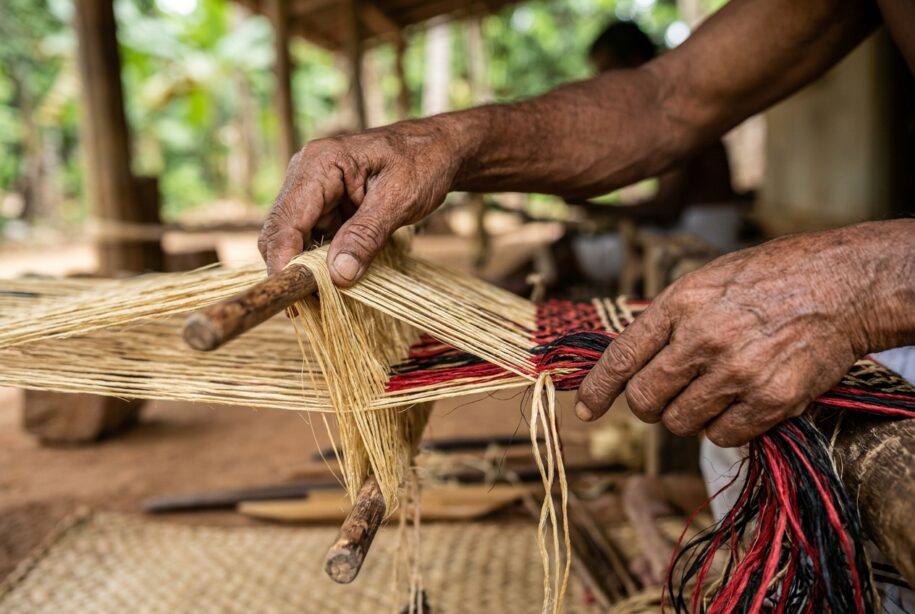
Most people picture weaving as a shuttle flying back and forth across a loom. Dumbara weaving Sri Lanka looks nothing like that. The technique, called Mal Bema or pick-up weaving, works one strand at a time. The artisan lifts individual threads, inserts thin wooden sticks to twist and redirect them, and builds the pattern from the ground up, cross-calculating thousands of yarn positions purely from memory. No written draft. No chart pinned to the wall. Just a rhythmic mental grid passed down through generations.
The result is a textile with a bold, geometric vocabulary. The most recognisable motif is Katuru Mala, a zigzag border design whose name translates to “scissors flower.” Others include Mal Petta (geometric flower petals), Maha Mal Petta (larger, more elaborate blooms), and Domba Mala (interlocking chains). Each pattern carries a specific count sequence, and a single miscount throws the entire grid off. Weavers often describe the process as closer to solving a long equation than to crafting a decorative object.
Then there is the fibre itself. Dumbara mats are woven from the Hana plant, a succulent in the agave family native to the dry stretches around the Dumbara Valley. The extraction process is slow and physical: leaves are cut, scraped clean to reveal the inner fibre, washed, sun-dried, combed, and then boiled with natural dyes drawn from tree bark, roots, and leaves. The finished strand is stiff, pale gold, and carries a faint earthy smell that no synthetic substitute has managed to fake.
So when a weaver in Kalasrigama picks up a bundle of prepared Hana thread and starts counting, the entire operation, from soil to finished mat, has passed through human hands at every single stage. That level of unbroken handwork is rare anywhere on the planet. It is the reason Dumbara weaving Sri Lanka earned its place on the UNESCO Representative List of the Intangible Cultural Heritage of Humanity in 2021, and it is the reason a finished mat can take weeks to complete.
The craft deserves an audience that understands what it is looking at. This brings the conversation to where exactly that audience should go.
Two Villages, One Heritage
The Dumbara Valley is not a single address. It is a fold of hills and small hamlets in the central highlands, administratively part of the Udadumbara region. Within that patchwork, two villages carry the living tradition of Dumbara weaving Sri Lanka forward.
Kalasirigama sits near Manikhinna in the Kandy District, roughly 20 kilometres from Kandy city. The roads are paved, a tuk-tuk can get you to the doorstep in 45 minutes to an hour, and the village has become the most accessible entry point for visitors. A couple of weaving families here are accustomed to hosting small groups, and the local Dumbara Salu outlet helps coordinate demonstrations. For a first-time visitor on a half-day itinerary from Kandy, Kalasirigama is the practical choice.
Alokagama is the deeper cut. Tucked near Yatawatta in the Matale District, it requires a private driver and a willingness to navigate narrower rural roads. The experience is quieter, strictly family-run, and rooted in daily routine rather than visitor schedules. Textile students, photographers who want unposed shots, and travellers who prefer their cultural encounters without any performative layer tend to gravitate here.
Both villages belong to the Kinnara community, the hereditary weaving caste that supplied ornamental mats to the Kandyan royal court for generations. The lineage stretches back over a millennium, anchored firmly in the Kandyan Kingdom era when these mats adorned palace floors and ceremonial halls. What a visitor sees today on a wooden loom in a modest open-air shed is a direct, unbroken continuation of that royal commission.
A small practical note: the two villages are about an hour apart by road. Trying to squeeze both into a single half-day trip is possible on paper and exhausting in practice. Pick one. Give it the time it deserves. The weaver across from you will thank you for not glancing at your watch.
Planning Your Dumbara Weaving Visit
Here is where the rubber meets the road, or rather, where the tuk-tuk meets the dirt path. Dumbara weaving Sri Lanka experiences take place inside family homes and small open-air weaving sheds. These are private spaces. Dropping in unannounced, the way one might wander into a Colombo gallery, simply does not work here.
Getting there. From Kandy, hire a tuk-tuk or a private car to Kalasirigama. The ride takes 45 minutes to an hour depending on traffic leaving the city. For Alokagama, a private driver is strongly recommended; the final stretch of road is narrow and poorly signposted. Most drivers from Kandy know Kalasirigama by name. For Alokagama, share the exact location pin in advance.
Booking ahead. This is the single most important step. Reach out to a community-based tourism initiative or a local eco-travel operator at least two to three days before the intended visit. The Dumbara Salu outlet in Kalasirigama can confirm whether a master weaver is available to demonstrate. During peak season, particularly from December through April, slots fill quickly because the number of active weavers is genuinely small.
What the visit looks like. Plan for two and a half to three hours. A typical session includes a 45-minute live demonstration where the weaver walks through the pick-up technique, a short break with plain tea and maybe a couple of biscuits, and unhurried time to browse finished pieces. Rushing any of these phases is considered disrespectful. The weaver has spent decades perfecting a craft that demands slow, deliberate movement. Matching that pace is part of the experience.
Terrain and accessibility. Expect uneven dirt paths, loose coir on the ground near the looms, and low doorways into the weaving sheds. The walking distance is minimal, a few hundred metres at most, but the ground is uneven and the sheds are not wheelchair accessible. Comfortable closed-toe shoes are a smart call.
A small note for travellers booking through a tour operator: Several Sri Lankan inbound operators, including our own team, can fold a guided Dumbara weaving visit into a Kandy or Matale day itinerary, complete with transport, a local guide who translates the weaver’s explanations, and a pre-arranged demonstration slot. It removes the guesswork and ensures the host family is expecting you. If that sounds useful, drop a line through the contact page, and the itinerary team will build it in.
With the logistics sorted, the next question is how to behave once you are sitting cross-legged in front of the loom. And the answer matters more than most travel guides bother to mention.
Manners at the Loom
The weaver you will meet is likely in their fifties, sixties, or older. They are holding a mental grid of several thousand thread positions while their fingers work at a steady, rhythmic clip. The concentration required is intense, physical, and deeply personal. A few small courtesies go a long way in keeping the atmosphere warm.
- Photography: Ask before raising the camera. Skip the flash entirely; it startles and breaks the weaver’s focus. The most compelling shots come from the hands, the wooden shuttle, the loom frame, and the raw Hana fibre bundles drying nearby. Avoid pointing a lens directly at the weaver’s face while they are mid-count. If children are around, ask a parent before photographing them.
- Dress: Rural Kandyan villages are conservative. Cover shoulders and knees. A light cotton shirt and trousers or a long skirt work perfectly in the tropical heat. It is a small gesture that signals respect and puts the host family at ease.
- Conversation: Approach with genuine curiosity rather than a checklist of questions. Let the weaver set the pace of explanation. Many speak basic English; some speak only Sinhala. A local guide or the host family member coordinating the visit will translate. Resist the urge to interrupt a weaving sequence mid-row to ask for clarification. Wait for a natural pause.
- Physical space: The loom and the prepared fibre bundles are the weaver’s tools. Do not touch the threads on the loom, move the wooden sticks, or pick up the shuttle without being invited to. At some sessions, the weaver may hand you a shuttle and guide your fingers through a basic pass. That is a generous moment. Accept it with both hands, literally.
The warmth you receive in return is often the highlight of the entire trip. A cup of tea poured from a battered kettle, a proud explanation of a motif’s meaning, a small laugh when a visitor’s clumsy shuttle attempt produces a crooked line. These are the moments no brochure captures.
And after the tea is finished and the loom demonstration winds down, there is the matter of the beautiful, stiff, golden mats stacked neatly in the corner. The buying part. And doing it right makes a genuine difference to whether this craft survives the next decade.
Buying Dumbara Mats Right
The most direct way to support Dumbara weaving in Sri Lanka is to purchase a piece from the weaver’s own hands, in the weaver’s own home. The money goes straight to the family, bypasses every middleman, and funds the next bundle of Hana fibre, the next set of natural dyes, the next few weeks of work.
Pricing. Village prices are a fraction of what the same mat costs in a Colombo boutique or a Kandy hotel gift shop, where markups of 300 to 500 per cent are common. A medium-sized wall hanging might run a few thousand rupees at the loom. Polite negotiation is acceptable in Sri Lankan culture, but keep perspective: a complex Dumbara mat takes weeks of daily work. Paying a fair price is the point. Haggling a master weaver down by a few hundred rupees saves the cost of a snack and chips away at the craft’s viability.
Spotting a genuine Dumbara mat. A few tactile checks help:
- Feel the texture. Real Hana fibre is stiff, slightly rough, and carries a mild organic, grassy smell. It does not drape or soften the way cotton does. If the mat feels plush or fabric-like, it is likely a printed or embroidered imitation.
- Flip it over. In authentic Mal Bema pick-up weaving, the reverse side shows floating or interlocking pattern threads that look visibly different from the front. Printed reproductions look identical on both sides. Embroidered fakes show stitch work rather than an integrated weave structure.
- Check the fibre. Genuine Hana strands have a pale gold, slightly waxy appearance. Synthetic substitutes look shinier and feel smoother.
What to buy. Traditionally, Dumbara mats served as floor coverings called Paduru. Today’s weavers produce a wider range: wall tapestries, cushion covers, table runners, small decorative hangings, and yes, the classic rectangular mat. Wall art and low-table pieces are the most practical purchases for travellers flying home, since they roll up compactly and travel well in a suitcase.
One honest caveat. A Dumbara mat is an ornamental textile. The Hana fibre is strong, but the weave structure is designed for beauty, not for bearing the daily grind of shoes, pets, and spilt coffee in a hallway. Frame it on a wall. Drape it over a low table. Hang it as a room divider. Treating it as a high-traffic floor rug will shorten its life considerably.
Where to avoid buying. Generic craft shops in Colombo or near the Kandy lakefront often stock machine-made lookalikes labelled loosely as “Dumbara” or “traditional mat.” Unless the shop can name the specific weaving family or village the piece came from, treat it with scepticism. The real thing has a texture, a weight, and a faint smell that a factory reproduction simply cannot mimic.
Buying well is the last and perhaps most meaningful act of the visit. The mat that ends up on your living room wall back home carries a specific pair of hands, a specific village, a specific morning of tea and conversation. That provenance is something no Colombo showroom can offer.
Dumbara vs. Handloom
Sri Lanka boasts a vibrant textile map. Handloom cotton fills the markets with bright, breathable apparel. Beeralu lace adorns tablecloths with delicate, intricate loops. Dumbara weaving Sri Lanka occupies a completely different category.
Handloom relies on a fly-shuttle to weave continuous warp and weft threads into cloth. Dumbara Rata Kalala employs the manual pick-up method, building striking geometric designs from stiff agave fiber. Handloom cotton finds its way into comfortable daily wear. Dumbara mats serve as bold, structural display pieces. Both stand as essential Sri Lanka traditional crafts. They simply serve entirely different purposes in a traveller’s suitcase. A cotton shirt goes on your back. A Hana fiber wall hanging goes on your wall.
Understanding this distinction helps set expectations before arriving at the village. You are looking at structural art, not apparel fabric. That realization makes watching the artisan work all the more impressive.
The UNESCO Effect
Earning a spot on the UNESCO Representative List of the Intangible Cultural Heritage of Humanity in 2021 brought global eyes to the Dumbara Valley. The real impact happened far away from the press conferences, right at the village level.
Recognition sparked a renewed interest in Community-Based Tourism. Government grants and NGO initiatives helped repair aging looms and secure better prices for raw Hana fiber. More importantly, the global spotlight gave the Kinnara community a profound sense of pride. Younger family members who had moved to Kandy or Colombo for office jobs started returning on weekends to learn the complex counting sequences.
The UNESCO Dumbara tag breathed fresh oxygen into a living tradition. The looms in Kalasirigama and Alokagama keep clacking today because of that renewed generational interest. The heritage is no longer just surviving. It is actively being passed down to a new crop of master weavers who understand the global value of their ancestral math.
That global interest inevitably leads to a few common questions from travellers planning their itineraries.
Dumbara Weaving FAQs
How long does a Dumbara weaving Sri Lanka experience take?
Plan for two to three hours. This allows time to watch a live demonstration, share tea with the host family, and browse the finished textiles without rushing the artisan.
Can tourists try pick-up weaving themselves?
Yes. Many families offer a brief hands-on segment where visitors hold the wooden shuttle and pass it through the warp threads. Mastering the full technique takes years, yet the basic movement is highly memorable to learn.
Is Kalasirigama or Alokagama better for a first visit?
Kalasirigama is the best starting point. The paved roads and proximity to Kandy make it highly accessible. Alokagama offers a deeper, more remote experience suited for textile scholars and repeat visitors.
How do I pack a Dumbara mat for an international flight?
Hana fiber is remarkably resilient. Roll the mat tightly around a cardboard tube or fold it gently along the existing weave lines. Wrapping it in a cotton cloth inside a hard-shell suitcase keeps it perfectly safe during transit.
Are authentic Dumbara mats vegan?
Completely. The entire process relies on plant-based materials. The Hana agave fiber and the natural dyes extracted from tree bark, roots, and leaves contain zero animal products.
Bringing the Heritage Home
A trip to the central highlands usually revolves around tea estates, botanical gardens, and ancient temples. Adding a Dumbara mat weaving experience to that itinerary shifts the entire rhythm of the holiday. It trades sweeping mountain vistas for the intimate, focused world of an artisan’s hands.
The Kinnara community has guarded this mathematical textile language for centuries. Supporting them through mindful tourism ensures the vibrant geometric patterns of the Kandyan Kingdom continue to unfold on wooden looms today. When that stiff, golden textile finally hangs in your living room, it will serve as a daily reminder of an unhurried morning in the Dumbara Valley, a cup of sweet tea, and a heritage kept beautifully alive.
The looms are waiting. The tea is brewing. All that is left is to book the ticket.