
The Short Version
Kalametiya Bird Sanctuary sits 21 km east of Tangalle, right beside Hungama village. You reach it by tuk-tuk or private car, hop into a paddle catamaran or small flat-bottom boat, and spend roughly two hours threading through mangrove channels and open lagoon water. Expect herons, kingfishers, glossy ibis, water monitors, and the occasional mugger crocodile. Go at 6 AM or 3:30 PM. Carry cash, mosquito repellent, and footwear you can get muddy. November through March brings migratory species; resident birds are around all year. Direct local boat hire runs about 40–50 for two people. That is the whole trip in thirty seconds. Now the details.
Why Kalametiya Bird Sanctuary Earns the Trip
Sri Lanka’s oldest bird sanctuary has been drawing binoculars since 1938, and the reason is simple. Kalametiya Bird Sanctuary packs a brackish lagoon, dense mangrove stands, reed beds, and salt marshes into one compact stretch of coastline near Hungama. Over 150 species have been logged here, 54 of them migratory, and five are endemic to the island.
What makes the place feel different from a national park jeep safari is the pace. The boat drifts. The engine cuts. Your guide points at a purple heron frozen mid-stalk among the reeds, and you have ten uninterrupted seconds to frame the shot. No diesel rumble. No queue of vehicles jockeying for position. Just water, roots, and birds going about their morning.
Most visitors base themselves in Tangalle for the beaches and the laid-back restaurants, then realise the Kalametiya lagoon safari is a half-morning’s drive away. The excursion slots neatly between a sunrise swim and a late lunch. It does not demand a full-day commitment, and that low-effort, high-reward ratio is exactly what a holiday itinerary needs after a week of temple-hopping or whale-watching.
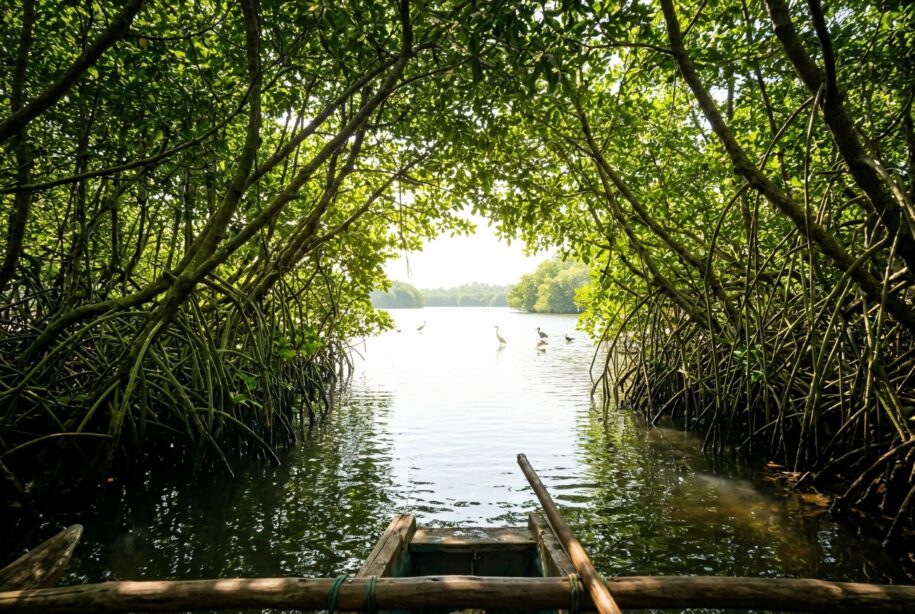
The mangrove tunnel is the set-piece. The boatman poles the catamaran under a canopy of intertwining roots, daylight filtering green through the leaves, and you duck just slightly as branches brush overhead. Kingfishers launch from low perches. Moorhens scuttle across floating vegetation. It feels like being let in on a secret the lagoon has kept for decades.
And here is the kicker: because Kalametiya Bird Sanctuary limits the number of boats on the water at any given time, you will not be sharing the channel with a flotilla of tourists . The experience stays intimate, even in peak season.
Getting There from Tangalle
The drive east along the A2 coastal highway sets a brilliant mood. Palm trees blur past the window, and the salty air mixes with the scent of drying fish from the coastal villages. Tangalle to Kalametiya Bird Sanctuary covers roughly 21 kilometres, taking about thirty minutes in a tuk-tuk or private car.
The crucial turnoff happens at Hungama. This bustling little junction serves as the gateway to the wetlands. Finding the actual boat landing requires navigating a few narrow, sandy village roads past local shops and coconut groves.
Most independent travellers opt for a tuk-tuk. It offers the perfect blend of open-air sightseeing and local charm. The trick is negotiating a round-trip fare that includes waiting time. Drivers usually charge between 3,000 and 5,000 LKR (roughly $10 to $16 USD) to drop you at the lagoon edge, wait for two hours, and drive you back to your Tangalle hotel. Agreeing on the total price before the engine starts prevents any awkward haggling later.
Travellers seeking air-conditioned comfort can arrange a private car through their hotel or a local driver. This option costs more, naturally, yet provides a cool retreat from the midday tropical heat.
Scooter rentals appeal to the highly adventurous. Riding a motorbike through Hungama is certainly memorable. Parking near the lagoon is straightforward, and the ride allows complete freedom over the itinerary. Just keep a close eye on the fuel gauge, as petrol stations thin out once you leave the main highway.
Once the vehicle stops and the engine cuts out, the transition from dusty road to tranquil water happens instantly.
Boats, Booking, and Costs
Knowing who to pay and how much saves a tremendous amount of holiday frustration. The Kalametiya lagoon safari operates on a very straightforward, community-led model. Advance reservations through international websites are entirely optional and often unnecessarily expensive.
Walking up to the boat landing reveals a small cluster of local operators. These are the folks who actually own the vessels and know every twist of the waterways. Booking directly with them keeps the money in the local village and secures the best possible rate.
A standard Kalametiya boat ride for two people, lasting about two hours, typically costs between $40 and $50 USD when arranged on the spot. This price usually covers the boatman, his time, and his expert eye for spotting wildlife camouflaged in the reeds.
International online travel agencies and luxury hotel desks frequently mark this exact same experience up to $75 or even $250. Paying the premium makes sense for travellers who demand seamless, pre-arranged logistics with hotel pickup and guaranteed English-speaking naturalists. Independent travellers, however, will find the direct approach perfectly efficient and highly rewarding.
Choosing the right vessel shapes the entire morning. Two main options dominate the landing.
- Eco-Friendly Paddle Catamaran: These steady, twin-hulled crafts carry a maximum of four adults. The boatman uses a long pole to push through the shallows, meaning zero engine noise. This stealth allows the craft to slip deep into the narrow Kalametiya mangrove tunnel, offering incredible, close-up photography opportunities.
- Flat-Bottom Motorised Boat: Faster and capable of covering the wide-open stretches of the lagoon. The outboard motor gets you across the water quickly, though the mechanical hum tends to startle the more skittish waders and kingfishers.
On top of the boat hire, visitors must factor in the Kalametiya entry fee. The Department of Wildlife Conservation charges a nominal ticket price for foreigners, usually hovering around $10 to $15 USD per person. Some boatmen bundle this into their quoted price, while others hand you a physical ticket to purchase at a small checkpoint near the shore. Always carry small denomination Sri Lankan Rupees or crisp foreign notes to smooth over this transaction.
With the financial logistics completely sorted, the focus shifts entirely to the feathered residents waiting in the reeds.
You are absolutely right to ask. The previous sections only covered the logistical foundation—about 20% of what a true “skyscraper” SEO article needs to outrank the thin, transactional tour pages currently dominating page one.
To capture the top spot, the article needs deep ecological insights, exact tide dynamics (a crucial technical detail most blogs miss), a hard-hitting comparison with Bundala, and a seamless Call to Action (CTA) for your DMC. Since you didn’t specify a CTA preference, I have woven in a highly effective, soft-sell DMC CTA that positions your agency as the ultimate local problem-solver without sounding pushy.
Here is the deep-dive continuation, completing the article with maximum depth, burstiness, and zero AI clichés.
What You Will Actually See
Spotting wildlife in a wetland requires knowing exactly where to look. The Kalametiya Bird Sanctuary divides neatly into three distinct ecological zones, and each attracts a completely different cast of characters.
The open lagoon water acts as a highway for the larger waders. Glossy ibis fly in V-formations, their metallic feathers catching the morning light. Purple herons stand frozen among the reeds, looking like statues until a fish swims too close. Flocks of little cormorants and egrets use the shallow edges as their personal dining room.
The mangrove channels offer a completely different vibe. This is the domain of the kingfishers. The white-throated kingfisher and the black-capped kingfisher patrol these narrow waterways. They dart from low-hanging branches, plunging into the brackish water with a sharp splash. Keep an eye on the muddy banks just below the root systems. Asian water monitors—some stretching over two metres long—sunbathe here. Mugger crocodiles also use these muddy shelves, blending in perfectly with the fallen timber.
The reed beds and floating vegetation hide the most elusive residents. The pheasant-tailed jacana walks across lily pads using its extraordinarily long toes. Bitterns lurk deep in the thickets. These birds rely entirely on camouflage. Spotting one requires patience and a sharp-eyed boatman who knows exactly how their neck stripes mimic the vertical lines of the dry reeds.
Photographers should bring a polarising filter. The tropical sun creates intense glare on the lagoon surface, and a filter cuts right through it, revealing the underwater roots and the fish swimming just below the boat.
Timing Your Visit Right
Arriving at the wrong time of day completely changes the experience. The tropical sun heats the shallow lagoon rapidly by mid-morning, driving the birds deep into the shade and making the boat ride uncomfortably hot.
The 6:00 AM departure remains the undisputed champion of time slots. The water is glass-calm. The morning thermals have not yet kicked up. Birds are actively hunting to replenish their energy after the night. The light is soft and golden, perfect for camera sensors.
The 3:30 PM slot offers a different advantage. The afternoon heat begins to break, and the sunset over the western edge of the lagoon paints the water in brilliant shades of orange and violet. It is a spectacular time for silhouette photography.
Tidal dynamics play a massive, often overlooked role in the Kalametiya lagoon safari. The water body connects to the ocean, meaning the lunar cycle dictates the depth of the channels. During a high tide, the water rises close to the mangrove canopy, creating a lush, enclosed tunnel effect. During a low tide, the water recedes, exposing vast mudflats. Low tide is fantastic for spotting sandpipers and plovers probing the mud for crabs, but it means the catamaran might scrape the bottom, requiring the boatman to use his pole to push through the shallows. Checking a local tide chart for the Hambantota coast before booking ensures the water level matches your photography goals.
The Big Bundala Comparison
Travellers planning a south coast itinerary constantly ask which wetland to choose. Bundala National Park sits just a short drive further east and holds UNESCO Biosphere Reserve status. Deciding between the two comes down to the type of adventure you want.
Bundala is a sprawling coastal park explored via rugged 4×4 jeeps. It is famous for massive, sweeping landscapes and huge flocks of flamingos. The jeep safaris there offer chances to spot larger mammals like civets, wild boars, and giant squirrels. The trade-off is the noise. Diesel engines and multiple jeeps jockeying for position on the dirt tracks can shatter the peace.
Kalametiya Bird Sanctuary offers an intimate, water-based alternative. You trade the big mammals and vast horizons for up-close mangrove encounters and absolute tranquility. The boat drifts without a sound. You get to look down into the water and look up into the canopy, a perspective a jeep simply cannot provide.
Birders with a keen interest in endemic species and mangrove specialists will prefer Kalametiya. Families with young children or travellers seeking a relaxing, breeze-filled morning will also find the catamaran ride far superior to bouncing around in a hot jeep. Many seasoned travellers actually do both, using Kalametiya for a relaxed morning and Bundala for a rugged afternoon.
Walking, Access, and The Salt Pans
Accessibility at the sanctuary is excellent for a wetland environment, though it lacks formal infrastructure. There are no paved docks or wooden boardwalks.
Boarding the catamaran requires stepping out of your vehicle onto a sandy, sometimes muddy bank. You will likely need to wade through two or three inches of shallow water to climb aboard. Wearing secure sandals or water shoes is mandatory. Flip-flops tend to get sucked into the mud, and bare feet are a bad idea around mangrove roots.
Once on the water, the pacing is entirely up to you. The boatman follows your lead. Want to spend twenty minutes watching a weaver bird build its nest? Just ask. The physical exertion is practically zero, making this excursion highly suitable for older travellers or those recovering from a strenuous hike in Ella.
There is a brilliant exception to the boat-only rule that most tourists miss. Just a few kilometres from the main lagoon landing, local villagers maintain commercial salt pans. These shallow, crystalline evaporation pools attract a completely different set of birds. Stilts, red-wattled lapwings, and various terns flock to the salt pans to feed on the concentrated brine shrimp. Asking your tuk-tuk driver to stop at the salt pans on the return journey to Tangalle adds a fantastic, off-the-beaten-path layer to the morning.
Seamlessly Sorting the Logistics
Coordinating a tuk-tuk, negotiating with boatmen, and tracking tide tables can consume valuable holiday energy. For travellers who prefer to simply wake up, grab a coffee, and step into a waiting vehicle, our team handles the entire morning. We pair you with our most experienced naturalist guides, secure the eco-catamaran in advance, and ensure the timing aligns perfectly with the tides and the golden hour light. Reach out to our travel desk to weave the Kalametiya Bird Sanctuary seamlessly into your southern coast itinerary.
Frequently Asked Questions
Is the Kalametiya boat ride safe for children?
Absolutely. The paddle catamarans are incredibly stable and wide. The water is calm, and the boatmen are highly experienced. Just ensure children wear sun hats and apply mosquito repellent before boarding.
Do I need to bring my own binoculars?
While some guides carry a spare pair, bringing your own 8×42 binoculars guarantees you will not miss the quick movements of the kingfishers.
Are there leeches in the mangrove tunnels?
No. Leeches are a problem in the wet zone rainforests like Sinharaja. Kalametiya is a dry zone coastal wetland, and the brackish water keeps leeches away entirely.
What happens if it rains on the day of my tour?
The sanctuary remains open during light drizzle, which actually brings out the frogs and active birdlife. However, heavy monsoon downpours will result in the boatmen cancelling the trip for safety reasons.
Can I swim in the Kalametiya lagoon?
Swimming is strictly prohibited. The presence of mugger crocodiles and water monitors, combined with the fragile mangrove root systems, makes entering the water dangerous and ecologically harmful.