
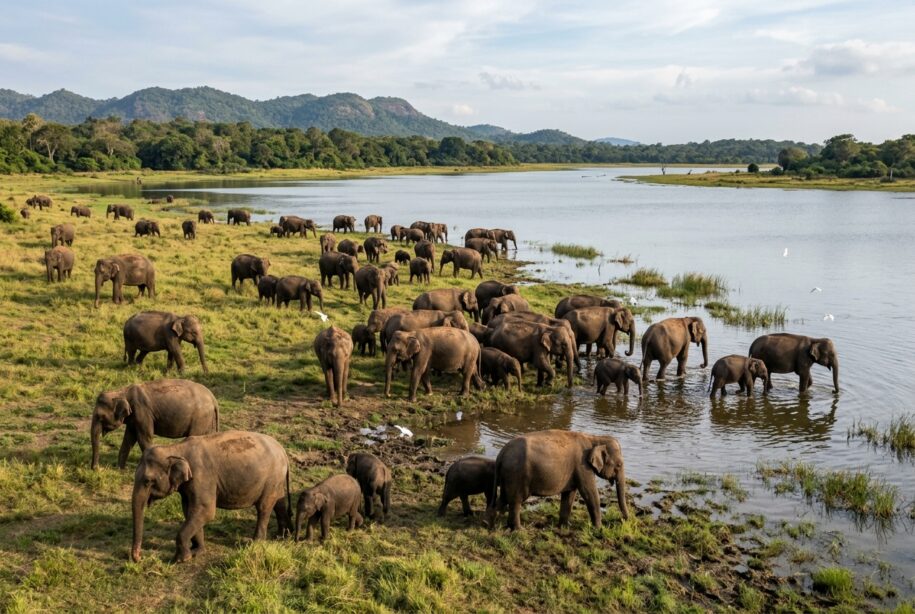
Up to 300 wild elephants can stand around one lake at the same time. That is the largest gathering of Asian elephants on the planet, and it plays out every dry season in the north-central plains of Sri Lanka. The stage for all of it is Minneriya National Park.
This guide covers everything a traveller needs before going: the gathering, the best months, ticket prices, safari timings, how to get there, where to stay, the park’s 1,700-year-old history, and the etiquette that keeps both you and the elephants safe. It is written for 2026, using this year’s actual water levels, crowd situation, and fee structure.
The short version, if you’re in a hurry. Visit between July and October, and aim for August or September if you can. Book an afternoon jeep safari that runs from about 2:30 pm to 6 pm. Budget roughly USD 42 per person in park fees on top of the jeep. Base yourself in Habarana or Sigiriya. Reserve a few weeks ahead, because the good jeeps go fast. Do that, and you’ve covered the essentials.
Now the detail.
What Is Minneriya National Park?
Minneriya National Park is an 8,889-hectare dry-zone reserve built around a vast man-made reservoir. It sits in the North Central Province, on the road between Habarana and Polonnaruwa, right in the heart of Sri Lanka’s Cultural Triangle. The nearest city is Polonnaruwa.
The park was first declared a wildlife sanctuary in 1938 and upgraded to full national park status on 12 August 1997. The Department of Wildlife Conservation runs it. Its reason for existing is simple and lovely: protect the catchment of the ancient Minneriya tank and everything that lives around it.
What makes the place special is the water. In an otherwise dry landscape, this one reservoir stays reliable through the hottest months. As it slowly shrinks, it exposes wide beds of fresh grass. That grass is what pulls in the elephants, by the hundred. More on that in a moment.
Minneriya National Park is not a big-cat park. Leopards and sloth bears live here, but they keep to themselves and are rarely seen. This is an elephant park, a bird park, and a landscape park. Come expecting open plains, golden evening light, and herds that stretch further than your zoom lens.
The Elephant Gathering
Between July and October, something remarkable happens at the tank. Family groups, lone bulls, teenagers testing their strength, and calves barely a month old all converge on the exposed lakebed to graze the new grass. On a good day at the season’s peak, 200 to 300 elephants can be visible at once, spread across open ground as far as you can see.
This is not a captive show and it is not fed or staged. These are wild animals following water and food, the way they have for as long as the tank has existed. Some travel from as far as 50 kilometres, drifting in from the forests of Matale, Polonnaruwa, and Trincomalee, and even from Wasgamuwa.
Timing is everything. The gathering peaks in August and September. Numbers build through July, hit their highest point in those two months, and then start to drift toward Kaudulla as the October rains refill the tank. History shows how sensitive this is to water: in September 2017, a count recorded 402 elephants, while by September 2021 that figure had fallen to about 20 after out-of-season water releases kept the grass flooded. A court case in 2025 pushed authorities back toward the natural water cycle, which is why the 2026 season looked healthy again.
The best viewing window is the afternoon. Elephants shelter from the midday heat under tree cover and move out onto the grass from mid-afternoon onward. That is why nearly every safari here runs from about 2:30 pm to 6 pm, catching the herds in the warm, low light just before close. Mornings are quieter and far better for birds.
And here’s the thing nobody tells you. The exact count changes with the rain, the releases, and the herd’s mood, so treat any promised number with a pinch of salt. What you can trust is this: in August or September, at dusk, watching a hundred elephants bathe in a lake built by a king 1,700 years ago is the single greatest wildlife moment Sri Lanka offers.
Minneriya National Park Safari Guide
Up to 300 wild elephants can stand around one lake at the same time. That is the largest gathering of Asian elephants anywhere on the planet, and it plays out every dry season in the north-central plains of Sri Lanka. The stage for all of it is Minneriya National Park.
This guide covers everything a traveller needs before going: the gathering, the best months, ticket prices, safari timings, how to get there, where to stay, the park’s 1,700-year-old history, and the etiquette that keeps both you and the elephants safe. It is written for the current season, using this year’s actual water levels, crowd situation, and fee structure.
The short version, if you’re in a hurry. Visit between July and October, and aim for August or September if you can. Book an afternoon jeep safari that runs from about 2:30 pm to 6 pm. Budget roughly USD 42 per person in park fees on top of the jeep. Base yourself in Habarana or Sigiriya. Reserve a few weeks ahead, because the good jeeps go fast. Do that, and you’ve covered the essentials.
Now the detail.
What Is Minneriya National Park?
Minneriya National Park is an 8,889-hectare dry-zone reserve built around a vast man-made reservoir. It sits in the North Central Province, on the road between Habarana and Polonnaruwa, right in the heart of Sri Lanka’s Cultural Triangle. The nearest city is Polonnaruwa.
The park was first declared a wildlife sanctuary in 1938 and upgraded to full national park status on 12 August 1997. The Department of Wildlife Conservation runs it. Its reason for existing is simple and lovely: protect the catchment of the ancient Minneriya tank and everything that lives around it.
What makes the place special is the water. In an otherwise dry landscape, this one reservoir stays reliable through the hottest months. As it slowly shrinks, it exposes wide beds of fresh grass. That grass is what pulls in the elephants, by the hundred. More on that in a moment.
Minneriya National Park is not a big-cat park. Leopards and sloth bears live here, but they keep to themselves and are rarely seen. This is an elephant park, a bird park, and a landscape park. Come expecting open plains, golden evening light, and herds that stretch further than your zoom lens.
The Elephant Gathering
Between July and October, something remarkable happens at the tank. Family groups, lone bulls, teenagers testing their strength, and calves barely a month old all converge on the exposed lakebed to graze the new grass. On a good day at the season’s peak, 200 to 300 elephants can be visible at once, spread across open ground as far as you can see.
This is not a captive show and it is not fed or staged. These are wild animals following water and food, the way they have for as long as the tank has existed. Some travel from as far as 50 kilometres, drifting in from the forests of Matale, Polonnaruwa, and Trincomalee, and even from Wasgamuwa.
Timing is everything. The gathering peaks in August and September. Numbers build through July, hit their highest point in those two months, and then start to drift toward Kaudulla as the October rains refill the tank. History shows how sensitive this is to water: in September 2017, a count recorded 402 elephants, while by September 2021 that figure had fallen to about 20 after out-of-season water releases kept the grass flooded. A court case in 2025 pushed authorities back toward the natural water cycle, which is why recent seasons have looked healthy again.
The best viewing window is the afternoon. Elephants shelter from the midday heat under tree cover and move out onto the grass from mid-afternoon onward. That is why nearly every safari here runs from about 2:30 pm to 6 pm, catching the herds in the warm, low light just before close. Mornings are quieter and far better for birds.
And here’s the thing nobody tells you. The exact count changes with the rain, the releases, and the herd’s mood, so treat any promised number with a pinch of salt. What you can trust is this: in August or September, at dusk, watching a hundred elephants bathe in a lake built by a king 1,700 years ago is the single greatest wildlife moment Sri Lanka offers.
Best Time to Visit Minneriya
If you’re planning around the elephants, the window is July to October, with August and September the sweet spot. Outside that, you’ll still see elephants, just in smaller, scattered family groups rather than the big congregation.
Here’s how the year breaks down at Minneriya National Park:
- May to June – water starts to drop and numbers build slowly. A good time to visit if you want fewer jeeps and don’t mind smaller herds.
- July – the gathering begins. Expect 100 to 200 elephants and rising.
- August and September – the peak. This is when the lakebed can hold 200 to 300 at once.
- October – the changeover. Rains return, the tank refills, and herds start moving toward Kaudulla.
- November to April – the herds are spread through the forest. Visit for birdlife and quiet, or switch to Kaudulla, Hurulu, or Udawalawe for reliable elephants.
Time of day matters as much as the month. For the gathering, the afternoon session is the one to book. For birdwatching and empty park roads, go early. September can still throw the odd shower, but the monsoon doesn’t usually set in until October, so conditions hold.
Minneriya National Park Ticket Prices
Park fees at Minneriya National Park are set by the Department of Wildlife Conservation, and Minneriya sits in the top fee category, the same one as Yala and Wilpattu. The headline number most travellers see is USD 25 per foreign adult, but the final amount is a little more once the mandatory extras are added.
Here’s the breakdown:
- Foreign adult – USD 25
- Foreign child, aged 6 to 12 – USD 15
- Children under 6 – free
- SAARC national adult – USD 20
- Sri Lankan adult – LKR 150
- Tourist service charge – USD 10 per jeep, not per person
- Vehicle entry for a jeep – LKR 300
- VAT – 18 per cent on the subtotal
Add those together and a typical foreign adult lands somewhere around USD 40 to 45 all-in for the park side of things. That fee is separate from the jeep itself. A half-day safari jeep, shared or private with a driver and tracker, usually runs between LKR 7,000 and 10,000 depending on the operator and the season.
Two things worth knowing. The service charge and vehicle fee are per jeep, so filling the seats drops the per-person cost sharply. And fees are quoted in dollars but collected in rupees at the day’s rate, so carry local currency and confirm the exact total at the gate, since prices can shift without notice. Some travellers book an all-inclusive afternoon tour where the jeep, tickets, and hotel pickup are bundled into one figure, which removes the arithmetic entirely.
Safari Timings and Rules
Minneriya National Park is open from 6 am to 6 pm, and every vehicle must be out by close. There are two sessions, and the afternoon is the one most people want.
- Morning session – roughly 6 am to 9:30 am. Cooler, quieter, best for birds.
- Afternoon session – roughly 2:30 pm to 6 pm. Best for the gathering and for golden-hour light.
A safari lasts three to four hours in an open-top 4×4. Each jeep carries up to six guests and must be accompanied by a park-appointed tracker, who rides along and knows where the herds have been spotted. You can’t wander the park on your own or walk the elephant zones. Everyone stays in the vehicle.
A few rules that genuinely matter:
- The speed limit inside the park is 20 km/h, and good drivers hold to it.
- No drones, no smoking, no alcohol, and no littering.
- Stay seated and keep noise down. Loud voices and sudden movement unsettle the herds.
- Never feed the elephants. Feeding is illegal and is one of the main drivers of human-elephant conflict.
- Keep a respectful distance, especially from bulls in musth, which you’ll recognise by the dark secretion running down the side of the head.
The permit you buy is valid for one entry to one park. That’s worth remembering, because if the herds have moved to Kaudulla and your driver switches at the gate, a second fee applies. Agree the plan before you pay.
How to Reach Minneriya National Park
Minneriya National Park is easy to reach because it sits on the main Habarana to Polonnaruwa road. The entrance and ticket office are at Ambagaswewa, about 6 km east of Habarana junction. Nobody drives their own car into the park. You get to your hotel or the gate, and a licensed safari jeep takes it from there.
The distances that matter:
- From Habarana – around 15 minutes.
- From Sigiriya – roughly 20 to 50 minutes depending on your exact hotel and route.
- From Dambulla – about 30 to 60 minutes.
- From Polonnaruwa – 15 to 30 minutes.
- From Kandy – about 100 km, or two and a half to three hours by car.
- From Colombo – about 182 km, or four to five hours by car.
Most visitors hire a car with a driver, which is the comfortable and flexible way to travel in Sri Lanka. Buses to Trincomalee, Polonnaruwa, and Batticaloa all pass through Habarana junction if you’re on a budget. There’s also a railway station at Habarana on the Batticaloa line, and a fast domestic flight from Colombo to Sigiriya lands about 30 minutes from the park for those short on time.
Where to Stay Near Minneriya
There’s no accommodation inside Minneriya National Park, so you base yourself in one of the nearby towns and let the jeep collect you. Three options cover most travellers.
Habarana is the closest and the most practical. It’s about 15 minutes from the gate, it’s where most safari operators are based, and it gives you the shortest transfer to Minneriya, Kaudulla, and Hurulu all at once. It suits anyone whose priority is the safari.
Sigiriya is about 20 km away and works beautifully if you also want the rock fortress. Climb at dawn, rest through the midday heat, then head out for the afternoon session. It adds a little driving but keeps the Cultural Triangle’s biggest sight on your doorstep.
Polonnaruwa is roughly 25 km away and suits travellers who want a full day among the ancient ruins as well as an afternoon with the herds.
During August and September, accommodation in all three towns books out weeks ahead, so reserve early if your dates fall in the peak. Prices rise with the season, and staying just outside the busiest weeks in May or late September often buys better rates and quieter roads.
Minneriya vs Kaudulla vs Hurulu
A common mistake first-time visitors make is treating these three parks as entirely separate destinations. In truth, they share the same elephant population, the same safari operators, and essentially the same pricing. The difference is seasonal.
Minneriya National Park holds the headline act from July to September. When the October rains arrive and flood the tank’s grass margins, the herds migrate northeast to Kaudulla, where the terrain remains accessible. Kaudulla then takes over from October through January, with peak numbers usually hitting in October and November. By February, the dry season begins again and the elephants start drifting back toward Minneriya.
Hurulu Eco Park follows a different rhythm entirely. It holds a smaller resident elephant population year-round and becomes the reliable choice outside the gathering months, especially from November to June. The safari experience there is a forest drive rather than an open lakebed panorama, which makes for a very different feel.
The smartest way to book is to arrange a flexible safari where the operator decides on the morning of your visit which park holds the best sightings. Most reputable operators in Habarana and Sigiriya run this as standard. If a booking platform forces you to commit to a single park weeks in advance without that flexibility, you’re working with a less nuanced model.
Keep in mind that a park permit is valid for one entry to one specific park. If you pay for Minneriya National Park at the gate and the driver suggests switching to Kaudulla because that’s where the elephants are, you’ll need to buy a second permit. Agreeing on the target park and the fallback plan before you hand over the cash saves a lot of confusion later.
A Day at Minneriya National Park
A typical afternoon safari follows a predictable rhythm, and knowing it in advance helps you pace the day.
Most operators schedule pickup from your Habarana or Sigiriya hotel around 1:30 pm. The jeep loads up with four to six guests, and you head for the Ambagaswewa gate. On arrival, you’ll queue for tickets and verification. In peak season, this can take anywhere from thirty minutes to two hours, which is why arriving early matters so much. Your tracker joins the jeep here, and drivers radio others already inside to find out where the herds have been spotted.
Once through the gate, you drive through about forty minutes of dense forest on a rough dirt track. Very little happens during this stretch, and first-timers sometimes worry they’ve made a mistake. The tank opens out suddenly after that, and the safari proper begins. The jeep follows the grassland margins where the herds feed, stopping for long stretches rather than racing between sightings. A good driver cuts the engine and lets the elephants approach on their own terms.
The final half hour inside the park catches the golden-hour light that makes the tank edges especially photogenic. You exit by 6 pm and drop back at your hotel by 6:30 pm, usually in time for dinner.
For a fuller Cultural Triangle day, pair the safari with a morning climb of Sigiriya Rock or a cycling tour of the Polonnaruwa ruins. Both fit naturally around an afternoon at Minneriya National Park and give you a mix of ancient history and wild nature in one trip.
The Story of Minneriya Tank
The reservoir at the heart of Minneriya National Park is not a natural lake. It was built in the third century CE by King Mahasena, one of the last great rulers of the Anuradhapura period and a legendary hydraulic engineer. The Mahavamsa, Sri Lanka’s great chronicle, credits him with sixteen vast reservoirs and two major irrigation canals. Minneriya was his largest, originally covering 4,670 acres with a 13-metre-tall dam running for two kilometres and holding over 20 billion gallons of water.
The engineering is staggering even by modern standards. Water arrived from the Amban River, a tributary of the Mahaweli, some 48 kilometres away, via the Elahera Canal. That canal was itself built by King Vasabha more than a century before Mahasena’s time, and Mahasena improved it to feed his new reservoir. The whole system was part of an ancient network of cascading tanks that turned the dry zone into the rice bowl of early Sri Lanka.
The tank fell into disrepair over the centuries but was never forgotten. British officials in the 1820s and 1850s marvelled at its construction and recorded the beauty of the vegetation and wildlife around it. It was restored in 1903 and improved again in 1953. Today it remains a working irrigation reservoir as well as the engine of the park’s ecosystem.
Local folklore still calls Mahasena Minneri Deviyo, the God of Minneriya, deifying him as a protector of tanks. There’s a shrine tradition around him at the site, which is a rare case of a hydraulic engineer becoming a deity. When you watch the elephants graze on the grass that grows where the water used to be, you’re watching a scene that has played out for nearly two thousand years.
Wildlife Beyond the Elephants
The gathering dominates the reputation of Minneriya National Park, but the broader wildlife is excellent and often overlooked. The park records 24 species of mammals, 160 species of birds, 9 species of amphibians, 25 species of reptiles, 26 species of fish, and 75 species of butterflies.
Sambar deer, enormous and majestic, often graze at the tank edge alongside the elephants. Spotted deer and wild buffalo are common, and you’ll see both purple-faced langurs and toque macaques, which are found only in Sri Lanka. Leopards and sloth bears live in the park but are very rarely seen, so don’t book expecting either.
The birdlife is outstanding, especially around the wetland margins. Painted storks, spot-billed pelicans, lesser adjutants, Asian openbills, grey herons, and black-headed ibis all feed in the shallows. The grey-headed fish eagle is a regular sight, and peafowl display at the forest edges at dawn.
Reptiles include the mugger crocodile, which basks on muddy banks during warm hours, as well as Indian pythons, rat snakes, cobras, and monitor lizards. Butterflies gather near water sources and flowering plants, with the blue Mormon and crimson rose among the more striking species.
Early morning safaris are far better for this supporting cast. The big herds are more of an afternoon affair, but if you have time for a dawn drive, the birding and the quiet are worth it.
Safari Etiquette
How you behave inside the park shapes the experience for everyone, including the elephants. A few simple habits make a real difference.
Dress in muted colours like beige, khaki, or olive. Bright colours attract attention and disturb wildlife. Long sleeves and trousers protect against sun, dust, and insects, and a hat is essential in the open stretches of the tank.
Carry more water than you think you’ll need. The dry zone is hot and dusty, and there’s no shade in an open jeep. Sunscreen, sunglasses, and insect repellent round out the basics. A zoom lens between 200 and 400 millimetres is the workhorse range for photography, and binoculars let you watch behaviour without raising the camera constantly.
When you arrive at a sighting, ask the driver to position the jeep once and wait rather than chasing each new group. Elephants that are left undisturbed keep feeding and drift closer on their own, and the best encounters often come after a patient wait in one spot. A good driver reads the herd’s mood and will reverse out of a situation long before it becomes tense.
If your guide asks everyone to stay seated and quiet, do exactly that. Sudden movement, loud voices, and standing up in the jeep unsettle animals and spoil the sighting for everyone else. And never, under any circumstances, feed the elephants. Roadside feeding is illegal and directly fuels the human-elephant conflict that kills hundreds of elephants every year.
Health and Safety
Sri Lanka is a remarkably safe destination for travellers, but a few things are worth knowing before you go.
Dengue is a real risk in the dry zone, and daytime-biting mosquitoes are common. DEET repellent is non-negotiable on safari, and long sleeves help. Malaria is no longer a risk anywhere in Sri Lanka, which is one less thing to worry about.
Road safety is the biggest real risk in the country. Driving is erratic, and accidents are frequent, particularly at night. The roads around Minneriya National Park are elephant-crossing country, so avoid night driving on the A11 and the Habarana to Trincomalee road. If you’re hiring a car, use a driver rather than self-driving, which requires both an International Driving Permit and a separate Sri Lankan recognition permit.
Wild elephants and crocodiles will attack humans on occasion, so follow your tracker’s instructions and never approach animals on foot. Feral dogs are common and sometimes carry rabies, so avoid contact with all animals.
The park itself is physically undemanding. You stay in the jeep, and the tracks are rough but manageable. The main discomforts are heat, dust, and the occasional long queue at the gate, all of which are easily managed with a bit of planning.
FAQs About Minneriya National Park
Is Minneriya National Park worth visiting outside the gathering season?
Yes, though for different reasons. Elephants are seen year-round, just in smaller groups. Outside the peak months, Hurulu Eco Park or Udawalawe offer more reliable large-herd sightings. Minneriya remains excellent for birdlife and quiet landscapes from November to April.
How much does a Minneriya safari cost per person?
A typical foreign adult pays around USD 42 all-in for the park permit, plus a shared jeep cost of roughly USD 15 to 20 per person if you fill the seats. Private jeeps cost more but offer flexibility.
What should I wear on a Minneriya safari?
Neutral colours, long sleeves, trousers, a hat, and comfortable shoes. Bring sunscreen, sunglasses, and more water than you think you’ll need. The dust gets everywhere.
Can I do a morning safari at Minneriya National Park?
Yes, and it’s a good choice for birdwatching and avoiding crowds. The big elephant herds are more of an afternoon affair, so treat a morning drive as a bonus rather than your only chance.
Is Minneriya better than Yala?
They offer very different experiences. Minneriya is best for large elephant gatherings in open landscapes. Yala is best for leopards in dense scrub. If you can only do one, choose based on which animal matters more to you.
Do I need to book a safari in advance?
During the July to October peak, yes. Good jeeps and hotels book out weeks ahead. Outside that window, same-day bookings are usually possible.
Is it safe to visit Minneriya National Park with children?
Yes. The jeep ride is gentle, and children tend to love the calves. Brief them beforehand on the rules: stay seated, speak softly, and don’t throw anything.
What if the elephants have moved to another park?
Book a flexible safari where the operator decides on the morning of your visit which park holds the best sightings. Most reputable operators in the area run this as standard.
____________________________________________________________________
Watching a hundred elephants bathe in a lake built by a king 1,700 years ago is the kind of moment that stays with you long after the holiday ends. Minneriya National Park offers that moment every dry season, along with open landscapes, rich birdlife, and a landscape that has shaped Sri Lankan civilisation for millennia.
For travellers planning a Cultural Triangle itinerary, the safari slots naturally alongside Sigiriya, Polonnaruwa, and Dambulla, giving you a mix of ancient history and wild nature in one trip. The key is timing your visit for the afternoon, booking a flexible operator, and treating the gathering as something you’re permitted to observe rather than entitled to.
JourneyScapes Travel designs private, tailor-made itineraries across Sri Lanka, including guided safaris at Minneriya National Park with experienced naturalist-drivers who know the herds and the park inside out. If you’d like help weaving the gathering into a wider trip across the island, the team is ready to put together an itinerary that matches your pace and interests. Reach out to start planning.