
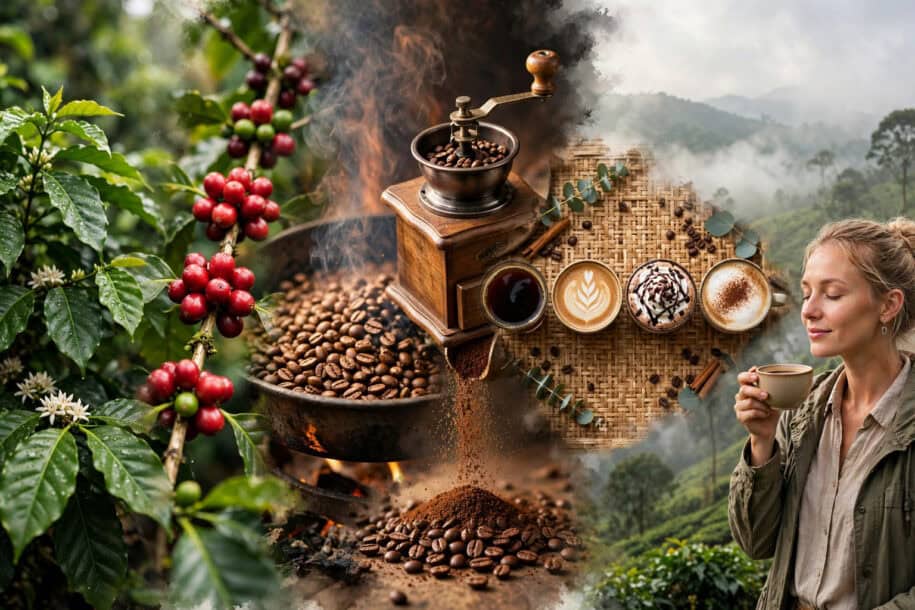
Order a Sri Lankan coffee in a hillside café and you are experiencing a cup of comeback story. Most travellers land here expecting exactly one thing in their cup: Ceylon tea. Fair enough. The island built its global name on tea leaves. Yet, long before a single tea bush took root, these mountains belonged to coffee.
The story runs wild. Boom, blight, disappearance, and now a determined return. For anyone planning a trip, that makes Sri Lankan coffee one of the most rewarding side quests on the island. Plantations you can wander without a crowd in sight. Roasters who will happily talk you through a pour-over. A flavour you cannot replicate back home.
This guide covers the whole arc: the history, the beans, the taste, the brands worth hunting down, and exactly where to fold a coffee stop into your itinerary. By the end, you will know your Lakparakum from your Robusta. And you will probably leave the island with a bag of beans wedged into your suitcase.
Coffee Before Tea
Here is the twist that surprises almost every visitor. Coffee came first.
Arab traders brought the plant to the island long before any European flag flew over the highlands. Local growers kept it as a garden crop for generations. The Dutch made the first organised push around 1740, when Governor Baron van Imhoff backed systematic cultivation. The effort stayed small-scale. Then the British arrived and changed the scale entirely.
By the 1860s, hillsides around Kandy were carved into coffee estates, and money poured into the highlands. A strange historical tailwind helped the boom along. When the West Indies abolished slavery, production there collapsed. Ceylon stepped in to fill the gap, and exports soared. The era peaked around 1870, when the island supplied close to a third of the coffee drunk in Europe.
Coffee was king. The port of Colombo ran on it. So peaked the first golden age of Sri Lankan coffee. And then, almost overnight, it was over.
The Rust That Ended It
In the late 1860s, a rust-coloured blight appeared on coffee leaves around the hill country. Botanists gave it a name that still makes agronomists wince: Hemileia vastatrix. Coffee leaf rust.
At the height of the boom, close to 400,000 acres of the island stood under coffee. The fungus tore through nearly all of it. Leaves withered. Cherries shrivelled on the branch. Estates that had printed money a season earlier went bankrupt. Planters ripped out dying trees and searched desperately for a crop that could survive.
They found one: tea. The switch stuck. Ceylon became the world’s tea island, and the first chapter of Sri Lankan coffee faded into footnotes.
For over a century, that was that. Coffee survived only in home gardens, a few plants here and there beside the tea bushes. Then, in the 1990s, a Dutch visitor spotted old coffee trees in a highland garden and started asking awkward questions. The answers reignited an entire industry. More on that revival in a moment.
Where Beans Grow
Coffee plants are notoriously fussy. They demand the right altitude, the right shade, and the perfect amount of rain. Fortunately, the island offers all three in abundance. The geography naturally splits the harvest into two distinct camps based on elevation.
Down in the warmer, lower elevations, farmers cultivate Robusta. This hardy bean thrives in the humidity of the southern coast and the sprawling plains of Kurunegala. It packs a serious caffeine punch and forms the backbone of many traditional local brews.
The real magic for specialty fans happens higher up. Arabica needs cooler air and misty mornings to develop complex sugars. The central highlands provide a perfect cradle.
Kandy, Nuwara Eliya, Badulla, and the famously scenic Ella region all produce spectacular highland harvests. Driving through these areas reveals steep, emerald slopes dotted with tall shade trees.
A good itinerary easily weaves a scenic drive through these highland estates. Just ask your travel team to route the journey past a working farm. Seeing the bright red cherries ripen on the branch guarantees the eventual cup will taste infinitely better.
Local Bean Varieties
Walk into a modern roastery in Colombo and the menu might look like a science experiment. Behind the sleek packaging lies decades of careful agricultural work. Local agronomists have spent years developing specific Arabica strains perfectly suited to the island’s unique microclimates.
Five main varieties dominate the specialty scene. Lakparakum, Laksaviru, and Lakkomali carry names that sound like ancient royalty. These modern hybrids were bred specifically for local soils and high resistance to diseases. Two other stalwarts, HDT and S 9, round out the top tier.
Each strain brings a slightly different character to the roasting pan. Some lean heavily into bright fruit notes. Others push forward with deep, earthy tones. Roasters love playing with these blends to create a signature cup.
Spotting these names on a café menu is a dead giveaway that the barista knows their craft. It guarantees a cup crafted with genuine respect for the local soil.
The Flavour Profile
Pouring a fresh cup of Sri Lankan coffee is a highly rewarding experience for the palate. The terroir of the central highlands creates a remarkably balanced profile. Visitors expecting a harsh, bitter jolt will find a much more refined drink.
The aroma usually hits first. Expect a sweet, floral scent carrying hints of citrus and warm spice. On the palate, the body sits comfortably in the middle. It feels incredibly smooth and rounded, offering a comforting weight without any aggressive heaviness.
As the liquid cools, the tasting notes really open up. Chocolate and caramel form a rich base. Nutty undertones provide a comforting warmth. Depending on the specific estate, bright flashes of orange or dried plum will dance across the tongue.
It holds its own beautifully against famous global origins. The smooth, nuanced character offers a wonderful departure from the heavier, spicier brews of neighboring India.
Trying a single-origin pour-over in a Kandy café is the best way to experience this magic. That first sip usually cements a lifelong love affair with Ceylon coffee.
Brands to Know
You cannot appreciate the revival without meeting the people driving it. The modern industry relies on passionate artisans rather than massive corporate conglomerates.
Soul Coffee Group leads the charge in the bean-to-cup movement, working directly with highland farmers to push the quality of the final roast. Damn Fine Coffee Roasters operates on a mission to restore lush plantations and champion top-tier local harvests. For a taste of true heritage, Hansa Ceylon Coffee has spent over 30 years roasting at high altitudes in Nuwara Eliya, sourcing directly from forest gardens.
Add in innovators like Tusker Coffee Co. and Whight & Co., and the local scene is practically bursting with talent. Knowing these names turns a standard caffeine fix into a masterclass in local agriculture.
Sri Lankan Coffee on Tour
Reading about the harvest builds anticipation. Stepping under the shade trees delivers the full sensory thrill. The central highlands offer incredible opportunities to weave agriculture into a travel itinerary.
A visit to a working estate near Kandy or Ella lets you wander through the canopy and watch the picking process. Harvest season brings the chance to pluck bright red cherries right off the branch. Many estates also demonstrate the washing and drying stages, showing exactly how the fruit transforms into a roastable seed.
Travelers can easily pair a morning on the plantation with an afternoon tea tasting. Just ask the tour team to slot in a private roastery visit or an estate walk. It transforms a regular sightseeing day into an unforgettable aromatic adventure.
Taking the Taste Home
The holiday ends eventually. The morning routine back home does not have to. Packing a bag of Sri Lankan coffee beans is the ultimate way to stretch a two-week trip into a month-long experience.
The golden rule is to buy whole beans instead of pre-ground powder. Whole beans lock in those delicate floral and citrus notes for much longer. Look for bags with a clear roast date and a one-way degassing valve. Store the bags in your hand luggage or carry-on to avoid the extreme temperature swings of the airplane cargo hold.
Most countries allow a few kilos for personal use, making it a breeze to bring through customs. Your kitchen will smell like the Kandyan hills every single morning.
Sri Lankan Coffee FAQs
Every great journey leaves you with a few lingering questions. Here are the answers to the most common queries from visitors.
Is Sri Lankan coffee good?
The specialty scene holds its own against any global origin. The highland Arabica is highly regarded for its incredibly smooth, nuanced profile.
Why did the country switch to tea?
The devastating 1869 coffee leaf rust epidemic destroyed the plantations, forcing a complete pivot to tea cultivation.
What does Sri Lankan coffee taste like?
Expect a beautifully balanced cup with notes of chocolate, caramel, citrus, and subtle floral aromas.
Where can I buy Ceylon coffee beans?
Specialty roasters in Colombo, Kandy, and Ella sell excellent fresh batches. Supermarket options are mostly imported instant varieties.
Is coffee native to the island?
Arab traders first introduced the plant long before European colonization.