
In Jaffna there is a seafood soup so fiery and so loaded with crab, prawns, anchovies, and the morning’s small fry that locals treat it as part meal, part medicine. It is the kind of detail that drops you straight into the reason offbeat Sri Lanka destinations 2026 are worth the detour, a corner of the island with its own cooking, its own festival calendar, and a curvy old script on the signboards. The stew is odiyal kool, thickened with the dried, ground root of the palmyra palm and credited with putting strength back into tired bodies and heat into the bones. It is also a full morning’s labour to build, cleaning the odiyal and layering in the seafood and roasted spices, so it surfaces mostly at family gatherings and festivals, or as the signature of a Jaffna restaurant. The same thorny giant also fences every road on the peninsula and yields its jaggery, its toddy, its woven baskets, and its roof thatch, one tree feeding, sweetening, and roofing an entire culture.
If the famous list is already ticked and you came back curious, or if you are plotting trip one and want the full island, greatest hits included, the timing could hardly be kinder. The north and east carry a Tamil and Muslim character all their own, in the drum-and-flute temple processions, the lagoon crab and tamarind fish curries, the colonial star-forts that still belong mostly to locals flying kites at dusk. Money followed the attention; Colombo channelled Rs. 131 million into Jaffna’s access roads and heritage sites this year, Batticaloa is halfway through building a proper tourism hub around its lagoon, and a daily train plus a revived airport have turned Jaffna from a maybe-someday into an easy day’s journey. The visitors are arriving too: Arugam Bay logged a record twelve thousand international arrivals in a single month, and Lonely Planet placed Jaffna at number two on its 25 Best Places to Visit in 2026.
Three places carry the thread from here, each with its own reason to arrive and a better reason to stay a day past your plan. Jaffna for the culture that stops you mid-step, Batticaloa for the lagoon that swallows your afternoons whole, Kalpitiya for the wind that turns an idle beach day into a sport you didn’t know you wanted — we’ll take them one at a time.
Jaffna: Temples, Tamarind, and a Year-Round Festival Calendar
Step off the train and the colour gets you before the heat does. Temple towers, gopurams, rise over the rooftops in electric blue, hot pink, and marigold yellow, every tier crowded with carved gods and beasts catching the hard northern sun. Palmyra palms stand in stiff rows along every road, their fan-leaves rattling like dry paper. The signboards run in a curvy, looping Tamil script you won’t have seen elsewhere on the island, and the air carries crab curry thick with coconut, the sweet smoke of palmyra jaggery, and, in the right month, the green perfume of unripe mangoes stacked in pyramids at the roadside. Jaffna announces itself loudly, and kindly, and entirely on its own terms.
This is the cultural heart of Sri Lankan Tamils, and the kinship runs straight across the water to Tamil Nadu. You feel it in the Dravidian temple architecture, in the Carnatic vocal drifting from a stall radio, in the way a morning meal lands on the table as string hoppers with coconut sambol and a bowl of fiery sothi, the peninsula’s own breakfast grammar. The place kept its own counsel for a long stretch, well away from the usual itinerary, and that is precisely why a visit now feels so unperformed. Nobody is putting on a show for the camera. The welcome is warm in a way that reads as personal, almost proud, as if the whole town has been waiting to share the good stuff and is delighted you finally asked.
What to Actually Do in Jaffna
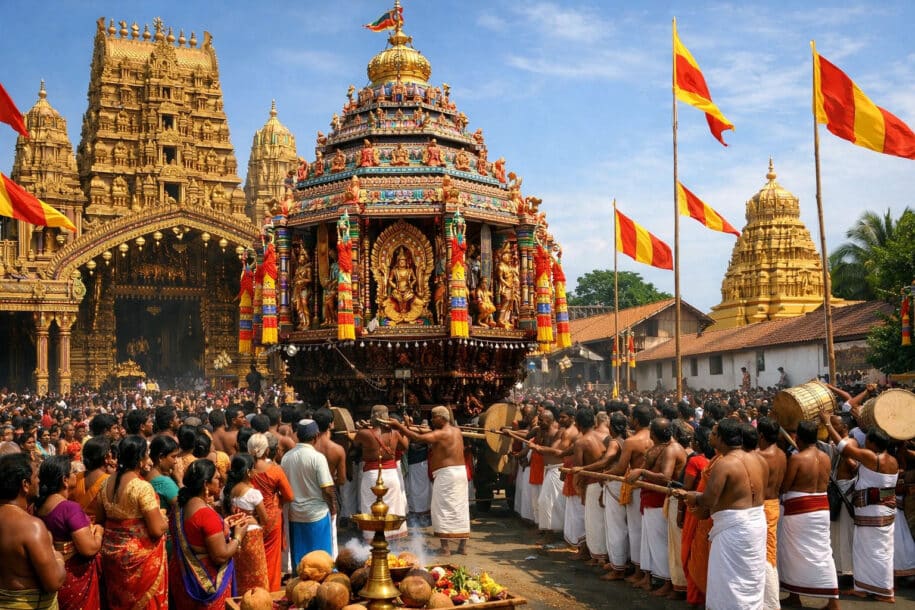
Nallur Kandaswamy Temple is the spiritual centre of gravity for the peninsula, a golden-crowned complex that hums with devotees from first light. On an ordinary afternoon the courtyard is calm, the flagstones warm underfoot, the air sweet with camphor while priests move through rituals older than the walls. Men enter bare-chested, a custom worth respecting, and the painted corridors cool you the moment you step inside. Time it right and the same temple throws the biggest party in the north, but more on the calendar below; even off-festival, a slow hour here, sitting on a step and watching the light move across the gopuram, is worth the trip on its own.
Jaffna Fort is a vast star-shaped fortress the Portuguese raised in 1619 and the Dutch later fattened into one of the largest in Asia, all thick coral-stone ramparts, a broad moat, and bastions named for the saints. Restoration has brought the walls back to walkable glory, and the view from the top runs clean across the lagoon to the islands beyond. Come for sunset, when the water goes molten and the cannons throw long shadows. You’ll have company, the good kind: families out for an evening stroll, teenagers flying kites off the bastions, couples sharing a bag of fried snacks. Inside the walls sit the ruins of an old Dutch church and the Queen’s House, quiet and photogenic, and the whole place has the unhurried, lived-in feel of a public park that happens to be four centuries old.
Jaffna Public Library is one of the most graceful buildings in the city, white colonnades and a domed reading room set in a tidy garden. The community that built it loved their books fiercely, and when fire destroyed the original in 1981 they simply rebuilt it, shelf by shelf, and filled it again, which is the kind of stubborn tenderness you can feel in the hush of the reading rooms. Browse the stacks, peek at the palm-leaf manuscripts, and chat with the staff, who are genuinely pleased to see a curious visitor. Twenty unhurried minutes here tells you more about the peninsula’s character than any plaque on the wall.
Keerimalai Springs are freshwater pools bubbling up from underground right at the edge of the sea, and the legend attached to them, of a sage cured of his ailments by a single dip, has drawn bathers for centuries. The water is cool, faintly mineral, and startlingly clear against the blue of the ocean a few steps away. A small Shiva temple keeps watch, men and women bathe on separate sides, and the whole scene has the easy rhythm of a neighbourhood swimming hole. Bring a towel and a change of clothes; you will go in, and you will come out grinning. If you’re here around the new moon of the Aadi month, you’ll catch the Keerimalai Theertham, when thousands arrive to bathe for purification and the shore turns into a slow, joyful procession.
Delft Island and Casuarina Beach round out the slower, salt-air side of the peninsula. A forty-minute ferry drops you on Delft, a flat, sun-bleached island ringed by coral-stone walls the Dutch left behind, where wild ponies graze the scrub and a single enormous baobab, planted by Portuguese sailors four centuries back, throws a canopy wide enough to picnic under. Hunt down the old pigeon nest, a crumbling Dutch dovecote, and the so-called Giant’s Footprint, a hollowed rock the locals have their own story for, and you’ve got a perfect half-day of wandering with almost no one else around. Back on the mainland, Casuarina Beach is a long, soft crescent shaded by the trees it’s named for, the water so shallow you can walk out a hundred metres and still have it at your waist, ideal for a lazy, shady, do-nothing afternoon.
Jaffna Market and the daily rhythm is where the culture stops being scenery and starts being a Tuesday. The central market is a glorious, clamorous sprawl: mountains of Kartha Colomban mangoes in season, the variety the whole country goes weak at the knees for, limes the size of your fist, slabs of dark palmyra jaggery, ropes of dried fish, brass oil lamps catching the light. Women in bright sarees haggle good-naturedly, a stall radio plays a slow Carnatic raga, and at dawn the thresholds of houses and shops bloom with kolams, the rice-flour patterns drawn fresh each morning to welcome the day and the gods. Wander it with no plan, buy a mango from a vendor who insists you try a slice right there, and let the noise wash over you.
Jaffna’s Festival Calendar: Pick Your Month
The peninsula rarely goes a few weeks without something worth staying up for, and timing your visit around a festival is the single best upgrade you can make to a Jaffna trip. Here’s the year as the temples keep it.
January, Thai Pongal. The harvest thanksgiving, and the most homely of the lot. Families boil milk and rice in a clay pot on an outdoor hearth and let it overflow on purpose, shouting “Pongal o Pongal!” as it spills, a wish for abundance. Courtyards fill with kolams, sugarcane, and the sweet pongal made with that palmyra jaggery again, and the second day, Maattu Pongal, honours the cattle with painted horns and a day off from the plough.
February or March, Maha Shivaratri. The great night of Shiva, kept with fasting, temple vigils, and lamps burning till dawn. The mood is hushed and devotional rather than loud, the perfect window if you want to see the contemplative side of temple life.
Late July into early August, the Nallur Festival. The big one, and the reason to book your room months out. Twenty-five days of it, opening with the flag-hoisting, Kodiyetram, and rolling through daily rituals, music, and dance before the grand finale: the Ther, the enormous temple chariot hauled through packed streets by hundreds of devotees on ropes, and the Theertham, the holy bathing day. Drumming shakes the walls, classical dancers go past midnight, and the food stalls run an endless rotation of vadai, jaggery sweets, and iced coconut water. The whole city is awake and glowing.
Around the same Aadi new moon, the Vel festivals and the Keerimalai Theertham. The sacred spear of Murugan, the Vel, is carried in procession through the streets, and at Keerimalai the spring-bathing turns into a mass pilgrimage. The two often overlap, so a late-July visit can stack a chariot, a spear, and a holy dip into one extraordinary week.
September or October, Navarathri. Nine nights for the goddess, temples decked in flowers and lights, and homes that keep the tradition setting out their golu, tiered displays of dolls and deities on stepped platforms, which you may be invited in to admire.
October or November, Deepavali. The festival of lights. Every threshold gets a row of oil lamps, everyone wears new clothes, the sweet shops run flat out, and the evenings sparkle.
November or December, Karthigai Deepam. More lamps, lit for the star Karthigai, temple towers and house walls twinkling into the dark. By now you’ll have noticed the pattern: Jaffna’s year is basically a string of festivals with a few ordinary Tuesdays slipped in between.
Jaffna Travel Guide 2026: The Practical Stuff
Is Jaffna safe for tourists now?
Yes, plainly and without asterisks. The US State Department and the UK’s FCDO both hold Sri Lanka at Level 2, “exercise normal precautions,” with nothing specific flagged for the Northern Province, and that matches what people actually feel on the ground. Visitors walk the streets at all hours, pop into temples, linger on the fort ramparts at dusk, and the word that keeps turning up in their accounts is welcoming. Crime aimed at tourists is rare to the point of being a non-issue. The north simply sat outside the tourism loop for a long time, so it’s only natural to double-check before you go; the on-the-ground reality is calm, kind, and glad to have you. Apply the same common sense you’d bring to any new city, and then relax into it.
How to get to Jaffna from Colombo?
Three good options, all of them smoother than they used to be.
- By train: Colombo Fort to Jaffna runs about eight hours, five services a day in 2026, second class around USD 4 to 6. The line pushes north through Anuradhapura’s dry scrub and opens into palmyra country as the peninsula nears, and honestly the journey is half the pleasure; grab a left-side window for the morning light and let the landscape change on you.
- By coach: Air-conditioned overnight buses do the 400 kilometres in seven to eight hours, cheap and comfortable, and you wake up already in Jaffna with a whole daylight day ahead of you.
- By air: Jaffna International Airport at Palaly has held full international status since 2019, and the hop from Colombo takes about an hour on Cinnamon Air or FitsAir. Schedules shift with the seasons, so check a few weeks out.
Where to stay: The scene is young and growing fast, and the fresh infrastructure money is pouring petrol on it. Expect clean, friendly guesthouses in the USD 15-to-30 range, where the host often ends up as your unofficial guide to the best curry and the nearest festival, plus a small cluster of boutique hotels nudging toward USD 60 to 90. One practical note that matters: if your dates touch the Nallur Festival, book early and firmly, because the peninsula fills to the rafters and the good rooms vanish first.
What to eat: Jaffna cuisine is its own tradition within the broader Sri Lankan food landscape, and it’s arguably the peninsula’s strongest selling point. a fiery seafood soup thickened with palmyra root until it turns hearty and almost gluey, served piping hot and eaten on its own, a whole meal in a single bowl. Restaurants that specialise in it will tell you on the day whether the pot is on, since it’s a labour to make, and if a local family invites you to share theirs, say yes before the sentence finishes. Mud crab curry is the other headline act: fiery and coconut-rich, with a pile of side dishes, and the rest of the table is just as distinct, mutton rolls, rasam, Jaffna-style fish curry with its sour tamarind base, and palmyra-fruit jaggery sweets that close the loop on the tree you met in the soup, the same palm sweetening your dessert that thickened your stew, with a pot of curd and treacle on the side, the best on the island. The area around the central market has no-frills lunch spots where a full spread costs less than three dollars and tastes like someone’s grandmother made it specifically for you.
Batticaloa and the East Coast:
A Lagoon That Sings, and a Table That Never Stops
Stand on the Kallady bridge after dark, go properly quiet, and the lagoon sometimes hums back at you. Locals have a name for it and a story to match: the singing fish of Batticaloa, a low musical thrumming that rises off the water on certain still nights, blamed over the years on everything from courting fish to the tide dragging across the lagoon bed. People have recorded it, scientists have listened and shrugged with a smile, and the mystery has stayed beautifully unresolved, which is rather the point. A town that keeps a singing lagoon in its pocket is a town that knows how to hold your attention, and Batticaloa does it the moment you arrive.
That lagoon is the spine of the whole place, one of the largest on the island, a slow green world of mangrove channels, low islands, and stilted brush-park traps, the wooden kraals fishermen stake into the shallows and check at dawn. Life here orbits the water. Boats come and go with the tide, herons stand sentinel on the posts, and the 17th-century Dutch fort, perched on its own little islet and reached by a short footbridge, watches the comings and goings exactly as it was built to do four hundred years ago. Step inside the coral-stone walls and you get the lagoon on one side and the open sea on the other, a double horizon that makes the old cannons feel almost theatrical.
The culture, like the coastline, is layered. Batticaloa’s heart is Tamil, all temple drum and Carnatic melody, and a short ride away sits Kattankudy, one of the most densely settled Muslim towns in the country, a tight grid of mosques, sweet shops, and falooda stalls that hums with its own rhythm. Spend an evening walking its lanes and you’ll understand the east coast’s character in your bones: two communities, two calendars, one shared love of feeding people well. That love is the real headline act. Lagoon crab pulled that morning, Batti-style fish curry swimming in a sour tamarind gravy you’ll try to recreate at home and fail, kottu roti clanged out on a griddle at nine o’clock, mutton rolls crisp and fragrant from a corner cart, lagoon prawns so sweet they barely need the chili. Pull up a plastic chair on the Bar Road, order whatever the cook is proud of that day, and let the table fill itself.
Batticaloa Things to Do, Beyond the Bridge
The lagoon boat tours are the thread that ties the days together. A traditional flat-bottomed boat will carry you through the mangrove tunnels, past the kraal fishermen hauling their catch, alongside villages where children wave from the bank, and out to small islands where the water goes so still it looks poured from a jug. The government’s Batticaloa Tourism Hub initiative is pouring money into exactly this, better jetties, cleaner boats, a few water-sport add-ons, so the experience is getting smoother without losing its handmade feel.
Passikudah beach, thirty-five kilometres up the coast, is the east’s answer to anyone who wants their swimming calm and their snorkelling easy. A long, shallow reef shelf holds the water at waist height for what feels like forever, the colour shifting from jade to deep teal as the bottom drops away, and the crowds that pack the southern beaches simply have not found their way here yet. It is one of those Sri Lanka hidden gems that still earns the word, a stretch of sand where the loudest thing is the wind in the casuarinas. Kalkudah, its neighbour round the headland, offers the same gentle water with a slightly wilder edge.
And the coast keeps giving if you have a few more days. North again, Trincomalee puts a great Hindu temple, Koneswaram, on a cliff above one of the finest natural harbours in the world, its gopuram glowing over the blue, and just offshore Pigeon Island runs a marine sanctuary where you can snorkel among reef sharks and turtles in water so clear it feels like flying. South of Batticaloa, Arugam Bay is the surfers’ town, a laid-back strip of guesthouses and wave-chasers that logged its busiest month on record in early 2026 and still manages to feel like a secret at breakfast time. The whole eastern seaboard reads as one long, generous invitation: arrive for one reason, stay for the next three.
The East Coast’s Own Festival Rhythm
The east keeps its own calendar, and catching a festival here is every bit as transporting as in Jaffna. Thai Pongal in January fills Tamil courtyards with the same overflowing milk-pots and sugarcane. The Vel festival at Koneswaram in Trincomalee, around July and August, sends the temple chariot through the harbour town with drums and devotion, and lines up neatly with Nallur if you want to chase two great processions in a single trip. And in the Muslim towns, Ramadan and the Eid feasts transform the streets, Kattankudy especially, into a glitter of lights and late-night food, the whole community awake and sharing; the dates move each year on the lunar calendar, so check before you plan. Time your visit around any of these and the coast stops being a place you visit and starts being a place that lets you in.
Getting There, Staying Safe, Finding a Bed
Is the east coast Sri Lanka worth visiting?
Warmly, completely yes. The Eastern Province has been calm and welcoming for well over a decade, and travellers describe wandering Batticaloa’s streets, cycling the flat peninsula roads, and lazing on Passikudah beach with the same easy confidence they’d feel anywhere safe. Bring the usual common sense you’d carry to a new city, and then let the lagoon take your afternoons.
From Colombo, the overnight train runs eight to ten hours for around USD 4 to 6, winding through the highlands before spilling onto the eastern plains, and the view alone justifies the ticket. Express buses cover it in seven to eight hours for USD 5 to 8, and domestic flights from Ratmalana touch down at Batticaloa Airport in about forty-five minutes when the schedule cooperates, so check a little ahead.
Where to stay: Batticaloa town keeps a cluster of guesthouses along the Bar Road and through the old Dutch quarter, mostly USD 10 to 25, the kind where the owner presses a plate of something delicious into your hands the moment you drop your bag. Passikudah’s growing line of mid-range resorts sits around USD 50 to 100, and the Tourism Hub money should widen the choices nicely over the next couple of years.
Kalpitiya: Wind, Reef, and a Peninsula of Many Faiths
Now the place that makes kitesurfers book their flights before they’ve finished their coffee.
Kalpitiya is a thin finger of land on the northwestern coast, about 170 kilometres from Colombo, with a geography so generous it almost feels rigged: the open Indian Ocean on one side, a vast shallow lagoon on the other, and a strip of sand and scrub between them where the wind blows steady and true for most of the year. That wind is the whole reason the sport’s community talks about Kalpitiya kitesurfing the way climbers talk about certain valleys. Flat lagoon water for learning, ocean swell for the ambitious, the two within a ten-minute walk of each other, and a reliability that lets schools promise progress rather than just hope for it.
The year splits into two very different moods, and both are worth your time. From May to October the southwest monsoon sends a steady 18 to 25 knots across the peninsula, the lagoon buzzes with intermediate and advanced riders, and the downwinder trips out to the sandbanks and Vella Island become the day’s big adventure. From November to April the wind eases, the lagoon goes glassy, and the whole place softens into snorkelling, paddleboarding, and gentle boat days, the perfect window for nervous first-timers who’d be terrified of the May gusts. Either season ends the same way: sunburnt, grinning, sand still in your hair at dinner.
But Kalpitiya would be a poorer story if it were only a sports brochure, and the peninsula has far more going on than kites. The fishing villages along the lagoon are predominantly Muslim communities, their days paced by the call to prayer and the tide, and the food that comes out of their kitchens, fragrant rice, lagoon fish, sweet strong tea, is its own reward after a day on the water. The peninsula also carries a surprising cross-current of faiths: a short drive away, the St Anne’s Church at Talawila draws one of the biggest pilgrimages in the country every August, tens of thousands arriving for the feast in a swirl of colour and devotion that has nothing to do with the kites and everything to do with the soul of the place. Back in Kalpitiya town itself, a small Dutch fort and the old St Peter’s Kerk, one of the island’s most ancient churches, sit quietly among the palms, four more centuries of history folded into a coastline most people only know for its wind.
Under the water, the Bar Reef runs as one of the largest coral systems in Sri Lanka, a protected marine sanctuary where a snorkel or a dive puts you among branching coral, parrotfish, and the occasional turtle, the colours almost unfair after the pale sand above. Out past the reef, the daily dolphin trips in season find huge pods of spinner dolphins leaping in the early light, and the operators here are small, local, and genuinely careful with the animals, which matters. The peninsula’s scatter of low islands, mangrove islets and sandbars you can have entirely to yourself, are made for a slow day of exploration by SUP or traditional boat, poling through the channels with a kingfisher for company and not another tourist in sight. It is, as one 2026 guide put it, a place where untouched nature, endless beaches, and real village life all arrive at once, and the description holds.
A useful planning note, and a happy one: the northwestern coast catches a different monsoon rhythm from the southwest, so when the southern and western beaches are in their rainy stretch, Kalpitiya is very often dry, breezy, and bright, which makes it a quietly brilliant beach choice for the middle of the year. The road from Colombo, on the improved northern highway, takes about three and a half to four hours by private transfer or shared van; there’s no direct train, though you can rail to Puttalam and pick up a short onward ride. Beds range from simple guesthouses around USD 30 to the kitesurfing resorts, Rascals, Bar Reef, the newer De Silva Windresort, that bundle lessons and gear into packages up to about USD 120, and the deliberate lack of big hotels is exactly what keeps the peninsula’s offbeat charm intact. For a place that ticks this many boxes, it remains one of the most complete offbeat Sri Lanka destinations 2026 has on offer, a wind-sport paradise that turns out to be a culture trip and a nature trip the moment you look up from the board.
The Curious Traveller’s Swap Sheet: Same Island, a New Register
The famous spots earned every bit of their fame, and if Ella’s misty green or Mirissa’s whales are on your list, they deserve to stay there. What follows is for the second-timer chasing variety, or the first-timer with an appetite for the whole island, a way of matching each beloved classic to a northern or eastern cousin that plays the same tune in a different key. Think of it as the island’s B-side, just as good, far less played.
If Ella’s hill-country magic moved you, and you’d love that same depth of feeling through colour and sound instead of mist, add Jaffna. Where Ella gives you waterfalls and rolling tea green, Jaffna gives you candy-bright temple towers, drum-and-flute processions, Dutch ramparts at sunset, and offshore islands where wild ponies outnumber people. The emotional weight is the same; the palette is entirely its own.
If Mirissa’s marine moments stayed with you, the whale boats and the warm water, the east coast and Kalpitiya keep that magic going with a different cast of creatures and a calmer sea. Passikudah’s shallow reef, Pigeon Island’s turtles, Kalpitiya’s spinner dolphins, the lagoon snorkelling at Batticaloa: the ocean wonder continues, the water often gentler, the boats often yours alone.
If Galle Fort’s colonial stonework charmed you, the ramparts and the sea air, Jaffna Fort and Kalpitiya’s old Dutch church carry the same centuries with a slower, more local rhythm. Same star-shaped walls, same golden-hour glow, same sense of standing where four hundred years of history happened, shared mostly with families out for an evening walk and teenagers flying kites.
If Bentota’s easy beach days were exactly the medicine you needed, Kalpitiya’s sandbanks offer the same cure with a wind-sport side quest bolted on. The sand is just as soft, the water just as warm, and you get dolphin trips, mangrove paddling, and the option to learn a kitesurfing trick or three between swims, all on a coast that stays sunny through the months the southwest turns rainy.
The pattern underneath all four is the real takeaway. The north and east are not a correction to the classic route; they are its companion volume, the chapters that turn a greatest-hits trip into a full read of the island.
Frequently Asked Questions
Is Jaffna safe for tourists in 2026?
Yes, plainly. Jaffna is considered safe for tourists, with no specific travel advisories attached to the Northern Province and visitors consistently describing friendly locals, low crime, and a comfortable atmosphere for exploring temples, beaches, and town streets at any hour. The north simply sat outside the usual tourism loop for a long time, so a quick double-check before you go is natural; the reality on the ground is calm, kind, and glad to have you. Standard common-sense precautions apply, as anywhere.
How do I get to Jaffna from Colombo?
The most popular route is the Colombo Fort to Jaffna train, about eight hours, five services a day in 2026, second class around USD 4 to 6, with a window seat on the left for the best morning light. Air-conditioned overnight coaches take seven to eight hours and let you wake up already there. Domestic flights from Colombo to Jaffna International Airport take roughly an hour on Cinnamon Air or FitsAir.
Is the east coast of Sri Lanka worth visiting?
Wholeheartedly. The Eastern Province offers a distinct Tamil and Muslim cultural blend, calm lagoons, uncrowded reef beaches like Passikudah, world-class surfing at Arugam Bay, the cliff-top Koneswaram temple at Trincomalee, and a seafood and street-food tradition you will not find anywhere else on the island. The region has been peaceful and welcoming for well over a decade and is actively building out its tourism infrastructure.
What are the best Batticaloa things to do?
Listen for the singing fish at the Kallady bridge, take a traditional lagoon boat tour through the mangroves and brush-park traps, explore the Dutch fort on its islet, walk out to the lighthouse at dusk, cycle the flat peninsula roads, and eat your way through the lagoon crab, tamarind fish curry, and Kattankudy’s sweet stalls. Round it off with a calm swim and snorkel at Passikudah beach, thirty-five kilometres north.
When is the best time for Kalpitiya kitesurfing?
The prime wind season runs May to October, with steady 18-to-25-knot breezes ideal for intermediate and advanced riders and for downwinder trips to the islands. November to April brings gentler conditions perfect for beginners, snorkelling the Bar Reef, dolphin watching, and paddleboarding. The peninsula rewards a visit in either window.
Are offbeat Sri Lanka destinations 2026 still affordable?
Very much so. Guesthouses in Jaffna and Batticaloa start around USD 10 to 15 a night, meals at local eateries run USD 2 to 4, and trains and buses between cities cost USD 4 to 8. Even Kalpitiya’s kitesurfing packages, gear and lessons included, sit comfortably below comparable rates across Southeast Asia and Europe, which makes the north and east as kind to a budget as they are to a sense of adventure.